By Mokobia Rita
ASABA/Nigeria: Delta State’s drive to reduce its dependence on oil revenue gained fresh momentum on Tuesday as the 2026 Delta State Economic and Investment Summit concluded with new investment proposals in agriculture, energy and mining, alongside renewed commitments to expand private sector participation in the state’s economy.
The two-day summit in Asaba attracted government officials, local and foreign investors, industry experts and business leaders, who identified agriculture, livestock, solid minerals, the blue economy and digital innovation as sectors capable of driving the state’s next phase of economic growth.
Among the major announcements at the summit was a proposal by Brazilian agribusiness investor Roberto Fonseca to partner the Delta State Government in developing an integrated cattle and beef value chain covering breeding, ranching, meat processing, cold storage and distribution.
Fonseca said Delta possesses climatic and environmental conditions comparable to parts of Brazil, making it suitable for commercial livestock production capable of serving domestic and regional African markets.
The summit also featured a major energy investment proposal from Mosra Energy, whose Managing Director, Ramos Olukayode, disclosed plans to establish a 600-megawatt power plant at Obomkpa.
Olukayode said more than 200 hectares of land had already been secured for the project, adding that geological studies indicate coal deposits exceeding 200 million tonnes across Obomkpa, Ugbodu and Ukunzu. He said the area also contains significant kaolin and clay deposits that could support future manufacturing activities.
In the agriculture session, former South-South Vice President of the Poultry Association of Nigeria (PAN), Chief Eta Enahoro, urged greater investment in fish and poultry farming, describing both industries as practical avenues for job creation, food security and youth entrepreneurship.
He said supporting young people to establish commercial poultry and fish farms would create sustainable employment while strengthening Delta State’s agribusiness value chain.
On the blue economy, development expert Dr. Uche Igwe called for stronger enforcement against illegal and unregulated fishing, saying improved regulation would enable the state to maximise the economic value of its extensive waterways.
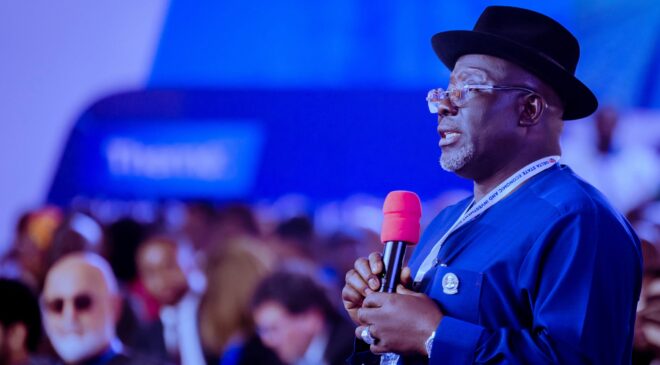
Declaring the summit closed, Governor Rt. Hon. Sheriff Oborevwori said Delta could no longer rely solely on oil earnings to sustain economic growth, stressing that attracting investments into productive sectors had become essential to creating jobs and expanding the state’s revenue base.
“We can no longer depend on one source of revenue. We must diversify our economy by attracting strategic investments into sectors where Delta State has a clear comparative advantage. That is the pathway to creating jobs, growing businesses and improving the quality of life of our people,” the governor said.
Oborevwori said the state government had taken steps to improve the investment climate by securing land for strategic projects, strengthening infrastructure and promoting partnerships with private investors. He added that investment promotion engagements in countries including China and Brazil formed part of efforts to attract international capital to the state.
He described the summit as a private sector-driven initiative designed to connect investors with commercially viable opportunities rather than serve merely as a policy discussion forum.
The summit ended with participants expressing optimism that the investment interests and partnerships initiated during the two-day event would translate into projects capable of accelerating industrial development, creating employment opportunities and strengthening Delta State’s transition towards a more diversified economy