ASABA/Nigeria:
Thousands of commuters across Delta State could soon enjoy safer, cheaper and more efficient public transportation following plans by the state government to introduce compressed natural gas (CNG) buses, electric vehicles and modern passenger terminals as part of a major overhaul of the state’s mass transit system.
The new transport initiatives were announced after the State Executive Council (EXCO) meeting in Asaba, where Governor Sheriff Oborevwori approved the projects. Briefing journalists after the meeting, the Commissioner for Transport, Mr. Onoriode Agofure, said the approvals were based on the findings of a comprehensive transportation study that assessed commuting patterns and infrastructure needs across major urban centres in the state.
According to Agofure, the survey covered Asaba, Warri, Ughelli, Agbor, Sapele, Abraka and Oleh, revealing a growing demand for improved public transportation as residents increasingly rely on commercial transit for their daily activities.
The study, he disclosed, showed that more than 19,000 commuters travel across the state’s major cities each day, with approximately 80 per cent depending on public transportation, while only about 20 per cent use private vehicles.
He said the findings highlighted the urgent need to strengthen the state’s transport network in order to meet the mobility needs of the majority of residents while supporting economic activities.
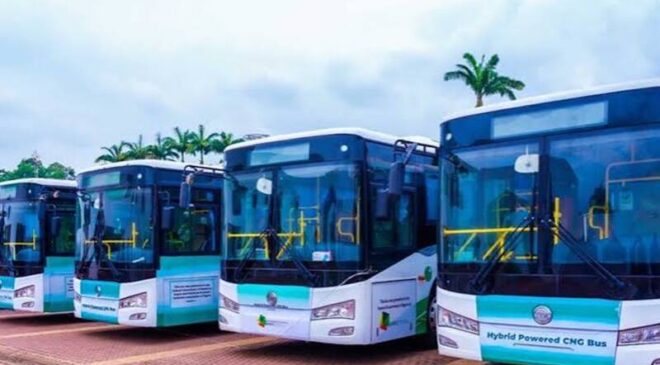
As part of the new transport programme, the state government approved the acquisition of 50 Compressed Natural Gas (CNG)-powered buses, which will form the backbone of the proposed M.O.R.E. Mass Transit Scheme.
According to the commissioner, the adoption of CNG technology is expected to reduce transportation costs, lower vehicle operating expenses and support the Federal Government’s clean energy transition by reducing carbon emissions.
In addition, the Executive Council approved the introduction of electric vehicles, a move the government believes will position Delta among states embracing environmentally friendly transportation technologies.
The transport reform programme also includes the construction of a state-of-the-art mega bus terminal in Asaba, designed to serve as the operational hub for the state’s expanding mass transit network.
Agofure explained that the facility would help ease congestion around the busy Koka Junction by relocating numerous roadside loading points and informal motor parks to a purpose-built terminal capable of providing a more organised transport system.
Beyond improving traffic flow, he said the project is expected to enhance passenger safety, improve the aesthetics of the state capital and create a more efficient environment for commercial transport operators.
The commissioner disclosed that the government has already secured the land required for the terminal and commenced preliminary activities ahead of construction.
“When completed, all existing mushroom parks, including those operated by private transport operators, will be relocated to the new terminal to ensure a more organised and efficient transport system,” he said.
Agofure also announced that plans are underway to develop a similar mega bus terminal in Warri, noting that the Federal Government has already approved the project following Governor Oborevwori’s intervention.
He described transportation as one of the key drivers of economic growth, stressing that efficient mobility supports commerce, education, healthcare and other productive sectors of the economy.
According to him, the latest approvals form part of the Oborevwori administration’s broader strategy to build an integrated transport network capable of supporting urban growth, improving connectivity and enhancing the quality of life of residents across Delta State.