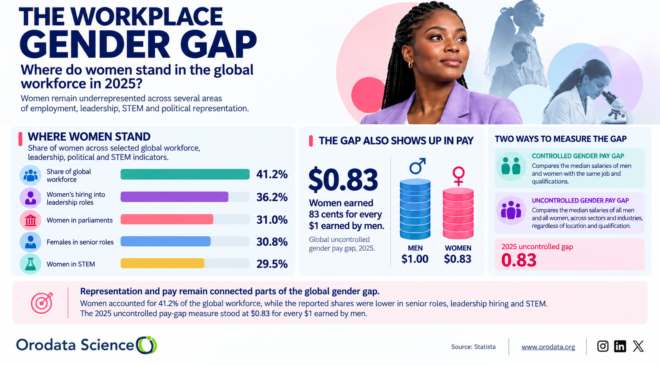
LAGOS/Nigeria: Women are making up a significant share of the global workforce, but their presence continues to fall at higher levels of employment and decision-making, according to the 2025 Workplace Gender Gap report by Orodata Science.
The report showed that women accounted for 41.2 per cent of the global workforce in 2025, but their representation dropped to 36.2 per cent in leadership recruitment and 30.8 per cent in senior positions.
The pattern was also reflected outside the workplace, with women occupying 31 per cent of parliamentary positions globally, while their share of the STEM workforce stood at 29.5 per cent.
The figures point to a continuing gap between women’s participation in employment and their access to positions of greater responsibility and influence.
Orodata Science also reported a disparity in earnings, putting women’s median earnings at 83 cents for every one dollar earned by men globally in 2025.
The organisation explained that the figure represented the uncontrolled gender pay gap, which compares the median earnings of men and women across the wider workforce without restricting the comparison to people working in the same occupation or with similar qualifications.
A controlled pay-gap assessment, by contrast, compares men and women performing similar jobs and with comparable qualifications.
The distinction is significant because overall earnings can be influenced by differences in occupation, industry, location, seniority and other factors. The reported 0.83 ratio therefore provides a broad picture of earnings across the workforce rather than establishing that women and men receive different pay for identical work.
Orodata’s figures nevertheless highlight how gender differences persist across several stages of economic and public participation.
Women recorded their highest representation among the indicators examined at the general workforce level. That share declined when the focus shifted to leadership recruitment and senior positions, suggesting a narrower female presence as responsibilities and organisational influence increase.
The STEM figure was lower still, with women accounting for less than one-third of the global workforce in science, technology, engineering and mathematics-related fields.
Political representation followed a similar pattern, with women making up 31 per cent of parliamentary representation globally, according to the report.
The figures place the issue beyond employment alone, pointing to a broader question about women’s access to economic, institutional and political decision-making.
The report described representation and earnings as interconnected aspects of the global gender gap, while presenting the 2025 figures as a snapshot of women’s participation across the workforce and other areas of influence.
The findings also suggest that measuring women’s participation solely by their presence in the workforce may provide an incomplete picture.
While more than four in every 10 workers globally were women, their lower representation in senior positions, leadership recruitment, STEM and parliaments indicates that access to employment does not necessarily translate into comparable representation at higher levels of influence.
For employers, policymakers and institutions, the figures provide data points for examining how women progress from entry and mid-level employment into senior management, specialised technical careers and decision-making positions.
The pay figures add another dimension, showing that workforce participation and economic outcomes do not necessarily move at the same pace.
Orodata’s 2025 snapshot therefore presents the global gender gap as a multidimensional issue involving not only whether women participate in the workforce, but also the positions they occupy and the income they receive.
The report’s figures underline the continuing differences between women’s overall workforce participation and their representation in some of the sectors and positions that carry greater economic, institutional and political influence.