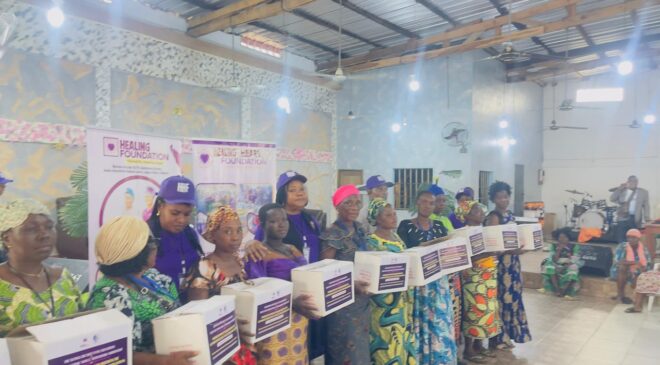
SEME/Nigeria: In a major cross-border empowerment initiative, the Healing Health Foundation has extended its humanitarian and economic empowerment programme to Seme in the Republic of Benin, where more than 300 widows, vulnerable women, young girls and other participants were equipped with practical skills aimed at promoting self-reliance and financial independence.
The three-day capacity-building programme, hosted by Evangelist Francios Tossou of the End-Time Soul Winners Ministry, combined vocational training, medical outreach and spiritual development, providing participants with tools and opportunities to improve their livelihoods and overcome economic challenges.
Speaking on the initiative, Founder and President of the Foundation, Rev. (Mrs.) Sophy Mbanisi, said the programme was designed to empower widows and vulnerable women with practical and sustainable income-generating skills capable of helping them rebuild their lives and support their families.
According to her, participants received hands-on training in the production of various crafts and household products, including liquid soap, detergents, disinfectants, fascinators, fabrics, stain removers and tie-and-dye materials.
Mbanisi explained that the training sessions were conducted in both morning and afternoon batches to accommodate the large number of participants, while evening crusades were organised throughout the three-day programme to provide spiritual encouragement and hope.
She disclosed that the Foundation also incorporated a free medical outreach into the programme, offering healthcare services to participants and members of the host community.
According to her, one of the programme’s sponsors, Gift Health Plus Lagos, provided medical supplies for the outreach, including free reading glasses and cartons of prenatal and postnatal vitamins distributed to pregnant and nursing mothers.
“The Foundation has been carrying out empowerment missions for several years, but this time we decided to take the initiative beyond Nigeria to Seme in the Republic of Benin.
“Our objective was to expose participants to profitable business opportunities that require minimal capital investment while creating pathways to financial independence and long-term sustainability,” she said.
Mbanisi noted that more than 300 participants, comprising widows, vulnerable women, young girls and men, registered for the programme, with each participant acquiring at least two vocational skills.
She expressed delight over the enthusiasm displayed by participants, revealing that many had already begun applying the skills they acquired before the Foundation’s team departed the community.
“No doubt, the participants were excited to be part of the training. Before our departure, many had already started practising what they learnt and displaying products they produced during the programme,” she said.
The Foundation’s president further disclosed that the organisation had reviewed its empowerment strategy after discovering that previous cash-based interventions often failed to achieve the desired long-term impact.
According to her, the Foundation has now adopted a more sustainable approach by providing start-up kits to selected beneficiaries rather than distributing cash grants.
She explained that a total of 12 widows and vulnerable women were selected to receive start-up materials to establish businesses in the various skills acquired during the training.
The beneficiaries were drawn from the four major vocational categories taught during the programme and were provided with the equipment and materials required to begin production immediately.
“In recent times, the Foundation empowered beneficiaries with cash gifts after training sessions. However, we discovered that the approach was not producing the expected results, particularly given the prevailing economic realities.
“Many beneficiaries often spent the money on immediate needs rather than investing it in the businesses for which it was intended. That is why we have now adopted the start-up kit model, which offers a more practical pathway to self-reliance,” she explained.
Mbanisi described the successful completion of the programme as the fulfilment of a vision that had been in the pipeline for two years.
“We thank God for the successful completion of our Skills Acquisition and Empowerment Mission in Seme. After two years of planning and preparation, this vision has finally become a reality through God’s grace,” she said.
She added that, in addition to the vocational training, the Foundation’s medical outreach provided free eye screenings, distributed reading glasses and supplied prenatal and postnatal supplements to more than 40 pregnant and nursing mothers.
Despite the success of the programme, Mbanisi identified inadequate funding as a major challenge confronting the Foundation, noting that the organisation spent far beyond its projected budget.
She attributed the increased cost largely to the declining value of the Nigerian currency and appealed to individuals, corporate organisations and development partners to support future empowerment initiatives aimed at uplifting vulnerable members of society.
The programme is widely seen as a significant milestone in the Foundation’s efforts to expand its impact beyond Nigeria’s borders while promoting economic empowerment, healthcare access and social inclusion among vulnerable populations across West Africa.