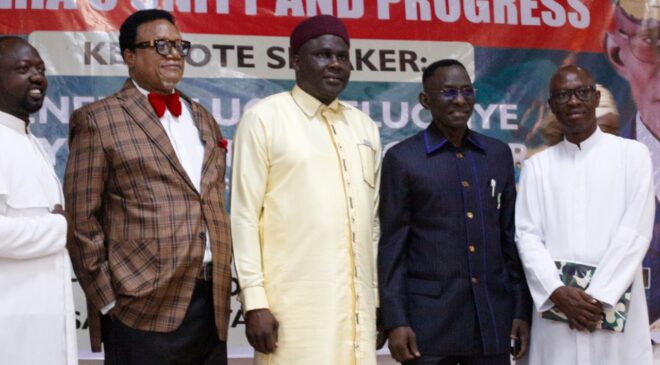
ASABA/Nigeria: Amid Nigeria’s deepening security crisis, Delta State Governor, Rt. Hon. Sheriff Oborevwori, has declared that government alone can no longer shoulder the responsibility of safeguarding lives and property, urging citizens to take a more active role in confronting the country’s persistent insecurity.
The governor made the assertion at the 2026 Maris Annual Public Service Lecture in Asaba, where he was represented by the Commissioner for Basic and Secondary Education, Dr. Kingsley Ashibuogwu. He described insecurity as an existential threat to national unity, stressing that collective vigilance and cooperation between citizens and security agencies are now indispensable.
“Security is no longer the exclusive preserve of government,” Oborevwori said, advocating for community-based policing and enhanced citizen intelligence as critical components of a modern security architecture.
He noted that his administration had continued to invest in operational support for security agencies, even as he underscored the need for a broader, collaborative approach to tackling the menace.
The lecture, themed “Insecurity: The Bane of Nigeria’s Unity and Progress,” drew policymakers, scholars, and security experts, many of whom agreed that the country’s security challenges have outgrown conventional responses.
Delivering the keynote address, former Chief of Defence Staff, Gen. Lucky Irabor (rtd), described insecurity as the greatest threat to Nigeria’s survival, linking the crisis to deep-seated political grievances and historical divisions.
Irabor warned that without a deliberate national reconciliation policy to address longstanding fault lines, security interventions would remain ineffective and unsustainable.
“Insecurity strikes at two of Nigeria’s most precious aspirations: unity and progress,” he said, citing separatist agitations in the South-East, farmer-herder conflicts, and resource control tensions in the Niger Delta as drivers of national disunity.
He further noted that insecurity has significantly undermined Nigeria’s development trajectory, revealing that the country has recorded progress in only 34.6 per cent of key Sustainable Development Goals (SDGs) indicators, while food insecurity has risen sharply since 2015.
According to him, poverty, hunger, and unemployment have worsened due to displacement of farmers, unsafe markets, and declining foreign direct investment, all of which continue to erode economic growth and national stability.
Irabor recommended improved coordination among security agencies through technology-driven surveillance, expansion of social protection programmes, police reforms, and the promotion of civic education and inclusive governance.
He also called for the establishment of a national reconciliation framework among federating units to address growing moral and socio-political divisions, particularly among youths.
Earlier, Chairman of the occasion and former Chief of Naval Staff, Admiral Dele Ezeoba (rtd), commended the organisers for sustaining the annual lecture series in honour of the late Stella Maris Egugbo, noting that it has become a vital platform for intellectual discourse on national issues.
He stressed that security remains the primary responsibility of governance but added that citizens must also play active roles, as insecurity reflects the absence of collective vigilance.
In his remarks, the Secretary to the State Government, Dr. Kingsley Emu, lauded the keynote speaker and other contributors, while highlighting the need for youth reorientation, noting that choices made by young people often exacerbate insecurity.
He disclosed that the state government has implemented various empowerment programmes in agriculture, commerce, and skills development to engage youths productively.
Other discussants, including former DSS Director, Mr. Mike Ejiofor, Prof. Hope Eghagha, Mr. Friday Warri, Rev. Fr. John Konyeke, Dr. Rosemary Ogabu, and Prof. Kemi Emina, contributed to deliberations, outlining roles for government and stakeholders in addressing insecurity.
Secretary of the Maris Trust Council and Senior Special Assistant (Media) to the Governor, Mr. Fidelis Egugbo, expressed appreciation to stakeholders for sustaining the lecture series, noting its role in fostering robust public discourse.
The event attracted top government officials, security experts, civil society actors, and media practitioners, including members of the Nigeria Union of Journalists (NUJ), Delta State Council, led by its Chairman, Comrade Churchill Oyowe, among other dignitaries.