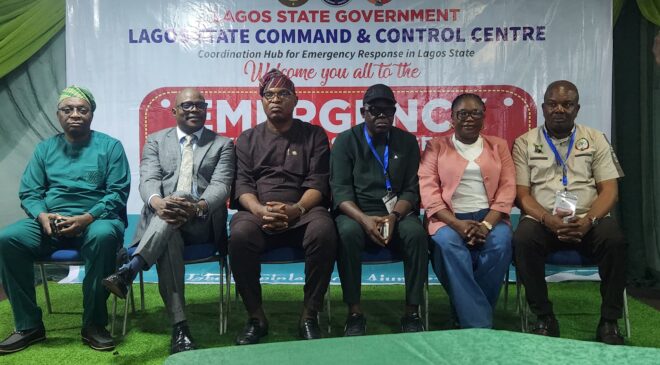
LAGOS/Nigeria: The Lagos State Government has launched the Lagos Emergency Responder Management System (LERMS), a technology-driven platform designed to strengthen emergency coordination, improve incident management and enhance operational efficiency across the state.
General Manager of the Lagos State Command and Control Centre (LSCCC), Mr. Femi Giwa, said the initiative would transform emergency response operations through improved coordination, real-time monitoring and seamless collaboration among emergency agencies.
Giwa spoke at the maiden stakeholders’ engagement and technical training on LERMS held in Lagos with the theme: “One Response, One Platform: Advancing Integrated Emergency Management in Lagos State.”
He said the initiative reflects the state government’s commitment to building a more integrated emergency response system through stronger inter-agency collaboration.
According to him, effective emergency management in a fast-growing megacity like Lagos requires efficient communication, shared information systems and coordinated response mechanisms among first responders.
Giwa noted that the engagement served as a strategic platform to harmonise operational protocols, strengthen inter-agency synergy and promote technology-based emergency management solutions.
He described LERMS as a major innovation that would improve incident reporting, responder deployment, dispatch coordination and real-time operational oversight.
“As the coordinating hub for emergency communication and incident management, the LSCCC remains committed to strengthening institutional capacity and advancing sustainable reforms that will improve public safety outcomes in the state,” he said.
He commended Governor Babajide Sanwo-Olu and the Ministry of Special Duties and Inter-Governmental Relations for their support towards strengthening public safety initiatives.
Giwa also praised emergency responders and stakeholders for their commitment to protecting lives and property.
Speaking at the event, the Commissioner for Special Duties and Inter-Governmental Relations, Mr. Gbenga Oyerinde, said modern emergency response systems depend on integrated communication platforms, real-time information sharing and unified command structures.
Oyerinde noted that Lagos continues to face evolving emergencies including fire outbreaks, flooding, road accidents, hazardous material incidents and building collapses, requiring sustained collaboration and standardised operational frameworks.
He said the deployment of LERMS would reduce emergency response time, improve operational visibility and support faster decision-making during critical situations.
The commissioner reaffirmed the state government’s commitment to sustained investment in emergency infrastructure, technology and inter-agency collaboration.
Earlier, the Group Managing Director of SOFTSEER Limited, Mr. Emmanuel Fakoya, said the system would deploy intelligent metrics and artificial intelligence to improve emergency dispatch and incident analysis.
According to him, the platform would enhance incident verification, filter nuisance calls and ensure rapid deployment of the nearest responders to emergency locations.
Permanent Secretary, Ministry of Special Duties and Intergovernmental Relations, Mr. Sesan Ogundeko, urged agencies to embrace the “One Government” approach, warning that minor operational lapses could escalate into major emergencies if left unattended.
Also speaking, Permanent Secretary, Lagos State Ministry of Youth and Social Development, Mrs. Toyin Oke-Osanyitolu, said the engagement would help clarify stakeholder roles and improve disaster response coordination.
Executive Secretary of the Lagos State Domestic and Sexual Violence Agency, Mrs. Titilola Vivour-Adeniyi, disclosed that gender-based violence response remained a round-the-clock emergency service, revealing that the agency records between 400 and 450 fresh cases monthly.
She stressed that domestic violence goes beyond physical assault to include emotional and verbal abuse, warning that concealing sexual offences could attract imprisonment under Lagos State laws.
The stakeholders’ engagement brought together emergency response agencies, security institutions, public safety organisations and technical partners aimed at deepening integrated emergency management across Lagos State.