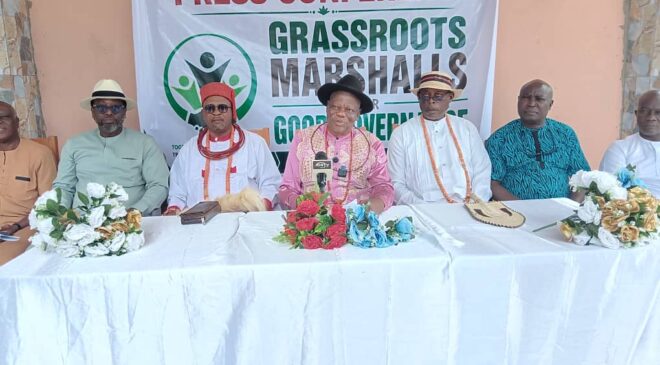
UGHELLI/Nigeria: The agitation for the creation of Ethiope State should not become a battleground for political differences or personal disputes, the National Secretary of the Ethiope State Creation Committee, Anthony Ochuko Onyokoko, has said.
Onyokoko made the call on Saturday at Isokolo in Ethiope East Local Government Area of Delta State while responding to recent criticism of Senator Ede Dafinone by the leadership of the Ethiope State Creation Committee.
He said disagreements over the senator’s position or actions could be debated publicly, but should not be allowed to degenerate into personal attacks or partisan political confrontation.
According to him, the demand for Ethiope State is bigger than the interests of individual politicians and should be pursued as a collective aspiration of the Urhobo people.
“Ethiope State is a collective aspiration of the Urhobo people. It does not belong to any individual, political party or organisation. It belongs to all Urhobo sons and daughters,” Onyokoko said.
He urged politicians seeking elective positions ahead of the 2027 elections to campaign on their policies, programmes and records rather than use the state-creation campaign to advance individual political ambitions.
Onyokoko also cautioned against attempts by individuals or groups to present themselves as the sole representatives of Urhobo interests, saying the community’s political and social diversity should be respected.
“No one should use the name of Urhobo Nation to push his own political aspirations and agenda,” he said.
He said differences among stakeholders should not obscure the practical requirements for creating a new state, which, according to him, include legislative action, political negotiations, consultation and consensus building.
The National Secretary specifically pointed to the role of Senator Dafinone, who represents Delta Central Senatorial District in the National Assembly, saying his legislative involvement could still be relevant to the state-creation process.
“Senator Ede Dafinone remains the duly elected Senator representing Delta Central Senatorial District. At this critical stage of our agitation, we may still require his legislative engagement and cooperation,” he said.
Onyokoko consequently appealed to Dafinone and other stakeholders to keep channels of communication open despite their differences.
“We may disagree without becoming enemies. We may criticise without insulting. We may correct without denigrating,” he said.
He also urged the chairman of the Ethiope State Creation Committee, Chief Dr Christopher Ominimini Obiuwevbi, and other stakeholders to moderate their public statements, saying the state-creation campaign should not become a source of further division among Urhobo people.
Onyokoko questioned the basis for speaking on behalf of the entire Urhobo Nation without a clear collective mandate, saying the interests of the wider community should be distinguished from the positions of individual organisations or political actors.
“The Urhobo Nation is larger than any individual or committee. Unless there is a clear collective mandate, we should be careful about speaking in the name of the entire Nation,” he said.
He said the campaign should remain non-partisan and involve traditional rulers, political and religious leaders, professionals, youths, women, community leaders and Urhobo people in the diaspora.
Onyokoko further warned that the people should learn from what he described as past divisions surrounding the creation of Delta State in 1991, particularly disagreements over the location of the state capital.
He argued that the experience should reinforce the need for unity when pursuing issues with long-term political and administrative implications.
“We must not repeat such mistakes,” he said.
He maintained that membership of the Ethiope State Creation Committee should not be interpreted as endorsement of every political position expressed by individual members.
“The political views of individual members must therefore not automatically become the position of the Committee,” he said.
With political activities ahead of the 2027 elections gathering momentum, Onyokoko urged stakeholders to separate their political ambitions from the state-creation campaign.
He said political alliances might change, but the broader aspiration for Ethiope State would remain, adding that the movement should therefore maintain its non-partisan character.
“Ethiope State must never become an instrument for promoting or opposing the political ambition of any individual,” he said.
Onyokoko said he recognised the right of the committee to respond to issues concerning the agitation but stressed that such responses should not become personal or partisan attacks against Dafinone or any other Urhobo leader.
“This is not about taking sides in anybody’s political contest. It is about protecting the unity, integrity and non-partisan character of the Ethiope State Creation Movement,” he said.
He called for greater cooperation among Urhobo stakeholders, saying the process required “friends, not enemies; bridges, not divisions; dialogue, not confrontation.”