
By Emmanuel Enebeli
The outcome of the August 15, 2026 governorship election in Osun State has given a fresh and unusually practical meaning to the conversation that took place at BEL Dialogue 2026 in Asaba barely two weeks earlier. When stakeholders gathered on July 30 to interrogate the theme, “Democracy That Works: Bridging the Gap Between Votes, Results and Institutional Accountability,” they were looking ahead to Nigeria’s next electoral cycle. Events in Osun have now provided a real-life setting in which many of the questions raised at the dialogue can be examined.
The election was fiercely contested. Incumbent Governor Ademola Adeleke, who contested on the Accord Party platform, faced a determined challenge from Bola Oyebamiji of the All Progressives Congress. The contest generated considerable political mobilisation and tension as both sides fought to control a state that had become one of the closely watched political battlegrounds ahead of the 2027 general elections. In the end, the Independent National Electoral Commission declared Adeleke the winner, giving the incumbent another mandate. The significance of the result, however, goes beyond the identity of the winner.
The deeper issue is what the election says about the health of Nigerian democracy and whether the institutions managing political competition are strong enough to command confidence when the stakes are high. That was the central concern of BEL Dialogue 2026 in Asaba, where participants deliberately moved the conversation beyond the question of who wins elections to the larger issues of credibility, accountability, institutional independence and the relationship between votes and governance.
The relevance of that conversation had already been underscored by the Asagba of Asaba, His Royal Majesty Prof. Epiphany Chigbogu Azinge, SAN, when the BEL Dialogue delegation led by the Advisory Board Chairman, Pharm. Paul O. Enebeli, visited his palace ahead of the event. The monarch welcomed the initiative and described the theme as timely, particularly because it came at a period when political activities were intensifying ahead of the 2027 elections. He urged Nigerians to work towards a democracy that responds to their aspirations and expressed the hope that the dialogue’s recommendations would contribute to improving the country’s electoral system.
The Asagba’s intervention now reads with added significance after Osun. His call for a democracy that works was not merely an abstract aspiration. It goes to the heart of what elections should accomplish. Democracy must give citizens the opportunity to choose their leaders, but it must equally ensure that the institutions through which those choices are made are trusted, that political competition remains peaceful and that elected leaders remain answerable to the people after the votes have been counted.
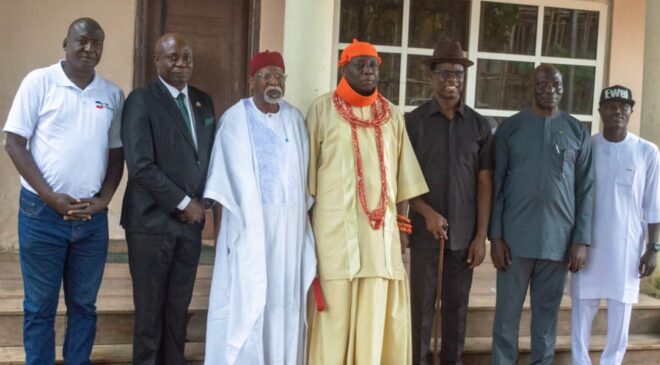
The BEL Dialogue Advisory Board Chairman, Pharm. Paul O. Enebeli, provided an important institutional framework for the conversation, emphasising the need for a democracy in which electoral outcomes genuinely reflect the will of the people and institutions responsible for elections and governance remain independent, transparent and accountable. The emphasis was not simply on elections as periodic political contests, but on the larger responsibility of building institutions capable of serving citizens and protecting democratic values.
The dialogue brought together a panel with considerable experience across electoral administration, governance, public affairs and civic engagement. They included Hon. Mike Igini, Prof. Andrew Agboro, Hon. Gibson Akporhe, Dr. Monday Michaels Ashibogu, Ambassador Augusta Chibuzor Keneboh and Lady Ejiro Umukoro, with Mr. Lawrence Okpewho serving as moderator. Their collective engagement placed electoral credibility, institutional accountability, citizen participation and the future of Nigerian democracy at the centre of the conversation.

What emerged from the Asaba dialogue was a collective concern that democracy must not end at the polling booth. Stakeholders called for free, fair, credible and inclusive elections, stronger electoral institutions, clearer electoral laws, effective enforcement of sanctions against electoral offenders, adequate support for electoral and security institutions and sustained civic education. They also stressed the need for political parties to embrace issue-based politics and for democratic institutions to remain stronger than the individuals occupying public offices.
Those recommendations acquire greater relevance when viewed against the events surrounding the Osun election. In the weeks leading to the poll, political exchanges between the incumbent’s camp and the APC became increasingly intense, with both sides seeking to convince voters that their candidate represented the better future for the state. There were also concerns about possible voter inducement, intimidation and the credibility of the process. Yet the election ultimately provided the constitutional mechanism through which the people made their choice.
That experience reinforces the BEL Dialogue’s emphasis on institutional strength. An election in a highly polarised environment cannot depend on electoral technology alone. It requires political actors who understand that an election is a contest for public trust, not a war in which the destruction of an opponent becomes the objective. It also requires electoral and security institutions capable of performing their duties without fear, favour or political interference.
The result has provided an important lesson about the relationship between incumbency and opposition strength. Adeleke retained power, but the APC mounted a serious challenge. Oyebamiji’s performance demonstrated that the opposition was capable of putting substantial electoral pressure on the incumbent. The lesson for political parties is therefore clear: electoral strength must be built continuously through credible organisation, public engagement, persuasive ideas and issues that resonate with voters, rather than improvised when an election approaches.
For Adeleke, however, the victory should be viewed as a responsibility rather than merely a political triumph. Re-election renews the mandate of the electorate, but it also raises expectations. The governor must now demonstrate that electoral victory can translate into accountable government, effective service delivery, institutional respect and inclusive governance. This is where the BEL Dialogue’s distinction between votes and results becomes particularly significant.
A democracy that works cannot be measured only by how efficiently votes are counted. It must also be measured by what elected governments do with the authority those votes confer. Citizens vote for leaders, but they also expect security, infrastructure, education, healthcare, economic opportunities and responsible management of public resources. The ballot becomes truly meaningful when it produces governance outcomes that citizens can see, experience and evaluate.
There is another lesson that should not be lost in the celebration or disappointment that follows an election: the conduct of the loser is as important to democracy as the conduct of the winner. A credible electoral system must provide lawful avenues for grievances to be addressed, but political actors must also recognise that democracy requires the willingness to accept legitimate outcomes. Where genuine disputes exist, they should be pursued through lawful and institutional channels rather than through threats, violence or attempts to undermine public confidence in the democratic process.
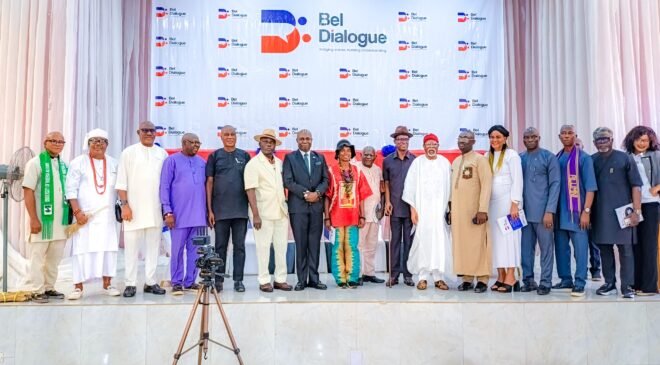
The Osun experience therefore gives BEL Dialogue 2026 an opportunity to become more than an annual event on the calendar of Bel Media Consult Limited. Its July 30 conversation now has an immediate case study. The Asagba of Asaba had urged stakeholders to pursue a democracy that works; the Advisory Board Chairman and the panel of discussants examined how that objective could be achieved; and Osun has now offered another practical test of those principles. The question moving forward is whether the lessons and resolutions of the dialogue will be carried beyond the conference hall and into the conduct of Nigeria’s political institutions.
Ultimately, the most important story from Osun is not simply Adeleke versus APC. It is the continuing struggle to build an electoral culture in which political competition can be intense without becoming destructive, institutions can be independent without being intimidated, citizens can vote without fear, and winners can govern without forgetting that the mandate belongs to the people. In that sense, the August 15 election has brought the conversation in Asaba into sharper focus. The democracy the Asagba called for must not merely be a democracy that holds elections; it must be a democracy in which votes matter, institutions work, leaders remain accountable and citizens can see the results of the choices they make at the ballot box.
Emmanuel O. Enebeli, FCISM, Mnipr, Secretary/Executive Director, Bel Dialogue Advisory Board