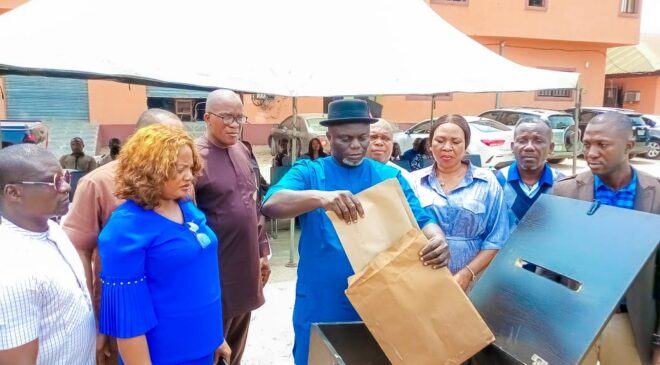
ASABA/Nigeria: The Delta State Universal Basic Education Board (SUBEB), in collaboration with the Universal Basic Education Commission (UBEC), on Thursday, February 26, 2026, conducted the official bid opening for the 2025 UBEC intervention projects, in line with the provisions of the Public Procurement Act and established national and state procurement guidelines.
The projects are primarily targeted at the construction and renovation of primary schools across Delta State, with stakeholders using the occasion to reaffirm their commitment to transparency, accountability, and due process in public procurement.
In her message at the ceremony, the Commissioner for Primary Education, Mrs. Rose Ezewu, underscored the state government’s resolve to uphold professionalism, integrity, and strict compliance with procurement regulations. Represented by Mr. Akpojaro Lawson, she urged bidders to adhere to project specifications and timelines to ensure quality delivery.
Mrs. Ezewu reiterated the Ministry’s collaboration with Delta SUBEB and other stakeholders to ensure that the intervention projects deliver tangible benefits to communities and significantly improve the learning environment for pupils across the state. She also commended the state government for releasing the funds required to drive the projects.
Speaking at the event, the Executive Chairman of Delta SUBEB, Hon. Samuel Mariere, highlighted the Board’s strong performance record, noting that 99 percent of previously awarded projects were completed according to specification. He praised the Department of Physical Planning and the Procurement Team for their diligence and professionalism.
Hon. Mariere acknowledged the impact of rising market costs but assured contractors that prevailing economic realities were taken into account in the 2025 procurement planning process. He stressed that transparency, fairness, and strict adherence to procurement laws remain the guiding principles of the Board.
He further disclosed that the Board works closely with regulatory bodies, including the Independent Corrupt Practices Commission (ICPC), to strengthen accountability and eliminate sharp practices in public procurement, assuring stakeholders that the 2025 intervention projects would be implemented in line with global best practices.
Also speaking, the ICPC representative in Delta State, Mr. Adira Akison, emphasized the Commission’s role in promoting transparency and accountability in project execution. He commended the Board for overseeing the successful completion of over 90 percent of last year’s projects according to specification.
Akison clarified that the ICPC’s role is not to persecute contractors but to monitor project implementation and address grievances when necessary, advising contractors to first engage the Board before escalating issues to the Commission.
The UBEC State Coordinator, Mrs. Sharon Dafiluelo, also praised Delta State’s consistent record in project delivery, noting that the state has demonstrated strong capacity in executing intervention projects in line with approved standards and timelines.
She observed that Delta State’s track record of accountability has strengthened UBEC’s confidence in releasing intervention funds to the state, while encouraging the Board and contractors to sustain the high standards that have earned the state its reputation for excellence.
Stakeholders at the ceremony reiterated SUBEB’s alignment with the development vision of Governor Sheriff Oborevwori, whose administration continues to prioritize quality infrastructure and improved learning outcomes across Delta State.
They called on contractors to uphold professionalism, ensure value for money, and contribute meaningfully to strengthening basic education infrastructure in the state.
Among those present were Mrs. Kenebo Augusta, Executive Director of the Afro Center of Development Peace and Justice; Mr. Osakwe Adolphus of the Nigerian Institute of Quantity Surveyors; Arc. Pius Amromanoh of the Nigerian Institute of Architects; members of the Board; Directors of Delta SUBEB; and other key stakeholders.