By Emmanuel Enebeli
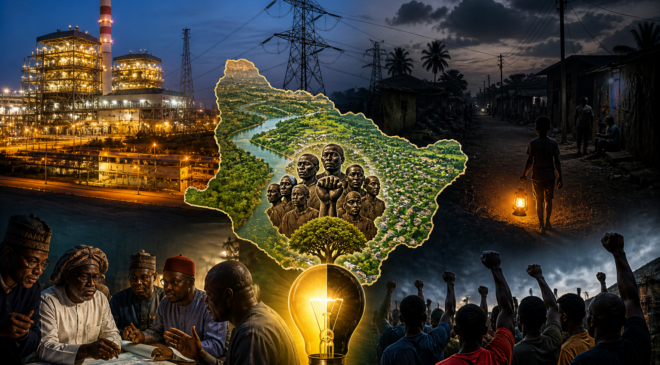
There is a troubling paradox at the heart of Ndokwa land—one that has lingered for decades and now demands urgent, coordinated resolution. It is the irony of a region that powers a nation yet groans in persistent darkness, a people whose land fuels economic prosperity but whose communities remain underdeveloped, underrepresented, and increasingly restless. The events of 2025, particularly the “Light Up Ndokwa” agitation, were not spontaneous outbursts of anger; they were the culmination of years of frustration, neglect, and perceived injustice.
That protest, which saw youths barricade the strategic Warri–Ughelli–Kwale–Asaba road, sent a clear message—not just to the Delta State Government but to the entire federation. It disrupted economic movement, stalled commercial activities, and underscored the centrality of Ndokwa to the state’s economic grid. Yet, beyond its immediate impact, the protest revealed a deeper issue: a disconnect between resource ownership and resource benefit, between representation and reality.
The anger of the people was particularly directed at the glaring contradiction within Ndokwa West, where oil and gas companies operate with uninterrupted power supply within their facilities, while host communities remain in darkness. This disparity has not only widened the trust deficit between the people and corporate operators but has also intensified calls for equity, accountability, and justice.
However, while the grievances are legitimate, the strategy must be interrogated. It is important to clearly situate responsibility: the Okpai Power Plant and its step-down project are fundamentally a federal undertaking, driven by contractual arrangements between the Federal Government, the operating company—Nigerian Agip Oil Company—and other technical contractors. The Delta State Government has had limited direct control over these contractual obligations.
What the state government did, however, particularly during the administration of Ifeanyi Okowa, was intervene at a critical moment to prevent total collapse of progress. When issues of compensation to affected communities threatened to stall the project, and the Federal Government failed to meet its obligations, the state stepped in to offset payments to impacted individuals in order to keep the process alive. This intervention, though not widely acknowledged, reflects a pragmatic attempt to bridge federal inertia and local expectations.
Still, the broader constraints remain. Evidence indicates that the failure to actualise the step-down infrastructure is not simply about unwillingness but is deeply tied to economic realities. Agreements initiated during the administration of Muhammadu Buhari were undermined by exchange rate volatility and rising costs of materials. Contractors, bound by earlier pricing frameworks, faced untenable conditions, while bureaucratic limitations made contract variations difficult.
This reality demands a recalibration of Ndokwa’s advocacy approach. Protests alone, especially when misdirected, cannot resolve technically complex and economically sensitive projects. Engagement must be precise—targeting the Federal Government, the operating company, and the contractual chain that governs the project’s execution.
Equally critical is the need for a deeper understanding of governance processes. Too often, communities equate high-level meetings with commissioners and ministers as evidence that solutions are imminent. This is a dangerous assumption. Political office holders are transient; they can be reshuffled or exit office abruptly, leaving negotiations without continuity.
A recent example illustrates this point. The leadership of the Ndokwa Neku Union (NNU) held engagements with the former Minister of Power, Adebayo Adelabu, who reportedly made encouraging assurances regarding Ndokwa’s power concerns. Yet, within a short period, he exited his ministerial role to pursue his gubernatorial ambition, effectively resetting the engagement process and exposing the fragility of personality-driven advocacy.
The lesson is instructive. Sustainable progress lies not only in engaging political appointees but in building enduring relationships with the institutional backbone of governance—permanent secretaries, directors, and career civil servants. These are the actors who provide continuity, institutional memory, and procedural guidance. They understand the system, manage the files, and often determine the pace at which decisions are implemented.
For Ndokwa, this means a strategic shift. Advocacy must move beyond episodic meetings and evolve into structured, institutional engagement. The region must cultivate allies within the bureaucracy, individuals who can guide processes, flag opportunities, and ensure that Ndokwa’s concerns remain active within the system regardless of political changes.
This need for strategy is equally evident in the ongoing discourse around electoral representation. The recent move by the Independent National Electoral Commission to restore suppressed constituencies has generated both hope and tension. Yet, as clarified, Ndokwa East is not among the constituencies currently covered, as the exercise is limited to cases backed by court judgments between 2014 and 2015.
Rather than deepen internal divisions, this development should galvanise a more coordinated response. The agitation for Ndokwa East Constituency 2 remains valid, but its success will depend on following the established pathway—legal action, sustained advocacy, and strategic influence.
Here again, the role of Ndokwa’s elite is crucial. Retired civil servants, military officers, technocrats, and traditional rulers must be mobilised as a unified force. These individuals possess the experience and networks required to navigate both legal and administrative processes. Their involvement can transform agitation into achievement.
At present, however, internal discord—particularly on social media—continues to undermine collective progress. Energy that should be directed toward strategic engagement is often dissipated in unproductive arguments. This must change. The challenges facing Ndokwa are too significant to be trivialised by division.
The truth is stark: neither the restoration of Ndokwa East Constituency 2 nor the realisation of the Okpai step-down project will happen in a fragmented environment. Success will require unity, discipline, and a shared sense of purpose.
Ndokwa stands at a crossroads. It has the demographic strength, the economic relevance, and the historical context to demand better. But demands must be matched with strategy. Agitation must be complemented by negotiation. And leadership must extend beyond elected offices to include the broader community of experienced professionals.
The paradox of Ndokwa can be resolved. But only if the people choose cohesion over conflict, strategy over sentiment, and sustained engagement over sporadic outrage.
The time for alignment is now.
Emmanuel Enebeli, FCSIM, MNIPR, Public Relations Consultant, and Media Strategist, enebelli@hotmail