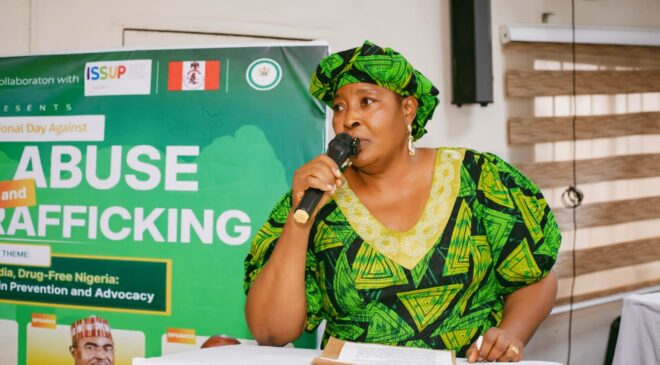
LAGOS/Nigeria: The Chairman and Chief Executive Officer of the National Drug Law Enforcement Agency, Brig. Gen. Mohammed Buba Marwa (Rtd), has called for a stronger partnership between the media and anti-drug agencies, warning that Nigeria remains at the epicentre of a growing drug abuse crisis that demands urgent, coordinated and sustained action.
Marwa said the fight against substance abuse could no longer be left to law enforcement agencies alone, stressing that journalists have a critical responsibility to shape public attitudes, promote prevention and drive national advocacy against illicit drug use.
Represented by the agency’s Deputy Director, Mrs. Rita Geh, the NDLEA boss made the call while delivering the keynote address at the 2026 Media Capacity Building Programme organised by the Nigerian Online Media Alliance in commemoration of the 2026 International Day Against Drug Abuse and Illicit Trafficking.
The programme, themed “Responsible Media, Drug-Free Nigeria: The Journalist’s Role in Prevention and Advocacy,” brought together journalists, public health experts, policymakers, anti-drug advocates and other stakeholders at the Federal Neuro-Psychiatric Hospital to examine the media’s role in combating substance abuse through responsible reporting and public education.
Describing media professionals as “shapers of perception, architects of public opinion and indispensable partners in national development,” Marwa said the influence of journalists extends far beyond news reporting and could determine the success or failure of efforts to curb drug abuse.
He expressed concern over projections indicating that drug use in Africa could rise by as much as 40 per cent by 2030, warning that Nigeria’s large population and strategic location place the country at the heart of the continent’s growing drug challenge.
According to him, the 2018 National Drug Use Survey revealed that 14.4 per cent of Nigerians use illicit drugs, a figure far above the global average of 5.6 per cent.
“This is not a statistic we can afford to ignore,” he said, adding that the alarming trend calls for greater investment in prevention, education and community engagement.
Marwa explained that while aggressive enforcement remains a vital component of the agency’s mandate, lasting success would only come through a balanced strategy that combines supply reduction with robust demand reduction initiatives.
Highlighting the agency’s achievements, he disclosed that the NDLEA has arrested more than 77,859 suspected drug offenders, secured over 14,122 convictions and seized more than 15 million kilograms of illicit substances in recent years.
He added that within the first ten months of 2025 alone, the agency recorded over 19,000 arrests, secured about 3,000 convictions, confiscated millions of kilograms of narcotics and destroyed large cannabis plantations across the country.
According to him, the achievements represent far more than operational statistics.
“Behind every arrest, conviction and seizure are lives saved, families protected and communities made safer,” he said, noting that the agency’s operations have also disrupted criminal supply chains and weakened financial networks linked to organised crime and terrorism.
Marwa, however, maintained that reducing the demand for illicit drugs remains the most sustainable solution, insisting that the media occupies a strategic position in influencing public behaviour, especially among young people.
He urged journalists to embrace responsible and ethical reporting by prioritising factual, evidence-based information over sensational headlines, while giving greater visibility to stories of prevention, rehabilitation and recovery.
According to him, media narratives that focus solely on arrests and punishment often reinforce stigma, discourage victims from seeking treatment and undermine public health interventions.
“Responsible media practice means going beyond headlines. It means helping people understand the realities of drug abuse, promoting evidence-based information and showing that recovery is possible,” he stated.
The NDLEA chairman also encouraged journalists to strengthen their watchdog role by promoting informed public conversations on drug policy, prevention strategies and rehabilitation while holding relevant institutions accountable.
He reaffirmed the agency’s commitment to transparency and sustained collaboration with media organisations, describing regular engagement with journalists as essential to deepening public awareness and strengthening advocacy.
Marwa further highlighted the agency’s ongoing investments in school-based sensitisation programmes, community outreach, rehabilitation services and the nationwide War Against Drug Abuse (WADA) campaign, noting that millions of Nigerians—particularly young people—have benefited from the initiatives.
He also called on parents, teachers, religious leaders and community influencers to play more active roles in protecting young people from substance abuse through early education, open communication and supportive environments.
“A drug-free Nigeria cannot be achieved without active community participation and personal responsibility,” he said.
Expressing optimism that the country can overcome the menace, Marwa said the vision of a drug-free Nigeria remains attainable through sustained commitment, consistency and collective action by government, the media, civil society and the wider public.
“Together, we can build a nation where young people make informed choices and where communities remain safe, productive and free from the scourge of drugs,” he concluded.