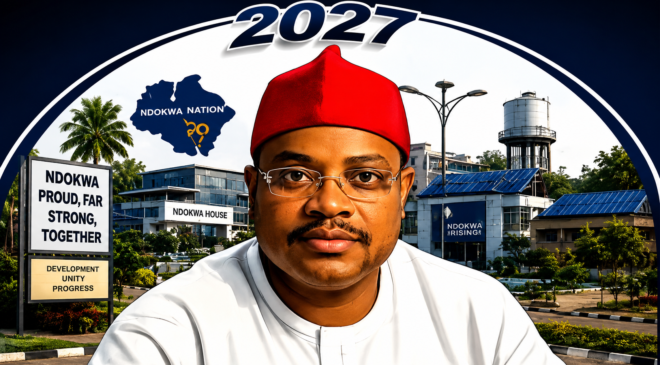
By Emmanuel Enebeli
Action Alliance candidate for Ndokwa/Ukwuani Federal Constituency, Ogbuefi Nicholas Onyekachukwu Enubuzor, says his proposed representation in the House of Representatives would be built around legislation, effective representation, oversight and measurable accountability.
In the final instalment of the Ndokwa Reporters exclusive interview series, Enubuzor said a federal lawmaker should understand not only the problems confronting constituents but also the institutions and processes through which those problems can be addressed.
He identified the three fundamental responsibilities of a member of the House of Representatives as legislation, representation and oversight.
But he added that representation must go beyond simply attracting constituency projects.
“A legislator should understand the problems of his people well enough to know which institutions can address them and how to influence those institutions,” he said.
‘Representation must be intelligent’
Enubuzor said that if a community needs electricity infrastructure, its representative should understand the institutional pathway for pursuing it.
Similarly, he said, the lawmaker should know which agencies can assist farmers, where opportunities for youth skills and financing exist, and how to pursue interventions in roads, healthcare and education.
Where government institutions fail to deliver, he said, the representative should be prepared to use the oversight powers of the National Assembly to demand answers.
He also argued that lawmakers should think beyond their four-year tenure.
The question, according to him, should not merely be what project a representative can bring home, but what economic and social structures can be created to continue benefiting constituents after the representative leaves office.
“That is the kind of representation I want to provide,” he said.
A formal Ndokwa/Ukwuani Legislative Agenda
Enubuzor said that if elected, he would develop a formal Ndokwa/Ukwuani Legislative Agenda after consultations with communities, professionals, traditional institutions, young people, farmers, women, businesses and civil society.
While stressing that such an agenda should emerge from consultation, he identified several areas he believes already require serious attention.
On electricity, he said he would pursue legislative and oversight initiatives focused on infrastructure and accountability in underserved communities.
For flooding, he proposed advocacy for stronger federal investment in flood mapping, early-warning systems, drainage, riverine infrastructure and post-flood agricultural recovery.
He also proposed initiatives aimed at creating stronger opportunities for qualified Ndokwa people and local businesses to participate in the oil and gas value chain.
Education, agriculture and youth employment
Education would also feature prominently in his proposed legislative agenda.
Enubuzor said he would pursue initiatives to expand access to tertiary education, vocational and technical training, as well as digital skills.
In agriculture, he proposed legislative initiatives encouraging processing, storage, financing and market access, while his youth-employment agenda would seek to move empowerment away from one-time distributions towards sustainable employment, enterprise and skills development.
The candidate said he wants to see a shift from a political culture in which young people wait for periodic distributions to one where they have sustainable economic opportunities.
Green communities and safer public spaces
Environmental protection and urban development also occupy a significant place in Enubuzor’s proposed agenda.
He said environmental management should become part of development policy, with attention to green communities, public parks, recreational infrastructure, pedestrian safety, drainage, public spaces, urban planning and responsible waterfront development.
He also wants technology explored as a tool for community security, including CCTV networks and other modern security systems.
The candidate’s wider vision includes treating the River Ethiope and other riverfront areas as potential assets for tourism, recreation and commerce rather than simply geographical features.
Tracking federal projects
One of the more specific accountability proposals in the interview is Enubuzor’s call for a system through which federal projects in the constituency can be tracked.
Under his proposal, residents should be able to know what was approved, how much was budgeted, which agency is responsible, where the project is located and what stage of implementation it has reached.
“That is not witch hunting. That is accountability,” he said.
The proposal reflects his broader argument that constituents should be able to assess their representative through verifiable records rather than political claims.
Five areas he says should define his first term
Enubuzor was asked what achievements he would expect constituents to use to judge him if he wins the 2027 election.
He identified five broad areas.
First, he wants to point to a significant electricity intervention, including tangible infrastructure and measurable improvement in electricity supply.
Second, he wants to establish a major education and human-capital programme covering scholarships, tertiary education support, vocational training, digital skills and strategic partnerships.
Third, he wants a sustainable youth economic programme that connects young people with employment, training, financing, businesses and markets.
Fourth, he proposes a combined flood, agriculture and environmental development programme involving flood preparedness, farmer recovery support, financing, processing and markets, alongside improved public spaces and environmental management.
Fifth, he wants to establish what he describes as a new standard of representation—one in which the people can audit his four years in office.
A public scorecard
On the final point, Enubuzor said he would publish a comprehensive Ndokwa/Ukwuani Legislative and Development Scorecard at the end of his first term.
He said the scorecard should show what he promised, what he pursued, what was approved, what was funded, what was delivered, what remained outstanding and the reasons for any outstanding commitments.
The objective, he said, would be to allow constituents to examine his performance without relying on campaign propaganda.
“A public mandate should come with public accountability,” he said.
The bigger vision
Asked to summarise the future he wants voters to believe in, Enubuzor described his vision of Ndokwa/Ukwuani as a “prosperous, educated, electrified, environmentally beautiful, economically productive and technologically secure constituency” where children have greater opportunities than those available to the present generation.
He spoke of young people working and building businesses, farmers making money, students coming into the constituency, properly planned housing, tourism, developed riverfronts, public parks and safer communities.
Ultimately, he said, he wants a constituency where political leaders compete over development achievements rather than the volume of handouts distributed.
“That is the Ndokwa/Ukwuani I believe is possible,” he said.