OVRODE/Nigeria: Delta State Government has reaffirmed that Governor Sheriff Oborevwori’s performance in office, driven by widespread infrastructure and human capital development, will serve as the foundation of his campaign for the 2027 general elections.
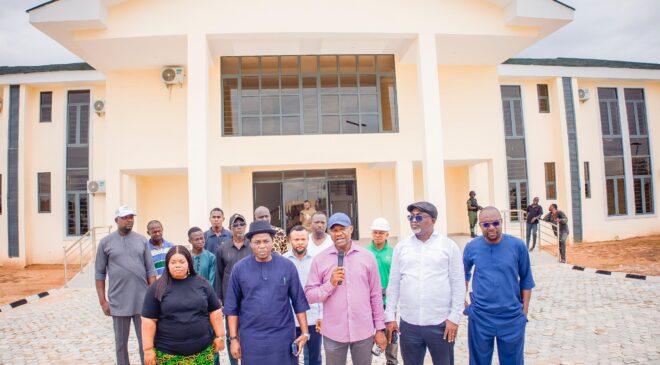
This position was reiterated on Tuesday when the Commissioner for Works (Rural Roads) and Public Information, Mr. Charles Aniagwu, led a high-level inspection team to the Delta State College of Health Technology, Ovrode, in Isoko North Local Government Area, to assess the extent of work done and readiness of the facility for commissioning.
Aniagwu made the assertion during the inspection of the Delta State College of Health Technology, Ovrode, where he evaluated the level of work completed at the facility.
The commissioner, who was accompanied by the Commissioner for Health, Dr. Joseph Onojaeme, and the Chief Press Secretary to the Governor, Sir Festus Ahon, said the visit was in line with the governor’s directive to assess project progress and address any outstanding issues.
He expressed satisfaction with the pace of work, noting that most of the earlier concerns raised had been resolved by the contractor, with only minor finishing touches remaining.
According to him, the project is expected to be ready for commissioning within the next few weeks, reflecting what he described as the governor’s unwavering commitment to delivering impactful infrastructure.
“What this shows is that the governor is indeed working. The progress here reflects his commitment to delivering projects that directly impact the lives of the people,” Aniagwu said.
He emphasized that Governor Oborevwori’s governance style is driven by tangible results rather than political rhetoric, stressing that the administration is focused on executing and commissioning projects as a demonstration of accountability to the people.
“While others may be busy talking about campaigns, the governor is busy working. His strategy is simple—deliver projects, improve lives, and let the people be the judges,” he added.
Aniagwu further explained that the completion of the College of Health Technology would not only boost healthcare training but also create employment opportunities and help address manpower shortages in the sector.
He referenced the recent approval of 700 health sector employments by the state government, noting that institutions like the Ovrode college are critical to sustaining a skilled workforce.
The commissioner also said the initiative would help stem the tide of migration of healthcare professionals, popularly known as the “Japa syndrome,” by equipping more residents with the necessary skills to fill vacancies within the state’s expanding health system.
On the broader development agenda, Aniagwu disclosed that the governor had approved over ₦400 billion worth of capital projects across Delta State, many of which are already at various stages of procurement and execution in different communities.
He added that the administration remains committed to equitable development, ensuring that all parts of the state benefit from ongoing and future projects.
According to him, Governor Oborevwori has maintained consistent engagement with residents through project inspections, flag-offs, and commissioning ceremonies across all 25 local government areas since assuming office.
“Commissioning of projects is not just ceremonial; it provides an opportunity for the governor to interact with the people. He does not believe in appearing only during election periods. He has continued to crisscross the state, delivering and unveiling projects that improve lives,” Aniagwu stated.
He noted that due to the volume of completed and ongoing projects, the governor has directed that some commissioning ceremonies may be delegated to the Deputy Governor or the Secretary to the State Government.
Aniagwu assured that the administration would sustain its focus on people-oriented development, insisting that the visible achievements across the state would form the cornerstone of Governor Oborevwori’s campaign as the 2027 elections approach.