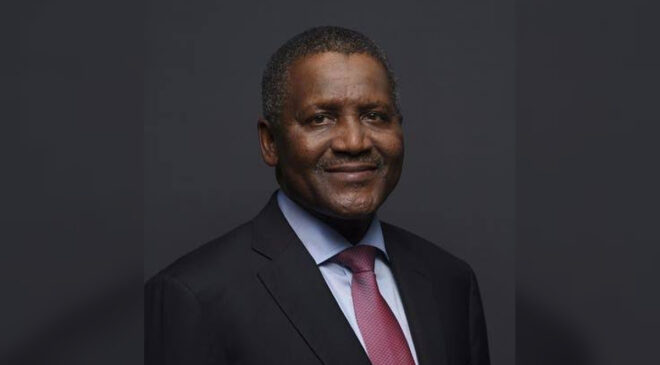
JOHANNESBURG/South Africa: Nigerian industrialist and businessman Aliko Dangote has been named the 2026 African Energy Person of the Year by the African Energy Chamber (AEC), with the organisation citing his investments in refining, industrial infrastructure and initiatives aimed at strengthening Africa’s energy security.
The award, announced by the Johannesburg-based Chamber, recognises individuals whose activities have contributed to the development of Africa’s energy sector, including infrastructure expansion, local content, economic resilience and improved access to energy.
The Chamber said Dangote’s emergence from a trading enterprise into the founder of one of Africa’s largest industrial groups has been marked by investments spanning manufacturing, logistics, fertiliser, petrochemicals and energy infrastructure.
At the centre of the recognition is the Dangote Petroleum Refinery in Lekki, Lagos, which has become a major source of refined petroleum products for Nigeria and export markets.
The refinery increased its crude-processing capacity to about 700,000 barrels per day in 2026, exceeding its original 650,000-bpd nameplate capacity. The facility is regarded as the world’s largest single-train petroleum refinery.
The development has coincided with a significant change in Nigeria’s petroleum-product trade. According to the U.S. Energy Information Administration, Nigeria’s seaborne imports of petroleum products fell from nearly 400,000 barrels per day in 2023 to less than 130,000 bpd in the second quarter of 2026.
During the same period, Nigerian petroleum-product exports to Europe averaged about 130,000 bpd, while exports to other African countries approached 120,000 bpd. The EIA attributed the broader increase in Nigerian petroleum-product shipments partly to increased output from the Dangote refinery.
In September, Dangote Petroleum Refinery launched an initial public offering involving 4.1 billion ordinary shares priced at ₦525 each, with the offer designed to raise approximately ₦2.15 trillion, or about $1.6 billion, if fully subscribed. The Securities and Exchange Commission approved the offering in September.
The proceeds are linked to the refinery’s planned expansion, which is projected to increase processing capacity from about 700,000 bpd to 1.4 million bpd. The estimated cost of the expansion has been put at $14.3 billion, with completion targeted around 2029.
The proposed expansion would further increase the facility’s ability to supply Nigeria and export markets, while expanding its associated petrochemical and logistics operations.
Through Dangote Group, the businessman has invested in cement, sugar, salt, flour and fertiliser production, among other sectors. The group has pursued an industrial model centred on processing raw materials and developing production capacity within Africa rather than relying primarily on the export of unprocessed commodities.
The broader strategy has also included transportation, storage and other infrastructure intended to support domestic manufacturing and regional supply chains.
Dangote’s entry into the petroleum sector has given his industrial strategy a major energy dimension.
The refinery’s scale has positioned Nigeria as a growing exporter of refined petroleum products at a time when disruptions in international supply routes have increased the importance of alternative sources of fuel.
The EIA reported that Nigerian petroleum-product shipments increased sharply in 2026, with higher refinery output contributing to greater domestic distribution and exports.
Dangote is also pursuing energy investments outside Nigeria. The group has announced plans for a 700,000-bpd refinery in Lamu, Kenya, aimed at serving the East African market. The project is expected to involve regional government participation and is being developed as part of a broader expansion of Dangote’s industrial activities across Africa.
The Kenya project, however, faces legal challenges over land rights, with a Kenyan court ordering a halt to site activities pending further proceedings. Dangote has said the legal dispute would not prevent the planned groundbreaking ceremony.
The Chamber also pointed to Dangote’s philanthropic activities through the Aliko Dangote Foundation, which works in health, education, economic empowerment, nutrition and humanitarian relief.
The foundation has partnered with governments and international organisations on public-health initiatives, including efforts to strengthen routine immunisation and eradicate polio in Nigeria. Its collaboration with the Bill & Melinda Gates Foundation and governments in northern Nigeria dates back to 2013.
Nigeria was certified free of wild poliovirus in 2020 following years of vaccination and surveillance efforts involving government agencies and international and private-sector partners.
The foundation’s current areas of work include child nutrition, healthcare, education, economic empowerment and emergency assistance, according to its own published information.
The African Energy Chamber said Dangote’s investments demonstrate the role private-sector capital can play in expanding Africa’s industrial and energy infrastructure.
The award places particular emphasis on the Dangote refinery and the wider industrial ecosystem being developed around it, as Africa continues to grapple with energy-import dependence, inadequate refining capacity and the need to retain more value from its natural resources within the continent.