Photo Bripin Enarusai
ANWAI/Nigeria: Delta State Government has intensified the construction and expansion of facilities in its four state-owned universities as increasing student enrolment puts additional pressure on existing academic infrastructure.
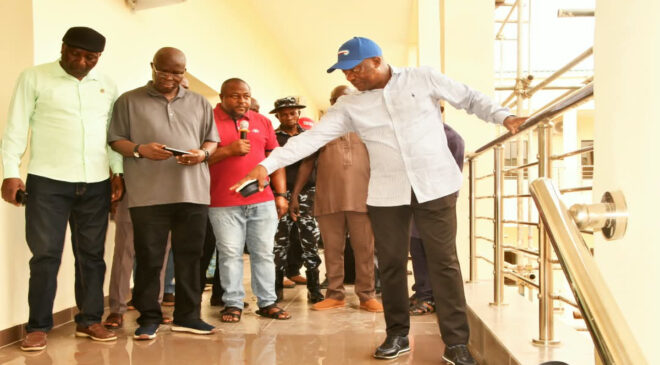
The latest assessment came during an inspection of the Faculty of Management Sciences and Social Sciences building at Dennis Osadebay University (DOU), Asaba, by senior officials of the state government and the university.
Commissioner for Works (Rural Roads) and Public Information, Mr Charles Aniagwu, led the inspection on Saturday alongside the Commissioner for Higher Education, Prof. Nyerhovwo Tonukari, and the Vice-Chancellor of DOU, Prof. Samuel Aghalino.
Aniagwu said the facility formed part of the infrastructure expansion programme of the administration of Governor Sheriff Oborevwori, explaining that the growing demand for university admission had made additional lecture halls, offices and other academic facilities necessary.
The Commissioner said the government’s response to the expansion of the university system went beyond the recruitment and retention of personnel, stressing that adequate physical infrastructure was equally important to sustaining the growth in student population.
He disclosed that similar projects were ongoing in other state-owned universities, particularly institutions established within the same period as Dennis Osadebay University, with projects distributed across Delta’s three senatorial districts.
While assessing the DOU project, Aniagwu acknowledged that some aspects still required finishing touches but expressed satisfaction with the quality of work executed so far.
“What we have observed is that there are a few things they need to put finishing touches to. But, on the whole, we are very much impressed with the quality of work,” he said.
The Commissioner also linked the infrastructure programme to the administration’s broader approach to project delivery ahead of the 2027 elections.
He said the administration’s campaign would be anchored on projects and achievements that could be physically assessed, describing the university development as part of the evidence of government activity.
“Our campaign is going to be evidence-based. What we have come here to do is part of that evidence,” Aniagwu said.
He added that investment in university infrastructure could also have wider economic benefits by contributing to improved economic activity and the purchasing power of residents.
For Tonukari, the expansion programme was necessary to keep the state’s tertiary institutions responsive to changing demands, particularly the steady increase in the number of students seeking university education.
The Commissioner recalled that the establishment of additional state-owned universities was intended to widen access to tertiary education and provide more admission opportunities for young people across Delta State.
“For the students, I can tell you that they are very happy. If you look back, three universities were commissioned at the same time to take care of the high number of Deltans seeking admission,” he said.
Recent figures cited by the state government indicate that enrolment across its tertiary institutions has grown substantially, with student numbers rising from slightly above 50,000 in 2023 to more than 100,000 in 2026. The state currently has four government-owned universities: Delta State University, Abraka; University of Delta, Agbor; Southern Delta University, Ozoro; and Dennis Osadebay University, Asaba.
The development of infrastructure comes alongside other measures by the state government to strengthen the university system. In September, Governor Oborevwori announced a new salary structure for academic staff in the four universities, effective from August 2026, while the new structure for non-academic staff and workers in other tertiary institutions was scheduled to take effect from September.
At Dennis Osadebay University, Aghalino described the faculty building as a significant intervention that would provide additional academic and administrative space for lecturers and students.
He said the facility included a library and other modern features capable of helping the institution address some of its infrastructure requirements.
“I can tell you it’s a state-of-the-art building. And we are grateful to the governor,” the Vice-Chancellor said.
The university’s Faculty of Management Sciences currently accommodates programmes including Accounting, Actuarial Science, Banking and Finance, Business Administration, Entrepreneurship, Finance, Hospitality and Tourism Studies, Management, Marketing and Transport Management, among others.
The inspection underscores the growing infrastructure demands created by the rapid expansion of Delta’s public university system, with the state government now seeking to match increased access to higher education with facilities capable of supporting teaching, learning and administration.
