LAGOS/Nigeria: Residents of Lagos experiencing delays in waste collection may soon see improvements as rehabilitation work on a key access road leading to the Olusosun Disposal Facility gathers pace, with authorities expressing confidence that the intervention will restore smoother waste evacuation across the state.
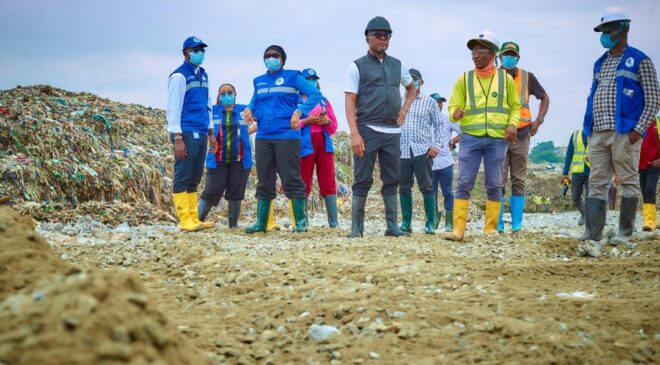
The assurance was contained in a statement issued by the Director of Public Affairs of the Lagos Waste Management Authority (LAWMA), Mukaila Sanusi, after the agency’s Managing Director and Chief Executive Officer, Dr. Muyiwa Gbadegesin, inspected the ongoing rehabilitation of Road E at the Olusosun facility on Tuesday.
According to the statement, the road project is expected to improve access for compactor trucks, reduce turnaround time and enhance operational efficiency at one of Africa’s busiest waste disposal sites.
Gbadegesin explained that heavy rainfall in recent weeks had affected movement into and out of the Olusosun facility, resulting in temporary delays in waste evacuation in some parts of Lagos.
He, however, said the rehabilitation of Road E would restore seamless access to the landfill and gradually ease the challenges currently being experienced by residents.
The LAWMA boss disclosed that the rehabilitation project is being executed by Zoomlion Nigeria under its Corporate Social Responsibility initiative, describing it as a strategic intervention to improve waste management operations across the state.
He noted that the Olusosun Disposal Facility currently receives about 10,000 metric tonnes of municipal solid waste daily, making uninterrupted access to the site critical to effective waste collection and disposal.
Gbadegesin also revealed that although the Lagos State Government plans to decommission the Olusosun landfill, the process would be implemented gradually to prevent disruption to waste management services.
According to him, the disposal facility will only be phased out after adequate replacement infrastructure has been developed to accommodate the huge volume of waste generated daily across Lagos.
As part of that transition, he said two modern Transfer Loading Stations are under construction at Olusosun and Solous III through a partnership with Zoomlion Nigeria.
Each of the facilities, he explained, is designed to process 2,500 metric tonnes of waste daily, significantly increasing the state’s waste handling capacity and improving transportation efficiency.
Gbadegesin added that LAWMA is also creating additional dumping platforms within the Olusosun facility to improve traffic flow and reduce waiting time for compactor trucks pending the completion of the new transfer stations.
He further disclosed that the Lagos State Government intends to acquire 3,000 compactor trucks of various capacities over the next three years to strengthen waste collection and evacuation statewide.
The first phase of the procurement programme, he said, will see about 150 new compactors, including tricycle compactors for narrow streets and densely populated communities, delivered before the end of the year.
According to him, Lagos requires at least 2,000 operational compactor trucks to cope with the volume of waste generated daily, noting that the planned fleet expansion would improve the operations of Private Sector Participants (PSPs) and broaden waste collection coverage.
Gbadegesin said the Transfer Loading Station model would be replicated in different parts of the state as part of the government’s long-term strategy to modernise waste management infrastructure, reduce haulage distances, lower transportation costs and support a transition to a circular economy driven by resource recovery.
While appealing for residents’ patience, he assured Lagosians that the current waste evacuation delays were temporary and would ease as the road rehabilitation progresses, additional operational platforms become available and ongoing investments in the sector begin to deliver results.
He reaffirmed LAWMA’s commitment to providing efficient and sustainable waste management services and acknowledged the Lagos State Government’s continued investment in strengthening the sector through infrastructure development, fleet expansion and strategic partnerships.