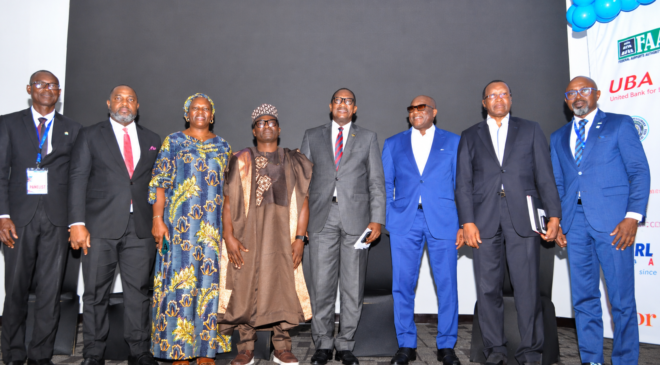
LAGOS/Nigeria: The Chairman of Air Peace Limited, Dr Allen Onyema, has called for presidential intervention in Nigeria’s aviation charges regime, expressing confidence that direct engagement with President Bola Ahmed Tinubu could help address the financial pressures threatening the survival of domestic airlines.
Onyema, who is also Vice President of the Airline Operators of Nigeria (AON), made the appeal on Thursday while delivering the keynote address at the 30th Annual Conference of the League of Airport and Aviation Correspondents (LAAC) in Lagos.
The conference, themed “Towards a Sustainable Aviation Industry: Balancing Government Revenue Demands with Sector Growth,” brought industry stakeholders together to examine the financial and regulatory challenges confronting Nigeria’s aviation sector.
At the centre of Onyema’s presentation was the five per cent Ticket Sales Charge (TSC), which he argued had become a significant burden on airline operators under the current collection arrangement.
He proposed replacing the percentage-based charge with a fixed amount per ticket, saying the alternative would provide greater predictability for airlines while preserving a revenue stream for aviation agencies.
“What will put an end to the high mortality rate of Nigerian operators is when there is an amicable tax and charges system that protects the airlines, aviation agencies and the travelling public in a win-win situation,” he said.
Onyema maintained that the industry’s difficulties could not be separated from the cumulative effect of taxes, levies and regulatory charges imposed on airlines.
He argued that a more balanced fiscal framework would strengthen the capacity of indigenous carriers to remain operational, improve competitiveness and contribute more effectively to the national economy.
The Air Peace chairman described President Tinubu as a “listening President,” recalling the Federal Government’s decision to exempt airlines from a four per cent Free on Board (FOB) levy introduced by the Nigeria Customs Service.
According to Onyema, the exemption followed discussions in which the potential consequences of the levy for airline operations were brought to the attention of the Presidency.
“I was there in the Presidential Villa with the Customs boss. This President acted swiftly and waived it for airlines within hours of being made to understand the would-be effects of such a charge on the viability of indigenous Nigerian airlines,” he said.
He said the episode demonstrated the importance of presenting policymakers with the practical implications of decisions affecting businesses.
“That is the power of listening. President Tinubu is a listening President,” Onyema added.
He expressed the view that a similar opportunity for direct engagement with airline operators could lead to broader reforms in the sector.
“The problem is that the President has not heard from us on why his country was so described by IATA, who equally compared Nigeria to Afghanistan,” he said.
“When he does see us, aviation will flourish in this country. It will benefit the agencies, the government and the flying public.”
Onyema’s comments came amid continuing industry concerns over the cost of operating airlines in Nigeria. He cited the country’s poor reputation as an aviation investment environment and the number of carriers that have exited the market as reasons for urgent policy reconsideration.
He maintained that the government’s revenue objectives and the survival of domestic airlines should not be treated as competing interests.
Rather, he advocated a system capable of supporting aviation agencies, protecting passengers and allowing local carriers to grow sustainably.
The airline executive also recalled that following the removal of the FOB levy, he pledged to create 1,000 jobs for Nigerians.
He said approximately 78,000 applications were received for the positions, with 1,000 young Nigerians eventually employed.
The proposed review of the TSC and other aviation charges is expected to remain a key issue in discussions about the future of Nigeria’s airline industry, particularly as operators seek measures to reduce costs and improve long-term viability.
Onyema’s appeal places renewed emphasis on the need for closer engagement between the Federal Government, aviation regulators and airline operators in shaping policies that balance public revenue requirements with the development of a sustainable domestic aviation industry.