ASABA/Nigeria: The Delta State Government has declared that the scale, spread and tangible impact of projects executed under Governor Sheriff Oborevwori have firmly positioned him favourably ahead of future electoral contests, insisting that performance on the ground has overtaken campaign rhetoric.
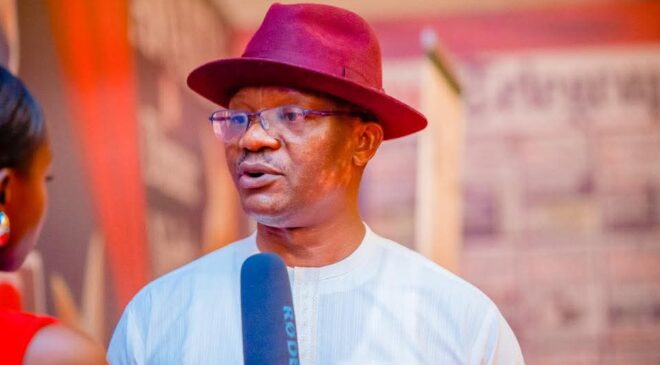
Commissioner for Works (Rural Roads) and Public Information, Mr. Charles Aniagwu, made the assertion during an appearance on “Politics Tonight” on TVC, where he reeled out what he described as sweeping accomplishments in infrastructure, security, fiscal management and rural development under the current administration.
According to Aniagwu, Governor Oborevwori has maintained an unbroken focus on governance despite political permutations, pushing forward major infrastructure projects across the three senatorial districts.
“The election is not stopping him; campaigns are not stopping him in any way. He is progressing very speedily and steadily with the promises he made,” Aniagwu said, stressing that visible development across the state has become the administration’s strongest campaign message.
He identified improved security as one of the most significant gains recorded in nearly three years of the administration, noting that sustained peace has enhanced investor confidence.
“One major achievement is the security of lives and property across Delta. That is why investors are coming in. We have demonstrated that Delta can be peaceful and safe,” he stated.
Providing updates on landmark infrastructure, the commissioner disclosed that top construction firms, including Julius Berger, are handling several strategic projects in Warri and its environs. Beyond the three major bridges, works at the DSC Roundabout Bridge, Enerhen Junction Bridge, PTI Junction Bridge and the slipway at Effurun Roundabout have reshaped traffic flow in the area.
He added that additional projects have been awarded to the firm at Uromi Junction in Agbor, Ika South Local Government Area, Otovwodo Junction in Ughelli North, as well as road expansions towards the Nigerian Ports Authority axis. While the DSC Roundabout and Enerhen Junction bridges are already in use, the PTI Junction Bridge is nearing completion.
Aniagwu also highlighted the completion of the 137-kilometre stretch from Koka Junction in Asaba to Ughelli, a development he said has reduced travel time to Warri to approximately one hour and fifty minutes, significantly improving connectivity within the state.
Other ongoing projects include the over 30-kilometre Ohoror–Bomadi Road, the Aboh–Akarai Road and Bridge in Ndokwa East valued at nearly N30 billion, and the delivery of 15 bridges and access roads in riverine communities in Ode Itsekiri. He noted that reputable firms such as CCECC and Levant Construction are equally engaged in project delivery across various zones.
Explaining the structural reforms behind the infrastructure push, Aniagwu said the creation of the Ministry of Works (Rural Roads) and the Directorate of Riverine Infrastructure was designed to fast-track development in rural and riverine communities, complementing interventions by DESOPADEC.
On equitable project distribution, he disclosed that Governor Oborevwori introduced a policy allocating specific funds to each of the 25 local government areas. In the 2024 budget, N1 billion was earmarked per council, amounting to N25 billion statewide. The allocation rose to N2.1 billion per local government in 2025 and was further increased to N3 billion for 2026, alongside an additional N4 billion intervention fund per council, bringing the total to N7 billion per local government.
“There is no single state with that kind of specific provision for their local governments,” Aniagwu asserted, noting that these allocations are separate from other sectoral budgetary provisions.
To ensure quality assurance, he said the governor personally inspects projects and enforces strict compliance with engineering standards. He disclosed that a whistleblower policy has been introduced, enabling residents to report substandard work directly to the governor through a dedicated WhatsApp line.
“The number is managed by the governor himself. Citizens send information, and action is taken immediately. Contractors are queried where necessary,” he said, adding that the administration has also banned indiscriminate mixing of concrete on tarred roads and pavements to safeguard structural integrity.
Beyond road infrastructure, Aniagwu cited erosion control, flood mitigation and environmental management efforts, including the construction of storm drainage systems in urban centres such as Asaba and Warri. Beautification initiatives, tree planting and installation of solar-powered streetlights on major and inner roads, he said, have improved security and enhanced the state’s aesthetic appeal.
On federal collaboration, he commended the Federal Government for ongoing works on access roads to the Second Niger Bridge and the Benin–Asaba corridor, including concrete pavement construction between the Head Bridge and Summit Junction, as well as progress from the Benin axis towards Sapele.
Addressing economic diversification, Aniagwu disclosed that the state government has opened access to the River Niger corridor near Government House, Asaba, with a dual carriageway leading to the riverbank as part of its blue economy initiative.
Maintaining that prudent resource management remains central to the administration’s stability, Aniagwu said Delta’s financial health is anchored on discipline rather than revenue size.
“We are solvent not because we receive more than other states, but because we manage our resources judiciously and deliver results,” he stated.
He expressed confidence that Governor Oborevwori’s record of performance would ultimately shape voter decisions, insisting that development projects and improved governance across the length and breadth of Delta State have placed the administration on a strong political footing.