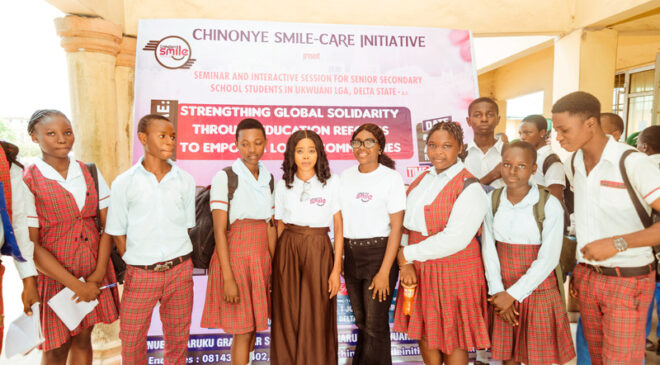
OBIARUKU/Nigeria: The Chinonye Smile-Care Initiative has again drawn attention to the state of secondary education in Ukwuani Local Government Area with the successful hosting of its 8th Annual Seminar and Interactive Session for senior secondary school students, as participants made strong calls for urgent reforms to improve learning conditions.
The programme, held recently at the Obiaruku Grammar School Hall, Obiaruku, brought together students from public secondary schools across Ukwuani, alongside educators, security personnel, health and legal professionals, community leaders and other stakeholders. Proceedings opened with prayers and the recognition of invited guests, including representatives of the Nigeria Police Force.
Delivering a welcome address on behalf of the Delta State Commissioner for Education, Mrs. Rose Ezewu, the Chief Inspector of Education, Ukwuani LGA, Mrs. M. C. Agbaluwa, commended the students for their discipline and large turnout. She praised the Founder and Convener of the initiative, Maureen Chinonye Achugbue, for her consistency and dedication to teenage and youth development, describing the programme as a critical intervention in shaping the future of young people. She urged participants to open their minds to the lessons shared and formally declared the seminar open.
A goodwill message was delivered on behalf of the Ukwuani Local Government Chairman, Hon. Possible Ajede, through the Secretary to the Local Government, who applauded the initiative for its sustained commitment to education and youth development. He highlighted ongoing efforts by the council to promote literacy and digital inclusion, reaffirming the local government’s support for programmes that advance learning and lifelong education.
In her keynote address, Achugbue reaffirmed the Initiative’s commitment to education, moral reorientation and community development, describing the seminar as a platform built on purpose, continuity and impact. She aligned the engagement with global development goals related to education, health, gender equity and strong institutions, noting that education must go beyond classroom instruction to include character building, emotional resilience and life skills.
Speaking on the theme, “Strengthening Global Solidarity through Education Reforms to Empower Local Communities,” she identified challenges such as poor learning environments, declining moral values, weak parental involvement and limited community engagement. She called for stronger collaboration among parents, teachers, community leaders and government institutions, while commending Delta State Governor, Sheriff Oborevwori, for prioritising development through the MORE Agenda. Addressing the students, she encouraged them to believe in their potential, speak up for their needs and remain focused on their goals.
The technical session on mental health awareness was delivered by Chiara Theodore Ikenna, Registrar, Department of Public Health, Federal Medical Centre, Asaba. He highlighted the importance of mental wellbeing among adolescents, discussing common challenges such as anxiety, depression and substance abuse, and stressed early detection, healthy coping mechanisms and school-based support as key to academic success and social stability.
Representing the Commissioner for Humanitarian Affairs and Girl-Child Support Services, Hon. Orode Uduaghan, Miracle Arimobi delivered a keynote address emphasizing education as a powerful tool for empowerment, identity formation and global competitiveness. She advocated reforms focused on digital literacy, critical thinking, entrepreneurship and strong moral values, calling for collective action among government, schools, families, civil society and the private sector.
The interactive panel session featured discussions on education as a driver of community development and self-discovery as a pathway to resilience. Panelists, including SP Bright Edafe, Barrister Osagu Collins and Dr. Ikenna, shared personal experiences on the transformative power of education, the dangers of ignorance and the importance of determination and self-belief. Students actively engaged the panel, raising concerns over the lack of classrooms, laboratories, libraries, ICT facilities, teachers, security, water supply and sporting equipment in their schools.
SP Bright Edafe cautioned students against dismissing education, describing it as fundamental to personal growth and societal development. He shared real-life experiences from policing to illustrate how lack of education often fuels crime and social crises. Barrister Osagu Collins also stressed that education remains the strongest form of sustainability, capable of changing life trajectories regardless of background.
Students from secondary schools in Obiaruku, Ebedei, Akoku-Ebedei and Obinomba spoke candidly about their learning conditions, calling for improved infrastructure, more teachers, better laboratories, libraries, security and exposure to academic and extracurricular opportunities.
The programme concluded with policy recommendations urging increased attention to secondary education, improved teachers’ welfare, stronger monitoring of education administration, closer teacher-student engagement and the introduction of continuous guidance, counselling and life-skills programmes. Closing remarks and prayers were delivered on behalf of the Chinonye Smile-Care Initiative, as teachers and community stakeholders commended the platform for giving students a voice and spotlighting grassroots education challenges.