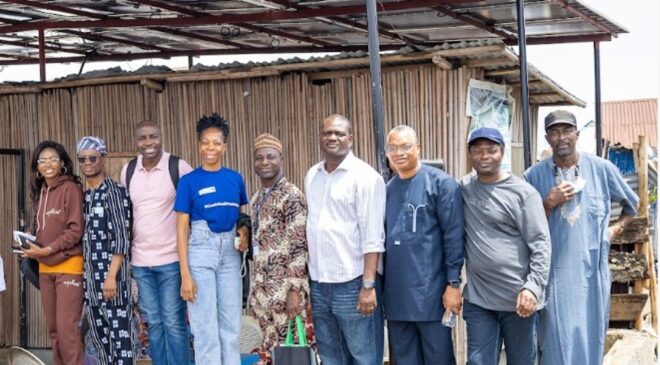
LAGOS/Nigeria: Fish processors in Sagbokoji, a coastal community in Lagos State’s Amuwo-Odofin Local Government Area, have received a significant boost to their livelihoods following the expansion of a solar-powered cold storage facility expected to reduce fish spoilage, improve incomes and promote cleaner energy use in the local fishing industry.
The upgraded facility, powered entirely by renewable energy, is designed to address one of the community’s biggest challenges—preserving fresh fish in a settlement where access to reliable electricity remains limited. By increasing cold storage capacity, the project is expected to strengthen the local fish value chain while reducing dependence on traditional preservation methods that rely on charcoal and firewood.
Implemented under the Global Environment Facility Small Grants Programme (GEF-SGP) of the United Nations Development Programme (UNDP), the intervention builds on an earlier solar-powered preservation project introduced in the community in 2024. The latest upgrade introduces a three-horsepower cooling system supported by solar panels, battery storage and inverter technology, enabling users to store larger quantities of fish without interruption.
Project officials said the expansion was driven by increasing demand from women engaged in fish processing, whose businesses had outgrown the capacity of the existing solar-powered freezers installed in the riverine community located opposite Tin Can Island.
Speaking during the inauguration on Tuesday, GEF-SGP Programme Assistant, Mrs. Rose Agbo, said the initiative reflects the programme’s commitment to supporting environmentally sustainable livelihood projects while responding to the practical needs of local communities.
She explained that the upgraded cold room now operates exclusively on solar energy, allowing beneficiaries to preserve more fish while lowering operational costs associated with conventional energy sources.
Agbo added that the GEF-SGP currently supports more than 200 community-based projects across over 30 states of the federation, with interventions focused on environmental protection, renewable energy and sustainable livelihoods.
Chairman of the Nigeria Energy Forum (NEF), Dr. Daniel Adeuyi, described the project as evidence that clean energy solutions can produce measurable social and economic benefits when deployed at the grassroots level.
According to him, improved cold storage facilities will not only reduce post-harvest losses but also strengthen food security, improve household incomes and encourage wider adoption of renewable energy technologies in underserved communities.
He stressed the need for stronger collaboration among development partners, host communities and project implementers to guarantee the long-term sustainability of similar initiatives across the country.
Also speaking, NEF Co-Chair and former President of the Nigerian Institute of Electrical and Electronic Engineers (NIEEE), Mr. Adekunle Makinde, expressed satisfaction with the community’s acceptance of the project, noting that beneficiaries had demonstrated both the functionality of the facility and their willingness to manage it responsibly.
The President of the NIEEE, Mr. Felix Adeboye, urged governments, private organisations, philanthropists and development agencies to replicate renewable energy projects in more rural and riverine communities, saying such interventions have the potential to transform local economies while addressing energy poverty.
He commended residents of Sagbokoji for embracing the initiative, observing that the success of community-based development projects often depends on the willingness of beneficiaries to take ownership of the facilities provided.
On behalf of the beneficiaries, leader of the Fish Sellers Association, Mrs. Jiselle Azankpo, described the expanded cold room as a major relief for fish processors, saying the facility had already been tested and found to be operating efficiently.
She assured stakeholders that members of the association would ensure proper maintenance of the facility to guarantee its sustainability and continued benefit to the community.
For years, fish processors in Sagbokoji depended largely on charcoal and firewood to preserve their catch—a method that not only increased operating costs but also contributed to environmental degradation and significant post-harvest losses. Stakeholders believe the upgraded solar-powered cold room marks another step towards improving livelihoods, enhancing food preservation and expanding access to clean energy solutions in Nigeria’s coastal communities.