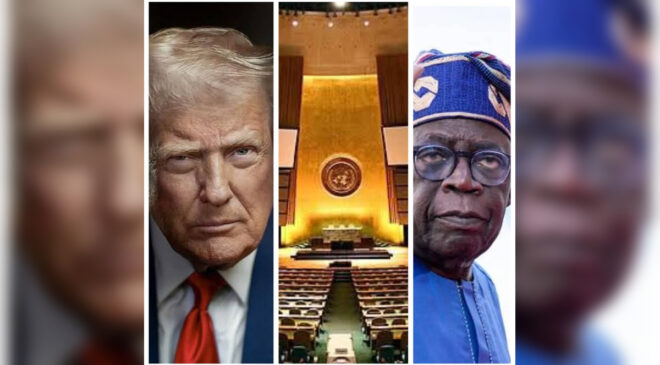
ABUJA/Nigeria: Questions surrounding President Bola Tinubu’s personal participation in major international diplomatic gatherings have resurfaced following a demand by African Democratic Congress (ADC) chieftain, Chief Eze Chukwuemeka Eze, for greater transparency over Nigeria’s representation at the United Nations General Assembly.
Eze, a media consultant and former National Publicity Secretary of the defunct New Peoples Democratic Party (nPDP), expressed concern over Tinubu’s absence from the 81st session of the United Nations General Assembly in New York, where Vice President Kashim Shettima led Nigeria’s delegation.
In a statement dated September 28, 2026, Eze questioned the President’s decision not to attend the annual gathering personally, arguing that direct engagement between heads of government provides opportunities to strengthen diplomatic relations, pursue investment and advance national interests.
The ADC chieftain observed that Tinubu had not personally attended the General Assembly in 2024, 2025 or 2026, with Shettima representing Nigeria on those occasions.
He maintained that although the Vice President could legitimately represent the country, the Presidency should explain the considerations informing the repeated delegation of the assignment.
Eze also raised questions about the Federal Government’s diplomatic engagements with the United States, particularly its efforts to strengthen bilateral relations and explore economic cooperation.
He questioned whether previously discussed diplomatic and investment initiatives had progressed as anticipated and called for greater public disclosure of the outcomes.
The politician referred to Tinubu’s September 18 meeting with French President Emmanuel Macron in Paris, contrasting it with the Nigerian President’s decision not to travel to New York for the UN gathering.
Eze argued that the President’s personal attendance at major international events could provide opportunities for direct discussions with other world leaders.
He acknowledged that Shettima was constitutionally capable of representing the President but maintained that Nigerians deserved an explanation of the administration’s approach to international diplomatic engagements.
The Federal Government, however, had earlier addressed concerns about Tinubu’s absence, explaining that the Vice President attended the General Assembly with the President’s full mandate.
In a statement issued through the Federal Ministry of Information and National Orientation on September 21, the government said Nigeria would be fully represented throughout the high-level session.
The Presidency separately explained that Tinubu was on a working vacation in Europe, during which he continued to discharge presidential responsibilities and undertake engagements, including meetings in France.
Shettima subsequently delivered Nigeria’s national statement at the General Assembly on September 24, renewing the country’s demand for reform of the United Nations Security Council and greater representation for Africa.
Nigeria’s delegation also participated in discussions covering international cooperation, economic development and other issues affecting the country’s interests.
Despite those engagements, Eze maintained that the Presidency should provide further information about its diplomatic priorities and the circumstances surrounding Tinubu’s decision to delegate attendance at the annual gathering.
He called for greater transparency regarding Nigeria’s international engagements and the outcomes of the government’s diplomatic initiatives.