By Mokobia Rita.
Asaba/Nigeria: For many Nigerians, the debate about governance is no longer simply about what governments promise, but about what ordinary people can actually feel in their homes, businesses and communities.
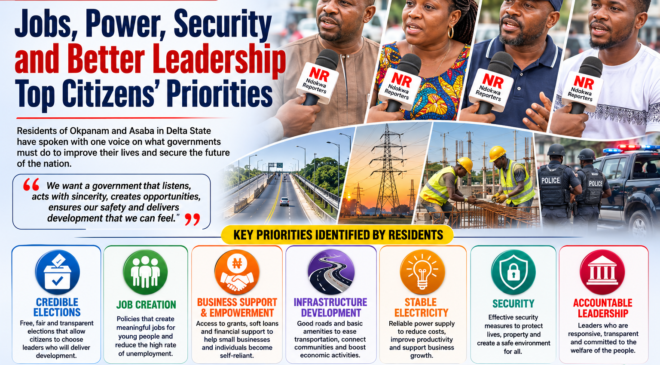
Across Okpanam and Asaba in Delta State, conversations with residents from different walks of life reveal a strikingly similar picture. At a time when households are confronting rising economic pressures and businesses are struggling with operating costs, residents say they want government to focus less on rhetoric and more on practical measures capable of improving their daily lives.
Their concerns range from credible elections and accountable leadership to employment, access to finance, roads, electricity and security. Although the respondents differ in age, occupation and circumstances, many of their expectations converge around one central demand: government should create the conditions that enable people to work, earn a living and live safely.
For Mr. Igwe Nwakam, a resident of Okpanam, the quality of governance begins with the process through which leaders emerge.
He believes Nigerians must be allowed to choose their representatives through elections that are free from vote-buying, intimidation and manipulation.
Nwakam argues that when voters are able to make independent choices, the country stands a better chance of producing leaders capable of confronting its developmental problems.
His position is shared by Mr. Ome Igbator, an engineer based in Asaba, who sees credible elections as a foundation for effective governance.
According to Igbator, public confidence in government institutions is difficult to sustain where citizens believe that electoral outcomes do not reflect their choices. He believes credible elections could improve the prospects of competent leaders emerging and, ultimately, influence the quality of policies on employment, infrastructure, electricity and economic development.
But while questions about leadership and elections remain important, the economic concerns expressed by residents are considerably more immediate.
Mrs. Chiamaka Ndin, a resident of Okpanam, says access to capital is one of the obstacles preventing many people, particularly women and unemployed persons, from becoming economically independent.
She points out that there are people with skills and viable business ideas who remain unable to translate them into sustainable livelihoods because they lack the resources to start or expand their businesses.
For Ndin, properly designed grants, soft loans and empowerment programmes could make a significant difference.
Her argument goes beyond simply giving people money. She believes effective economic empowerment should create the capacity for beneficiaries to establish businesses that can generate continuing income rather than depend permanently on government assistance.
That concern is echoed by businessman Mr. Chika Nwaore, who says existing businesses are themselves under pressure.
Rising operating expenses and the wider economic uncertainty, he says, are making it increasingly difficult for entrepreneurs to maintain their businesses, let alone expand them and employ additional workers.
His solution is stronger financial support mechanisms for small and medium-sized enterprises.
For Nwaore, supporting businesses is not merely about helping individual entrepreneurs. It is also an indirect way of creating jobs and stimulating economic activity within communities.
The employment question becomes even more significant when viewed through the experiences of young people.
Comrade Clever Johnson, a businessman and community resident, believes the shortage of meaningful employment opportunities leaves many young people economically vulnerable.
He argues that government policies should deliberately create an environment in which businesses can expand and employ more people, rather than relying exclusively on public-sector employment.
The concern is particularly relevant to young people who have acquired skills but cannot find opportunities to use them.
Mr. Uzoma Madu, a bricklayer, says many young Nigerians are willing to work but are constrained by a shortage of opportunities.
For him, employment programmes must go beyond training. Young people need actual avenues through which their skills can be converted into income.
The implication, he suggests, is that training a young person without creating an environment in which that person can find work or establish a business only addresses part of the problem.
The infrastructure burden
The economic concerns raised by the residents also lead directly to another issue: infrastructure.
For people running businesses, poor roads are not simply an inconvenience. They can affect the cost and speed of transporting goods, connecting with customers and reaching markets.
Nwaore argues that road infrastructure should therefore be regarded as an economic investment rather than merely a construction project.
Johnson similarly wants improved roads and basic amenities that can strengthen connections between communities and make commercial activity easier.
The underlying argument is straightforward: when roads are functional, people and goods can move more easily, businesses can reach wider markets and economic activities can expand.
Electricity presents another side of the same problem.
For artisans and small businesses, unreliable power supply can mean additional expenditure on alternative sources of electricity.
Mr. Uchenna Uguru, a welder, says the cost of operating without dependable public electricity directly affects productivity.
According to him, stable power would reduce the amount businesses spend on alternative energy, improve efficiency and give entrepreneurs greater opportunity to expand.
His concern points to a broader relationship between infrastructure and economic growth. A business may have customers, workers and a viable product, but unreliable electricity can still make its operations more expensive and less competitive.
Uguru therefore wants sustained investment in electricity generation, transmission and distribution to improve the reliability of supply.
Security and the ability to do business
The residents also see security as inseparable from economic development.
Madu says people cannot confidently invest, operate businesses or pursue their livelihoods where they are constantly worried about their safety.
For him, protecting lives and property should remain a fundamental responsibility of government.
A secure environment, he argues, provides the confidence necessary for people to invest and for businesses to operate without the additional burden created by fear and uncertainty.
The concerns expressed by the residents therefore form an interconnected picture rather than isolated demands.
A business owner struggling with electricity costs may also be affected by poor roads. A skilled young person may remain unemployed because businesses cannot expand. A woman with a viable business idea may be unable to proceed because she lacks capital. And all of these economic activities depend on a secure environment and a governance system that citizens trust.
Beyond promises
What emerges from the interviews is not a demand for government to solve every problem overnight. Rather, the residents appear to be asking for policies that produce visible and measurable results.
They want credible elections because they believe the quality of leadership matters. They want access to finance because capital can turn skills and ideas into businesses. They want jobs because employment provides a sustainable means of livelihood. They want roads and electricity because businesses cannot function efficiently without basic infrastructure. And they want security because economic activity cannot flourish where lives and property are at risk.
The findings from Okpanam and Asaba cannot, on their own, be presented as a scientific representation of the views of Nigerians across the country. The interviews were qualitative and involved selected residents rather than a statistically representative sample.
But the consistency in the concerns expressed by people from different occupations is significant.
For government, the message from these residents is clear: the real measure of governance is increasingly being found in the everyday experiences of citizens — whether they can find work, keep a business alive, move their goods, power their equipment, protect their families and participate in choosing the leaders who govern them.
As Nigeria prepares for another electoral cycle and governments continue to formulate economic and development policies, those everyday experiences may ultimately prove more important to citizens than the promises made from political platforms.