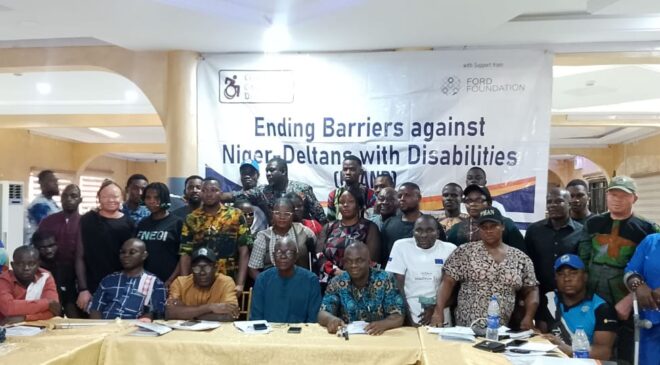
AWKA/Nigeria: The Centre for Citizens with Disabilities (CCD) has called for the full inclusion of Persons with Disabilities (PWDs) in the implementation and benefit structures of the Petroleum Industry Act (PIA) 2021 across oil-producing communities in the Niger Delta, including Anambra State.
The organisation made the call in Awka during a two-day capacity-building workshop organised by CCD with support from the Ford Foundation, aimed at empowering Persons with Disabilities to actively participate in advocacy surrounding the implementation of the PIA.
Speaking at the workshop themed, “Ending Barriers Against Niger Deltans with Disabilities,” Acting Director of CCD, Mr. Godwin Unumeri, expressed concern that despite provisions such as the Host Community Development Trusts under the Petroleum Industry Act, Persons with Disabilities remain largely excluded from the benefits and opportunities created by the law.
He described the exclusion as discriminatory and contrary to both national disability laws and international conventions protecting the rights of Persons with Disabilities.
According to Unumeri, Anambra State’s recent emergence as an oil-producing state presents enormous opportunities for economic growth, increased revenue generation, infrastructure development and employment creation, but also raises fears over environmental degradation and the possible marginalisation of vulnerable groups.
“PWDs are disproportionately affected by environmental degradation resulting from oil exploration, yet they are not included in the PIA benefit framework,” he said.
He explained that the workshop was designed to equip participants with the knowledge, advocacy skills and practical tools needed to demand their rightful inclusion in the implementation of the Petroleum Industry Act.
Unumeri stressed that development policies in the oil and gas sector must deliberately accommodate vulnerable populations to ensure fairness, equity and sustainable community development.
Also speaking, Ms. Blessing Ononogbu of CCD described disability as a long-term physical, mental, intellectual or sensory impairment which, when combined with societal barriers, limits the ability of individuals to participate fully and equally in society.
She cited a 2018 World Bank estimate showing that about 29 million Nigerians live with one form of disability, noting that the figure continues to rise due to violent conflicts, road accidents, insecurity and poor healthcare systems.
According to her, Persons with Disabilities remain among the groups most severely affected by the activities of oil and gas exploration, with many losing their traditional means of livelihood and access to economic opportunities.
“They require deliberate care and support to access services that are rightfully theirs,” she stated.
In her presentation, Senior Programme Officer at CCD, Ms. Florence Attah, reaffirmed the organisation’s commitment to advancing disability rights through advocacy, policy engagement and capacity development programmes.
Attah said the centre remained focused on empowering Persons with Disabilities to demand accountability and secure their rightful place within development policies and benefit frameworks, including those created under the Petroleum Industry Act.
In his remarks, Chairman of the Joint National Association of Persons with Disabilities (JONAPWD), Anambra State Chapter, Mr. Ugochukwu Okeke, commended CCD for championing inclusive development and advocating for the protection of the rights of Persons with Disabilities.
Okeke expressed optimism that participants at the workshop would acquire the necessary knowledge and confidence to effectively engage relevant stakeholders and advocate for their inclusion in the implementation of the Petroleum Industry Act across oil-producing communities.