Photo: Bripin Enarusai
By Mokobia Rita.
ASABA/Nigeria: Delta State Governor, Rt. Hon. Sheriff Oborevwori, has intensified efforts to improve learning conditions in public schools across the state with the phased production and distribution of thousands of new classroom furniture for primary and secondary schools.
The large-scale intervention, currently being implemented across the three senatorial districts of the state, is part of the administration’s broader education renewal agenda aimed at strengthening public education infrastructure and creating a more conducive learning environment for pupils and students.
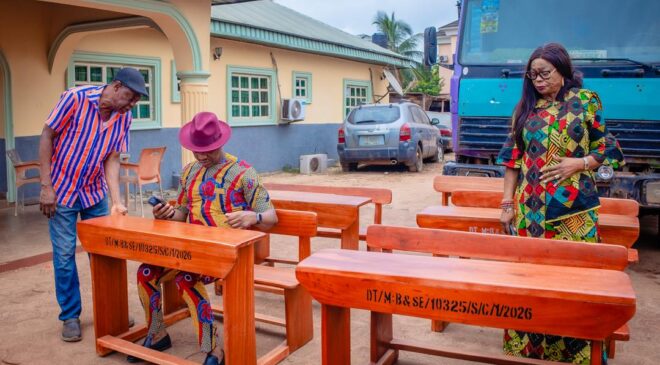
Speaking during an inspection visit to Setal Consolidated Enterprises, the company handling the production and supply of the furniture, the Commissioner for Works (Rural Roads) and Public Information, Mr. Charles Aniagwu, said the Oborevwori administration remains committed to addressing critical gaps within the state’s education sector through strategic and data-driven interventions.
Aniagwu disclosed that shortly after assuming office, Governor Oborevwori ordered a comprehensive statewide assessment of public school facilities to determine the true condition of classrooms, laboratories, furniture, libraries and other learning infrastructure across Delta State.
According to him, the assessment revealed widespread infrastructural deficiencies in many schools, including worn-out furniture, dilapidated classrooms, damaged laboratories and inadequate learning facilities resulting from years of usage, rising student population and, in some cases, vandalism.
“The governor did not act based on assumptions,” Aniagwu stated. “He first directed proper investigation and assessment of the condition of schools across the state. Since then, interventions have continued every year, focusing not only on classroom renovation and construction but also on furniture, laboratories, libraries and other learning facilities.”
He explained that the current furniture initiative was designed to restore dignity to the learning environment and ensure that pupils and students no longer study under uncomfortable and overcrowded classroom conditions.
Aniagwu emphasized that the governor specifically directed that quality standards must not be compromised in the production process, a decision which informed the engagement of a contractor with proven competence and capacity to deliver durable products according to approved specifications.
“The governor insisted that if we must provide furniture for our children, it must be durable and of high quality,” he said. “That is why the government chose a company that has demonstrated capacity to deliver according to specification.”
The commissioner further disclosed that the distribution process would be implemented in phases and guided strictly by verified needs assessments conducted by the Ministries of Primary and Secondary Education.
According to him, allocation of the furniture would not be influenced by political considerations or arbitrary sharing arrangements, but by the actual needs and existing realities within individual schools.
“A school with a larger population may receive fewer chairs than another if it already has functional furniture,” Aniagwu explained. “The essence is not politics; the essence is to close identified gaps and ensure fairness.”
He also revealed that Governor Oborevwori had introduced stricter monitoring and project verification mechanisms aimed at eliminating politically motivated project nominations that previously led to misplaced interventions in schools without urgent needs.
“In the past, some individuals nominated projects simply to favour contractors or political interests,” he said. “But the governor has stopped that system completely. Today, interventions are based on professional assessment and verified realities.”
Aniagwu dismissed what he described as deliberate attempts by critics to portray the state’s public schools negatively through misleading social media narratives and selective images of abandoned structures.
According to him, many of the buildings being circulated online are not currently in active use and do not reflect the broader interventions already ongoing across schools in the state.
“Government is not interested in cosmetic propaganda,” he noted. “What matters is ensuring that our children have conducive spaces to learn.”
The commissioner stressed that the Oborevwori administration’s education reforms extend beyond physical infrastructure, noting that teacher recruitment, provision of instructional materials and broader learning support systems also remain central priorities of government.
He disclosed that Delta State currently operates over 1,200 public primary schools and about 500 public secondary schools, describing the responsibility as enormous but essential for the future development of the state.
“We are not just building schools,” Aniagwu said. “We are also employing teachers, supplying learning materials and improving educational standards because Governor Oborevwori understands that education remains one of the strongest investments any government can make.”
Also speaking, the Commissioner for Primary Education, Mrs. Rose Ezewu, confirmed that the ministry had completed inventory and needs assessments of schools requiring classroom furniture through its planning and research department.
She assured that distribution would strictly reflect verified student population and classroom requirements across benefiting schools.
“We are being very careful with the distribution,” she said. “Furniture meant for 500 pupils cannot be sent to a school with only 200 pupils. Every allocation will reflect verified realities on ground.”
Ezewu also dismissed claims suggesting that some schools in the state had been abandoned, insisting that many of the structures being highlighted publicly were not presently needed for academic activities.
Meanwhile, Managing Director of Setal Consolidated Enterprises, Chief Suru Salami, assured the state government that production of the classroom furniture was progressing steadily and according to schedule.
Salami disclosed that the company was currently handling about 3,800 units of classroom furniture, with over 2,600 units already completed. He added that the remaining units would soon be finalized while distribution would commence immediately the government releases the approved deployment list.
“We are committed to quality delivery and accountability,” Salami stated. “Every supply will be properly documented with records and photographs to ensure transparency.”
Accompanying the commissioners during the inspection visit were the Functioning Permanent Secretary, Ministry of Basic and Secondary Education, Mrs. Patricia Iniovosa-Okakwu; Director of PRS Department, Mr. Ernest Ossai; and other senior government officials.
Beyond the ongoing production and distribution exercise, stakeholders say the intervention represents a broader effort by the Oborevwori administration to restore confidence in public education and improve learning outcomes for children across Delta State.