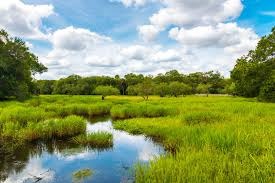
LAGOS/Nigeria: Environmental experts and conservation advocates have raised concerns over the increasing incidence of flooding in Lagos State, attributing the situation largely to unchecked encroachment on wetlands, poor urban planning and weak enforcement of environmental regulations.
The stakeholders, who spoke in separate interviews with the News Agency of Nigeria (NAN), urged authorities to strengthen environmental protection measures, enforce existing laws and promote sustainable urban development to safeguard the state’s fragile ecosystems and reduce the devastating impact of recurrent flooding.
Executive Director of the Renevlyn Development Initiative, Mr. Philip Jakpor, described the indiscriminate construction of buildings on wetlands as one of the major drivers of flooding across Lagos.
According to him, wetlands serve as natural buffers that absorb excess rainwater and help minimise the impact of heavy rainfall, but their continued destruction has disrupted the natural drainage system.
“The wetlands are supposed to serve as buffers that absorb excess water from the rains. When structures obstruct water from their path, it naturally causes havoc elsewhere,” Jakpor said.
He alleged that some estates and other developments were being permitted in environmentally sensitive areas, warning that nature would inevitably respond when natural water channels are blocked.
Also speaking, environmentalist Mr. Michael Simire called for stronger collaboration among government agencies, environmental regulators and other stakeholders involved in wetland management.
Simire noted that Lagos wetlands had undergone significant changes over the past three decades due to rapid urbanisation and increasing demand for land.
He said the pressure for development had resulted in widespread wetland reclamation, excessive dredging, sand-filling of lagoon shores, deforestation and encroachment on natural drainage channels, all of which have contributed to environmental degradation and increased flood risks.
To reverse the trend, Simire advocated the integration of wetlands into urban planning policies, landscape development frameworks and water management systems.
He also recommended mandatory environmental impact assessments for projects affecting wetlands, as well as regular mapping and inventory exercises to support conservation efforts and informed decision-making.
Similarly, Biodiversity Pillar Lead at the Nigeria Conservation Foundation (NCF), Dr. Stella Egbe, stressed that environmental conservation and real estate development could coexist if sustainability principles were incorporated into planning processes.
While acknowledging the importance of the real estate sector in addressing Lagos’ housing deficit, she maintained that development should not come at the expense of critical ecosystems.
“The real estate industry is an essential one as we tackle housing deficits. However, developmental needs do not have to be in discordance with nature, and incorporating sustainability is important,” she said.
Egbe urged developers to adopt environmentally responsible designs and called on corporate organisations to integrate wetland conservation into their operational strategies and corporate social responsibility programmes.
She also commended Lagos State for identifying key wetlands requiring protection and urged authorities to intensify enforcement efforts to preserve the state’s natural flood-control infrastructure.
Meanwhile, Director of Public Affairs at the Lagos State Ministry of the Environment and Water Resources, Mr. Adekunle Adeshina, disclosed that the government had stepped up monitoring and compliance activities to curb illegal encroachment on wetlands.
Adeshina said developers involved in unauthorised reclamation and construction activities on wetlands were being served statutory notices and given 48 hours to cease operations or face enforcement action.
He revealed that the state government recently sealed nine facilities linked to illegal wetland encroachment in Ogombo, Lekki Phase II, the Itoikin-Epe axis and Majidun in Ikorodu.
According to him, the move was aimed at preventing further degradation of environmentally sensitive areas and preserving the ecological functions of wetlands.
The experts unanimously agreed that stronger law enforcement, increased public awareness, sustainable urban planning and greater stakeholder collaboration remain crucial to protecting Lagos wetlands and mitigating the growing threat of flooding across the state.