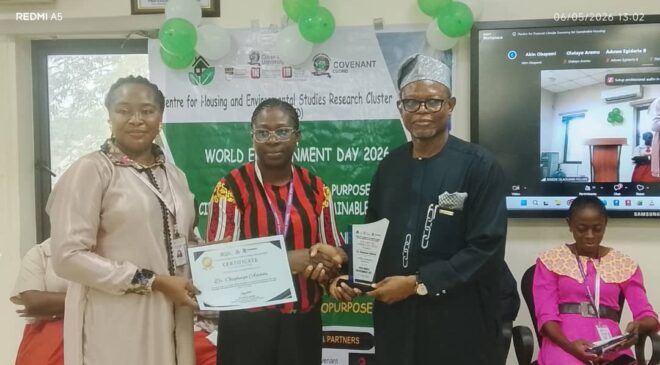
OTA/Nigeria: The National President of the Association of Waste Managers of Nigeria (AWAMN), Dr. Olugbenga Adebola, has called for the adoption of circular economy principles to transform Nigeria’s growing plastic waste challenge into opportunities for affordable housing, clean energy generation, job creation and sustainable economic development.
Adebola made the call during a presentation at the Centre for Housing and Environmental Studies, Covenant University, Ota, as part of activities marking the 2026 World Environment Day celebration.
The waste management expert said Nigeria has the potential to address both its mounting waste disposal problems and housing deficit by converting plastic waste into valuable construction materials and alternative energy products through recycling and innovative technologies.
According to him, waste should no longer be viewed as a nuisance but as an economic resource capable of generating wealth, improving public health and promoting environmental sustainability.
“Waste is not waste until it is wasted. We do not have a waste problem; we have a resource misplaced in the wrong place and in the wrong hands,” he said.
Adebola urged Nigerians to abandon indiscriminate waste disposal practices and embrace waste segregation at source to improve recycling efficiency and resource recovery.
He explained that waste could generally be classified into recyclables, combustibles and compostables, adding that materials such as plastics, paper, glass, aluminium and textiles can be processed into new products, while other waste streams can be converted into energy and organic resources.
The AWAMN President identified plastic pollution as one of Nigeria’s most pressing environmental challenges, particularly in urban centres such as Lagos, where indiscriminate disposal of plastic waste frequently blocks drainage channels and waterways, leading to flooding and environmental degradation.
He painted a vision of cities where drains and waterways remain free of waste because recyclable materials are collected and processed directly from households, markets and businesses.
According to him, effective waste management contributes significantly to environmental sustainability, public health and climate resilience.
He described efficient waste collection and recycling as a form of preventive healthcare, capable of reducing the prevalence of diseases such as malaria, cholera, food poisoning and other sanitation-related illnesses.
“Effective and efficient waste management is free healthcare service because it prevents diseases before they occur,” he stated.
Adebola further disclosed that plastic waste can be converted into biofuels and other alternative energy products capable of supporting Nigeria’s growing energy demands.
He noted that Nigeria generates over 60,000 tonnes of waste daily, with plastics accounting for a significant proportion of the total volume, while Lagos alone produces thousands of tonnes of waste every day.
A major highlight of his presentation was the showcase of prototype housing structures constructed from recycled plastic materials, which he described as durable, environmentally friendly and aesthetically appealing.
According to him, recycled plastics can be processed into building materials through thermoplastic technology and cement-based composite systems.
He explained that thermoplastic construction materials can contain as much as 70 per cent recycled plastic mixed with sand to produce durable building components suitable for housing projects.
Adebola said widespread adoption of recycled construction materials could significantly reduce environmental pollution while helping to address Nigeria’s housing deficit.
He commended the Centre for Housing and Environmental Studies, Covenant University, for promoting innovative solutions that integrate environmental sustainability with housing development.
The AWAMN President noted that Nigeria already has several policy frameworks supporting sustainable waste management and circular economy practices, including the National Environmental Policy on Solid Waste Management, the Extended Producer Responsibility framework and the Nigerian Circular Economy Roadmap launched in 2024.
Despite these policy initiatives, he expressed concern over weak implementation and enforcement.
“Nigeria has many good policies, but implementation remains a challenge,” he said.
He called for stronger enforcement mechanisms, improved standards and updated building regulations to encourage the use of recycled materials in the construction sector.
Adebola also advocated increased investment in recycling infrastructure, noting that plastic recycling remains capital-intensive because of the high transportation and logistics costs involved in collecting lightweight waste materials.
He urged government at all levels to provide incentives for recycling companies and developers investing in sustainable housing projects, while also promoting green building policies and circular housing systems.
According to him, government should consider mandating the use of recycled materials in selected housing and infrastructure projects, as is already being practised in several European countries.
The waste management expert also encouraged private developers to partner with waste collectors and recyclers to incorporate recycled materials into roofing sheets, partitions, pavements and other building components.
He disclosed that AWAMN has partnered with the Nigerian Armed Forces Resettlement Centre (NAFRC) to establish waste management and recycling training programmes for retiring military personnel, equipping them with practical skills in recycling and environmental entrepreneurship.
Adebola challenged universities and research institutions to intensify studies on the performance, durability and safety of recycled construction materials, stressing the need for stronger collaboration among researchers, industry operators and policymakers.
He said Nigeria must bridge the gap between academic research and practical implementation if it hopes to fully harness the economic and environmental benefits of the circular economy.
The AWAMN President further urged educational institutions to promote environmental awareness and waste management education among young people, noting that early exposure to sustainability values would help build a culture of responsible waste management.
Projecting a long-term vision for Nigeria, he said increased recycling and sustainable construction practices could reduce plastic pollution, create millions of jobs across the waste collection, recycling, manufacturing and construction sectors, and expand access to affordable housing.
He expressed confidence that Nigeria has the capacity to become a leading African model for integrating waste management with sustainable housing development.
“The time to transition from conventional housing to modular sustainable housing is now. Let us turn plastic waste into plastic purpose,” Adebola declared.
The event concluded with the presentation of an award to the AWAMN President in recognition of his contributions to environmental stewardship and sustainable waste management in Nigeria.