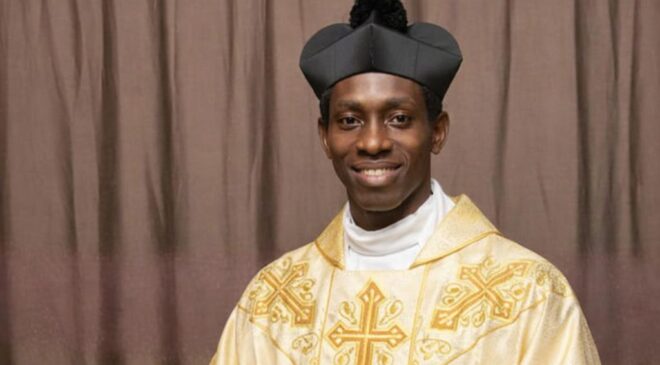
LAGOS/Nigeria: Prominent Nigerian cleric, legal scholar and democracy advocate, Very Rev. Fr. Benedict Ferife, has described the reported Federal High Court judgment nullifying the registration of the National Democratic Congress (NDC) as the inevitable consequence of the party’s failure to adhere to constitutional and statutory requirements, insisting that the crisis was “a self-inflicted wound” rather than an act of political persecution.
In a statement titled, “NDC’s Self-Inflicted Wounds: Why Due Process Matters in Democracy,” Ferife said the reported court decision should serve as a sobering reminder that democracy is sustained by strict compliance with the Constitution, the Electoral Act and the regulatory framework governing political parties, not by public sentiment or media narratives.
According to him, political parties have a legal obligation to comply with the constitutional guidelines established by the Independent National Electoral Commission (INEC), warning that the judiciary cannot be expected to shield political organisations from the consequences of their own procedural lapses.
“Democracy is sustained not by public sympathy or media narratives but by strict obedience to the Constitution, the Electoral Act and the rules governing political parties. The NDC’s present predicament is, sadly, not persecution. It is a self-inflicted wound,” he stated.
Ferife maintained that the 1999 Constitution of the Federal Republic of Nigeria (as amended) remains the supreme law of the land and is binding on all persons, institutions and political organisations without exception. Citing Section 1 of the Constitution, he argued that no political party or individual could legitimately operate outside the constitutional framework while expecting judicial protection.
The cleric also expressed concern over allegations that the party failed to observe internal democratic procedures by issuing nomination tickets to individuals who neither participated in nor emerged victorious from validly conducted party primaries. If proven, he said, such actions would amount to a direct violation of the Electoral Act, 2022.
He noted that Sections 82, 83 and 84 of the Electoral Act require political parties to notify INEC before conducting primaries, allow the electoral body to monitor the exercise, and ensure that candidates emerge through transparent and democratic processes. Likewise, he said, Section 223 of the Constitution mandates political parties to operate in accordance with democratic principles.
“These provisions are not mere technicalities; they are legal safeguards designed to prevent impunity, candidate imposition and abuse of the democratic process. Democracy must first be practised within political parties before it can be credibly preached to the nation,” he said.
Ferife placed responsibility for the party’s current legal troubles squarely on its national leadership, arguing that the disregard for due process during candidate selection inevitably exposed the party to legal challenges.
“One cannot ignore due process during party primaries, impose candidates, sideline legitimate aspirants and later seek the protection of the courts when the consequences of those actions become apparent. The judiciary is a guardian of the law, not an instrument for legitimising political shortcuts,” he added.
The transparency advocate warned that should the NDC eventually lose the opportunity to sponsor candidates in future elections, including the presidential poll, the responsibility would lie with those who failed to uphold constitutional procedures.
He urged all political parties in Nigeria to treat constitutional compliance, the Electoral Act, INEC’s guidelines and internal party democracy as non-negotiable pillars of democratic governance.
“Respect for the Constitution, the Electoral Act, INEC’s guidelines and internal party democracy is not optional—it is mandatory. The rule of law is impartial. It neither rewards popularity nor excuses procedural recklessness. Political parties that sow disregard for due process should not be surprised when they reap legal consequences,” Ferife concluded.