By Bon Peters
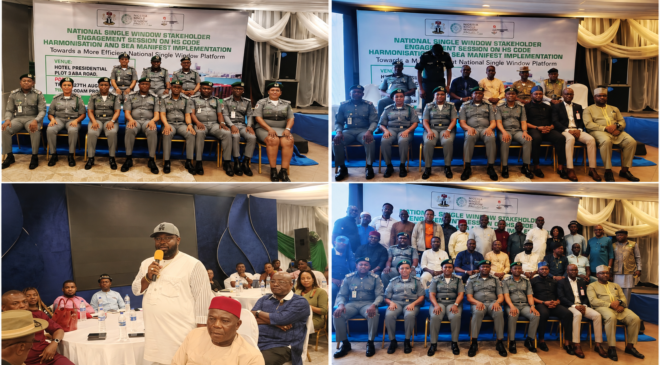
PORT HARCOURT/Nigeria: The implementation of Nigeria’s National Single Window (NSW) came under fresh scrutiny in Port Harcourt on Thursday as government agencies, customs brokers, freight forwarders and other players in the maritime sector examined operational challenges affecting the platform.
The stakeholders met at the Customs Zone C Headquarters, Port Harcourt, five months after the first phase of the electronic trade platform went live on March 27, 2026.
The engagement focused principally on the harmonisation of Harmonised System (HS) Codes and the implementation of sea manifests, with participants examining how the two areas could be better integrated into the system to facilitate cargo clearance and trade processes.
The Acting Assistant Comptroller-General and Zonal Coordinator, Customs Zone C Headquarters, ACG Pascal Chibuoke, said effective collaboration among the agencies and private-sector operators would be crucial to the success of the initiative.
Chibuoke, who welcomed participants to the forum, said the National Single Window was designed to provide a central electronic platform through which import and export processes involving government agencies and regulators could be coordinated.
He said the initiative was expected to reduce transaction costs and processing time while strengthening transparency in trade procedures.
But the Customs Zone C coordinator cautioned that technology alone would not guarantee the success of the project, stressing the need for sustained cooperation among the agencies and other users of the platform.
He said the Port Harcourt engagement offered an opportunity for regulators, importers, exporters, customs agents, freight forwarders, terminal operators and shipping companies to bring their experiences and concerns directly to the NSW team.
According to him, such feedback would help the operators of the platform determine how subsequent improvements would be designed, tested and deployed.
Speaking after the engagement, the Director of Operations, National Single Window, Peter Ekunkoya, said the project had been in development for about two and a half years, while the first phase was rolled out on March 27.
He explained that the meeting was part of a continuing stakeholder-feedback process initiated after the commencement of the platform.
Ekunkoya said the objective was not only to identify problems encountered by users but also to provide the project team with practical information that could be used to improve the system.
“We started it immediately we clocked three months to understand how the platform performed, what are the issues they are dealing with, give you some context feedback perspectives and listen to your complaints so that we can go and address them,” he said.
He disclosed that the simplification of HS Codes was among the areas receiving attention, adding that stakeholders should also expect further expansion of the platform as the next phase of the project approaches.
Ekunkoya said the team was already preparing for the next stage of implementation and would use lessons from the first phase to address identified gaps.
He acknowledged that some of the concerns raised during the Port Harcourt meeting were already known to the project team, while others had emerged for the first time.
“We have good insight of some of the challenges presented here today, but others I am hearing for the first time. But we promise to tackle all of them,” he said.
The NSW director commended the Nigeria Customs Service, participating government agencies and freight-forwarding associations for their cooperation, noting that their involvement was important to the development of a system that could work effectively for port users.
The forum included technical discussions and a question-and-answer session, during which participants raised concerns and sought clarification on aspects of the platform’s operation.
Some participants said they remained supportive of the National Single Window despite difficulties associated with its early implementation.
They expressed the expectation that a properly integrated electronic system would help reduce avoidable delays and improve the movement and clearance of cargo.
However, those expectations are dependent on the resolution of operational and regulatory challenges identified since the platform’s rollout.
The National Single Window has previously faced implementation issues linked to data migration, documentation gaps and overlapping regulatory responsibilities, although the project management has reported progress in resolving some of the early problems.
The Port Harcourt engagement was attended by representatives of the Nigeria Customs Service, NAFDAC, NDLEA, the Standards Organisation of Nigeria (SON), the Nigeria Agricultural Quarantine Service (NAQS), NESREA and the National Single Window team.
Also represented were the Association of Nigerian Licensed Customs Agents (ANLCA), National Association of Government Approved Freight Forwarders (NAGAFF), Association of Professional Freight Forwarders and Logistics of Nigeria (APFFLON), as well as other operators in the maritime and cargo-clearance sector.
Among the officials present were the Customs Area Controller, Area 1 Command, Port Harcourt, Comptroller Salamatu Atuluku; Customs Area Controller, Area 5 Command, Ibeto Seaport and Terminal, Comptroller Usman Yahaya; Comptroller Martala Mu’azu and Comptroller Aondona Christopher Fanyam, PhD, among others.