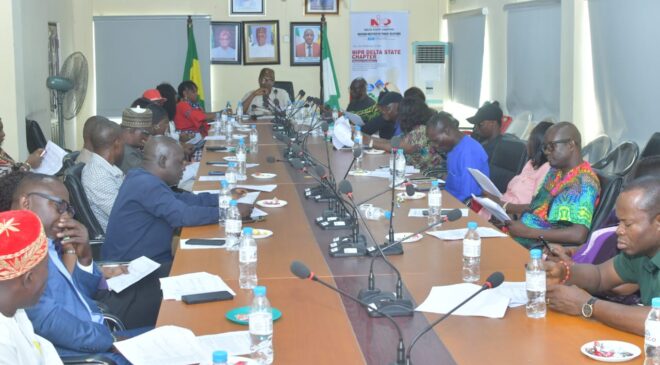
WARRI/Nigeria: The Delta State Chapter of the Nigerian Institute of Public Relations (NIPR) has declared its readiness to enter into a strategic partnership with the management of Delta Ports, as part of deliberate efforts to strengthen port operations in the state and promote a more balanced maritime economy in Nigeria.
The institute described the continued concentration of port activities in Lagos as unhealthy and economically restrictive, stressing that coastal states in the Niger Delta must be fully activated and optimised to unlock their enormous economic potential for both host communities and the national economy.
This position was articulated by the Chairman of NIPR Delta State Chapter, Mr. Godfrey Osakwe, FNIPR, during the chapter’s End-of-Year Meeting and final PR Clinic for 2025, held on Tuesday, December 16, at the Conference Hall of the Nigerian Ports Authority (NPA), Warri.
Osakwe spoke while responding to a welcome address Sa’adu Dahiru Mohammed Port Manager, divered on his behalf, by his Technical Adviser, Mr. Charles Ogoor. He commended the port management for hosting the institute, describing the engagement as timely, strategic, and forward-looking.
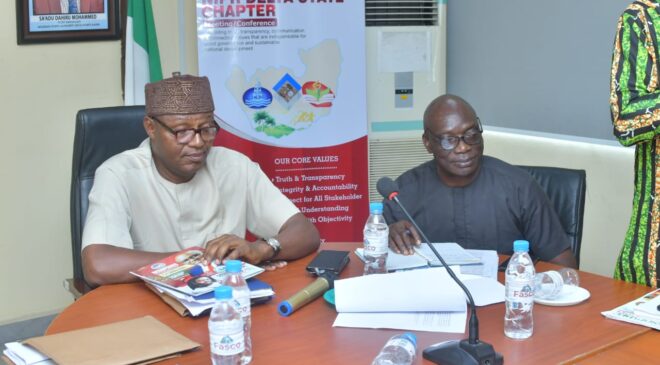
According to him, the institute is fully committed to supporting Delta Ports through professional communication strategy, stakeholder engagement, and structured advocacy, aimed at repositioning the ports for optimal performance.
He noted that the over-centralisation of port operations in Lagos has continued to deprive oil-producing states of the economic benefits naturally associated with maritime activities.
“Delta Ports should not remain underutilised. The economic benefits of port operations must be felt in our states and across the nation. As a professional body, we are prepared to support Delta Ports to ensure these facilities are properly positioned, promoted, and fully integrated into the national logistics chain,” Osakwe said.
He disclosed that the institute plans to convene a roundtable dialogue involving critical stakeholders and policymakers to redefine and strengthen the operational framework of Delta Ports, noting that sustained engagement and focused policy conversations have been largely absent in the past.
Osakwe expressed confidence that renewed collaboration between NIPR and port management would translate into tangible outcomes, including improved public perception, increased patronage, enhanced operational efficiency, and stronger economic impact for Delta State and Nigeria at large.
Earlier in his remarks, the representative of the Port Manager welcomed the institute and lauded its leadership for consistent engagement with key public institutions.
He expressed optimism that the proposed partnership would help reposition Delta Ports, boost stakeholder confidence, and contribute meaningfully to Nigeria’s economic diversification drive.
Beyond port-focused discussions, the NIPR Chairman charged members of the institute to think creatively, demonstrate greater commitment, and work collectively to elevate the Delta Chapter to higher levels of relevance and professional excellence.
He emphasised that the future of the chapter depends on innovation, active participation, and practical ideas capable of positioning it as a benchmark among NIPR chapters nationwide.
Osakwe also unveiled the 2026 Action Plan of the chapter, urging members to contribute meaningfully through their time, resources, and intellectual capacity to ensure its successful implementation.
He further stressed the importance of professional ethics, advising members to cultivate positive and productive working relationships with superiors, colleagues, and stakeholders as a cornerstone of effective public relations practice.