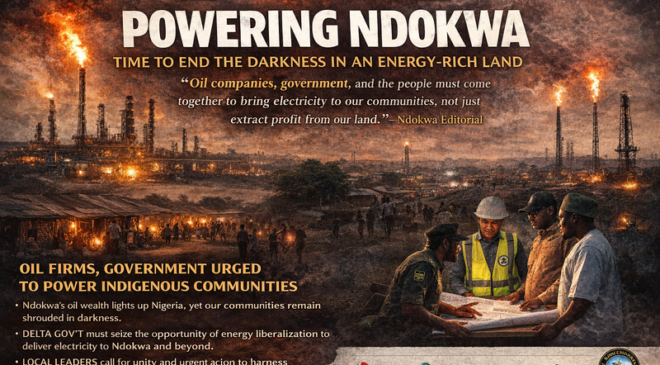
For a region that hosts some of Nigeria’s most strategic oil and gas assets, the persistent darkness across Ndokwa communities remains both unacceptable and indefensible. From Kwale to Aboh and across Ukwuani and Ndokwa East and West, the irony is glaring—communities that sit atop abundant energy resources continue to live without stable electricity. This contradiction must now give way to deliberate action.
At the heart of this failure is a long-standing neglect of Corporate Social Responsibility (CSR) obligations by oil and gas companies operating in the area. While these firms extract enormous value from Ndokwa soil, the host communities see little in terms of sustainable infrastructure, particularly in power supply. This must change, and it must change urgently.
Companies such as Energia, Oando, Sterling Oil, Midwestern, Chorus Energy, Platform Petroleum, Pan Ocean and others operating within Ndokwa have both the technical capacity and proximity to support embedded power solutions for their host communities. Extending electricity to surrounding towns and villages should no longer be seen as charity, but as a responsibility tied to their continued operations.
The argument is simple: if these companies can generate power for their facilities, they can, through structured partnerships, extend such capacity to neighbouring communities. Mini-grids, modular power systems, and gas-to-power solutions are no longer novel concepts—they are practical and achievable interventions that can transform lives across Ndokwa.
At the same time, agitation around the Okpai Independent Power Plant (IPP) must be reframed. While the demand for step-down infrastructure in Kwale and surrounding areas is legitimate, stakeholders must look beyond a single facility. The fixation on Okpai alone risks limiting broader opportunities that exist across the region.
Agitators and community leaders must therefore expand their engagement to include all operational oil and gas firms within Ndokwa. A multi-source approach to power generation and distribution will not only be more sustainable but also reduce overdependence on one installation.
It is also important to acknowledge that some of the setbacks in local power development have been self-inflicted. Reports of disruptions during federal inspections and stakeholder engagements in the past must serve as lessons. Development cannot thrive in an atmosphere of hostility and division. Going forward, unity of purpose must guide all advocacy efforts.
The Delta State Government, on its part, must rise to the occasion. With the ongoing liberalisation of electricity generation and distribution in Nigeria, there is now a clear opportunity for subnational governments to take initiative. Delta cannot afford to lag behind in this new energy reality.
The state government should immediately begin to harness the vast gas resources within its territory by creating frameworks that encourage independent and embedded power projects. Strategic partnerships with oil and gas operators can unlock a decentralised power network capable of serving multiple communities simultaneously.
This is not merely about infrastructure; it is about economic survival and growth. Stable electricity will unlock small and medium-scale enterprises, boost local industries, improve healthcare delivery, and enhance educational outcomes across Ndokwa. It will also reduce the cost of doing business and improve overall quality of life.
The Federal Government’s policy direction on energy reform has opened the door, but it is the responsibility of state actors and local stakeholders to walk through it. Ndokwa, given its resource endowment, should be at the forefront of this transformation—not left behind.
Ultimately, the responsibility is collective. Oil companies must act beyond profit, the government must provide leadership and policy direction, and the people must engage constructively. The era of excuses has passed.
Ndokwa cannot continue to power Nigeria while remaining in darkness. The time to act is now.