By Emeka Nwokocha
EFFURUN/Nigeria: Sixteen trained peace coordinators have been mobilised across eight local government areas in Delta State to monitor emerging conflict risks, verify reports and support early intervention ahead of the 2027 general elections.
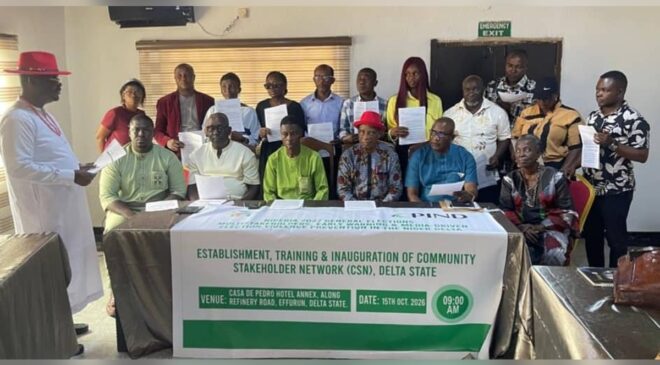
The coordinators were inaugurated and trained on Thursday, October 15, 2026, under a Community Stakeholder Network established by One Love Community Development and Promotion of Peace Initiative (CDPPI), with support from the Foundation for Partnership Initiatives in the Niger Delta (PIND).
The event, held at Casa DePedro Hotel Annex in Effurun, Uvwie Local Government Area, was part of efforts to strengthen community-level mechanisms for identifying potential electoral violence and responding before disputes escalate.
The eight participating local government areas are Uvwie, Udu, Ughelli South, Ughelli North, Warri South, Warri North, Warri South-West and Ethiope East. Two coordinators have been assigned to each area.
Speaking at the inauguration, Executive Director of One Love Community Development, Prof. Andrew Agboro, said the training equipped participants with skills in political-risk assessment, conflict-sensitive reporting, scenario planning, grassroots mediation and dialogue.
He said the coordinators would be expected to gather information from their communities, assess emerging threats and help ensure that credible warnings reach the relevant response channels in time for action.
The initiative is designed to address a critical challenge in electoral peacebuilding: identifying warning signs is only useful when the information is verified, communicated to the appropriate institutions and followed by a timely response.
Agboro outlined a five-part strategy for strengthening the network’s work in Delta State, beginning with engagement with editors, bloggers, broadcasters and other media practitioners to promote responsible reporting and discourage sensational coverage capable of worsening tensions.
The strategy also includes scenario planning to identify potential election-related flashpoints and prepare targeted peace messages for communities where tensions may arise.
Under the early-warning and early-response component, coordinators are expected to monitor rumours and incidents both online and offline, verify reports and channel relevant information through the established PIND-supported system for assessment and response.
Agboro said the approach would also promote mediation and dialogue, including the use of radio programmes and other communication platforms to encourage constructive engagement among stakeholders with competing interests.
The fifth component involves closer coordination among media organisations, the National Orientation Agency, the Independent National Electoral Commission, civil society groups and security institutions to improve information sharing and response to emerging threats.
He stressed that the intervention was a collaborative effort rather than a standalone programme by PIND. While the foundation provides strategic coordination and data infrastructure, he said, One Love contributes local relationships, community knowledge and grassroots engagement needed to identify and interpret emerging concerns.
The wider network is expected to work with Partners for Peace, community-based organisations, women’s groups and youth organisations to promote shared responsibility for conflict prevention.
Agboro said the objective was to improve early threat detection, accelerate institutional responses and encourage responsible communication before, during and after the 2027 elections.
“Early warning is logically meaningless unless it yields immediate early action,” he said, emphasising the need to verify information before publication, coordinate responses and protect lives.
PIND’s broader election-violence prevention initiative covers 24 high-risk local government areas across Delta, Akwa Ibom and Rivers states, with partner organisations assigned implementation responsibilities in the three states. The regional programme combines early-warning systems, community peacebuilding, media engagement and coordinated responses to reduce the risk of electoral violence.
In Delta, the deployment of the 16 coordinators establishes a local structure intended to connect community-level observations with wider peacebuilding and response mechanisms.
Its effectiveness will depend on the reliability of reports, the speed with which verified warnings reach relevant institutions and the willingness of political and community stakeholders to address grievances peacefully.
