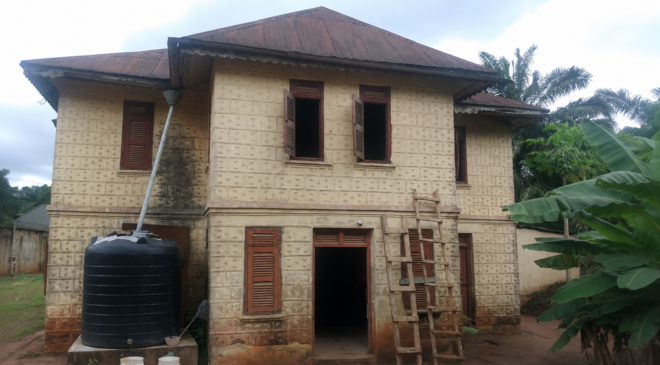
IGBO-UKWU/Nigeria: An 87-year-old storey building in Igbo-Ukwu, Anambra State, is set for renovation as its owners seek to preserve the structure and connect it to the town’s wider archaeological and cultural heritage.
The building, completed in 1939 by the late Chief John Ubabukoh, is regarded by his family as an important part of Igbo-Ukwu’s history. His grandson, Ozioma Ubabukoh, said the proposed restoration was intended to give the structure a new lease of life while retaining its historic character.
Speaking with journalists on Saturday, Ubabukoh said the project would transform the building into a heritage attraction capable of complementing the National Museum in Igbo-Ukwu and drawing visitors interested in the history and culture of the community.
He said plans were being developed to give the structure a vintage and monumental appearance, while exploring ways of linking it with the museum and other historical sites in the area.
According to him, the initiative could help expand Igbo-Ukwu’s identity beyond its archaeological significance by creating a cultural tourism destination that would attract visitors, filmmakers and researchers.
Ubabukoh said some movie producers had already shown interest in the building as a location for epic productions, adding that such interest demonstrated the potential of the structure as both a historical and creative asset.
He appealed to the Anambra State Government, corporate organisations and individuals to support the preservation project, arguing that the story of Igbo-Ukwu deserved greater visibility.
“Igbo-Ukwu is an ancestral land of Igbo culture and the land of arts,” he said, urging stakeholders to support efforts to preserve and promote the community’s heritage.
Ubabukoh said the decision to preserve the building was also rooted in a family instruction handed down by his father, Ifeanyichukwu Ubabukoh, who inherited the property from Chief John.
He said his father, before his death in February 2024, had specifically advised him not to demolish the structure but to preserve it as a legacy for the family and the wider community.
The history of the building is closely tied to that of its original owner. Okey Ubabukoh, 73, the only surviving child of Chief John Ubabukoh, recalled the difficulties his father faced while constructing the building during the colonial era.
He said restrictions and demands on timber supplies at the time made building materials difficult to obtain, forcing his father to source wood from the forest for the project.
Okey described his father as a businessman with extensive interests in Northern Nigeria who spoke Hausa fluently. He said Chief John also worked as a contractor, executing the construction of schools, churches and houses, and served as a customary court judge.
He further recalled his father’s involvement with British archaeologist Prof. Thurstan Shaw during the archaeological investigations that brought international attention to Igbo-Ukwu.
Historical research confirms the importance of Shaw’s work in Igbo-Ukwu. Archaeological investigations there, which began with discoveries in the late 1930s, later led to systematic excavations by Shaw from 1959 and helped establish the significance of the community’s ancient bronze-working culture.
The National Commission for Museums and Monuments currently lists a National Museum in Igbo-Ukwu, located on the Umudege-Ezinifite Road in Aguata Local Government Area.
Okey said the family remained committed to supporting the renovation of the building, describing it as part of the legacy left by their patriarch.
Another member of the family, Pa Emeka Ubabukoh, 86, recalled the prominent place the structure occupied in the community during his childhood.
He described Chief John’s building as unusual for its time and said its survival over the decades made it worthy of preservation.
“We played football in that compound, and it is worthy that such great work be celebrated,” he said.
A family associate, Pa Timothy Anigbogu, also described Igbo-Ukwu as a community with a significant archaeological and cultural history, saying the proposed renovation could complement the town’s existing heritage assets.
He argued that preserving the building alongside Igbo-Ukwu’s archaeological attractions could strengthen the community’s prospects as a destination for cultural tourism.
For the Ubabukoh family, the proposed restoration is therefore more than the rehabilitation of an old structure. It is an attempt to preserve a physical reminder of a bygone era and connect it to the broader story of Igbo-Ukwu’s cultural and archaeological heritage.