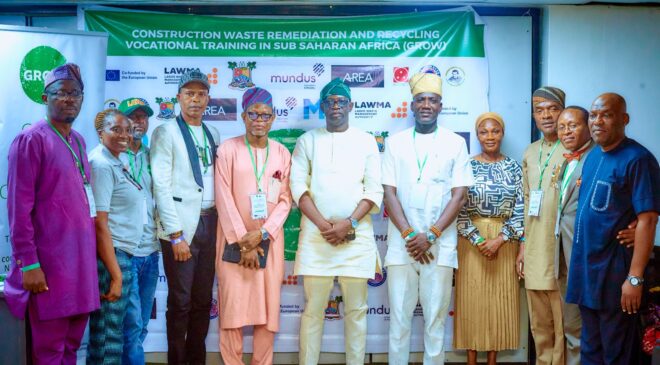
LAGOS/Nigeria: The Lagos Waste Management Authority (LAWMA), in collaboration with European Union-backed partners, has intensified efforts to address the growing challenge of construction and demolition waste through the Green Waste Remediation and Recycling (GROW) Vocational Training Workshop, aimed at promoting sustainable waste practices and technical capacity development.
The initiative was unveiled in Lagos on Tuesday in a statement by the Managing Director of LAWMA, Dr. Muyiwa Gbadegesin, who was represented at the event by the Authority’s Executive Director, Finance, Mr. Kunle Adebiyi.
Gbadegesin described the GROW project as a strategic intervention designed to bridge existing technical skill gaps in the construction sector while aligning waste management practices with global standards.
He explained that the programme seeks to drive the green transformation of the construction industry by encouraging sustainable waste handling, strengthening technical expertise, and fostering collaboration among government agencies, training institutions, and private sector stakeholders.
According to him, the project, co-funded by the European Union under the ERASMUS+ programme, targets Nigeria and Mozambique as emerging economies grappling with increasing volumes of construction waste.
He noted that LAWMA is taking deliberate steps to strengthen the management of Construction, Demolition, and Disaster Waste (CDDW), ensuring efficient processes from waste generation to disposal, while also unlocking opportunities for recycling and resource recovery.
Gbadegesin further emphasised that the initiative would not only improve waste management outcomes but also support skills development, create employment opportunities, and accelerate the transition from a linear to a circular economy in the waste management sector.
In her remarks, the Project Coordinator, Isabel Goncalves, described the workshop as timely and impactful, noting that the GROW project is structured to deliver practical, skills-based solutions to the increasing challenge of construction waste.
She added that the initiative would enhance workforce capacity, improve environmental outcomes, and strengthen collaboration among participating countries and stakeholders.
The workshop attracted a broad range of stakeholders, including representatives from industry groups, waste management associations, academia, and private sector partners, who engaged in discussions on sustainable practices and policy implementation.
The statement reaffirmed the collective commitment of stakeholders to deepen partnerships, strengthen policy frameworks, and advance sustainable construction waste management practices in Lagos and beyond.