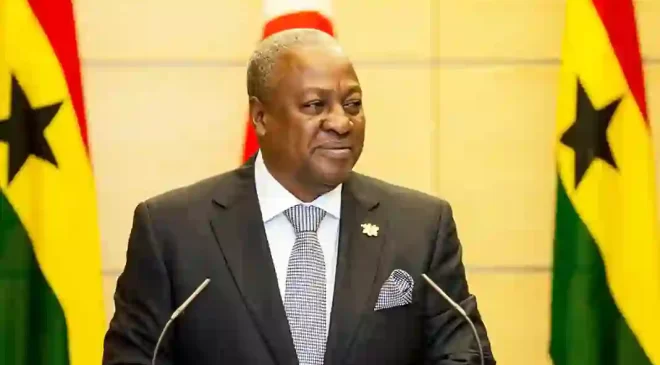
It is no longer news that Ghana’s President, John Mahama, made remarks at the African Heritage Awards in Accra that stirred conversations across West Africa. He revealed that he prays daily for Nigeria to “get its act together,” warning that instability in Africa’s most populous nation could trigger significant migration pressures on Ghana. While some critics interpreted his comments as condescending, a closer and more contextual reading shows his statement was misunderstood. Rather, they were brotherly, anchored in empathy, realism, and a clear understanding of the shared destiny of both nations.
Against this backdrop, it is important to stress that Mahama’s remarks should not be seen as criticism, but as a heartfelt appeal from one twin to another. Nigeria and Ghana have come a long way together, and his words reflect the depth of that enduring bond.
Mahama’s connection to Nigeria is not merely diplomatic, it is deeply personal. Before his rise to prominence, he spent part of his formative years in Nigeria. During Ghana’s political instability in the late 1970s and early 1980s, he lived in Offa, Kwara State, under the care of his Nigerian stepmother, Hajia Nusirat Balogun. Those years left a lasting imprint on him. He has often spoken of his familiarity with the town and the cultural grounding he received there. His ties to the community were further cemented when he was conferred with the chieftaincy title of Aare Atolase of Offa Kingdom. Even his father, Emmanuel Adama Mahama, found refuge in Nigeria during the 1981 coup.
Beyond these personal ties, Nigeria and Ghana share one of the most enduring bilateral relationships on the continent. As pioneers of African independence, Ghana in 1957 and Nigeria in 1960, their founding leaders envisioned a united Africa.
Over the decades, the relationship has seen moments of strain. The “Ghana Must Go” episode of the 1980s, when Ghanaians were expelled from Nigeria, and subsequent tensions, underscore the challenges of regional integration. Yet, despite these setbacks, the bond has endured. Citizens of both countries continue to live, work, and thrive across borders. They share vibrant cultural exchanges in music, film, cuisine, and even spirited sports rivalry. This shared history reinforces why Mahama’s remarks must be understood as fraternal. He spoke not as a detached observer, but as a brother whose nation has walked side by side with Nigeria for decades.
Indeed, Mahama’s description of both countries as “twins of the same mother” is more than rhetoric, it reflects reality. Nigeria, with its vast population and economic weight, remains a regional powerhouse. Ghana, though smaller, has built a reputation for stability and democratic consistency. Together, they form the backbone of West Africa’s political and economic architecture.
Even the lighthearted rivalry over jollof rice and football speaks to this closeness. Such competition is not a sign of division, but of intimacy. Twins may disagree, but their bond remains unbroken. Mahama’s analogy captures this enduring fraternity.
His concerns about Nigeria’s stability are rooted in pragmatism, not alarmism. He noted that economic decline in Nigeria could trigger large-scale migration into neighboring countries like Ghana. Given Ghana’s population size, such an influx would place enormous pressure on infrastructure, social services, and national cohesion.
This is a realistic concern. Across the world, migration pressures have shaped political and economic discourse, from Europe’s experience with migrants from the Middle East and Africa to regional movements within the Global South. West Africa is not immune. Mahama’s call is, therefore, a plea for foresight, stability, and shared prosperity.
Importantly, he balanced his concerns with reassurance. He rejected xenophobia and the idea of mass deportation, reaffirming Ghana’s commitment to regional unity and cooperation. This reflects Ghana’s longstanding tradition of hospitality and Pan-African ideals. His message was clear: Ghana stands with Nigeria, not against it.
Critics who framed his remarks as condescending missed this nuance. His daily prayers for Nigeria are not expressions of superiority, but of concern, much like one would have for a struggling sibling. The sensitivity surrounding Nigeria’s current economic challenges may explain the misinterpretation. In times of hardship, external commentary can easily be perceived as criticism. But context matters, and in this case, the context is one of shared destiny.
Nigeria’s stability is not just a national issue; it is a regional imperative. As Africa’s largest economy, Nigeria drives trade, investment, and cultural influence across West Africa. Its challenges inevitably spill across borders, affecting neighbors like Ghana. Mahama’s remarks simply underscore this interconnected reality.
They also serve as a reminder of collective responsibility. No West African nation can afford to stand alone. Regional bodies like ECOWAS were established precisely to foster cooperation in times of crisis, be it political instability, economic shocks, or migration challenges. Mahama’s words call for stronger collaboration and shared solutions.
Beyond politics and economics, the cultural ties between both nations remain profound. Nollywood enjoys a massive following in Ghana, just as Ghanaian music thrives in Nigeria. Artists collaborate seamlessly, strengthening a shared identity that transcends borders. Even the famed jollof rice rivalry reflects a deeper connection rooted in familiarity and mutual respect.
Ultimately, Mahama’s remarks were unmistakably brotherly. Far from disparaging Nigeria, they conveyed empathy, realism, and a genuine desire for stability. By invoking the imagery of twinship, he highlighted a truth that cannot be ignored: the destinies of Nigeria and Ghana are intertwined.
His call for Nigeria to “get its act together” was not a rebuke, but a sincere appeal, one that recognizes that Ghana’s progress is closely tied to Nigeria’s stability. By pairing concern with reassurance, he struck a balance that reflects true solidarity.
In the end, Mahama’s message is simple but profound: in West Africa, nations rise or fall together. Nigeria and Ghana may compete over food and football, but they remain bound by history, culture, and destiny. His words should, therefore, be seen for what they truly are, a testament to fraternity, not a gesture of criticism. Together, they rise. Divided, they falter.