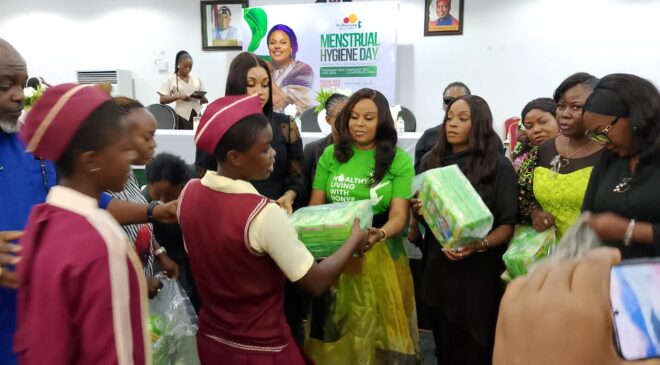
AWKA/Nigeria: More than 25,000 packs of sanitary pads have been distributed to schoolgirls across Anambra State, while pad banks have been established in over 350 schools as part of efforts to improve menstrual hygiene, boost girls’ confidence and reduce absenteeism during menstrual periods.
The wife of the Anambra State Governor, Dr. Nonye Soludo, disclosed this on Thursday in Awka during the 2026 Menstrual Hygiene Day celebration organised by her pet project, the Healthy Living Initiative. She said the intervention had significantly enhanced access to menstrual hygiene products for schoolgirls and created a more supportive learning environment across the state.
Speaking at the event, which was held under the theme, “Together for a #PeriodFriendlyWorld,” Soludo explained that the pad banks are regularly replenished based on usage and demand to ensure continuous support for beneficiaries.
According to her, the initiative has not only improved personal hygiene among girls but has also restored confidence and helped reduce school absenteeism associated with menstruation.
“So far, over 25,000 packs of sanitary pads have been distributed through this initiative to support our school girls.
“These pad banks have not only improved personal hygiene among girls, but have also restored confidence, reduced absenteeism, and created a more comfortable environment for learning and concentration in schools,” she said.
The governor’s wife described menstruation as a natural biological process that should never be a source of shame, stigma or discrimination against women and girls.
She lamented that despite growing awareness, many girls still face harmful cultural stereotypes, isolation and ridicule because of menstruation.
“Menstruation is not a curse. It is not a taboo. It is not something any girl should be ashamed of.
“Every girl deserves to experience her womanhood with dignity, confidence and pride, not fear or humiliation,” she said.
Soludo noted that the Healthy Living Initiative has continued to promote hygiene, nutrition, physical wellness and preventive healthcare in schools, homes and communities across Anambra State.
She explained that hygiene remains one of the six cardinal pillars of the initiative, stressing that healthy habits cultivated early in life contribute significantly to healthier families and communities.
According to her, the initiative’s Healthy Living School Clubs have continued to educate children on personal hygiene, self-care and environmental responsibility.
She called on parents, schools, religious institutions, corporate organisations and development partners to support efforts aimed at ending menstrual stigma and creating safe spaces for girls.
The governor’s wife also encouraged young girls not to allow menstruation hinder their ambitions and aspirations.
“You are strong. You are valuable. You are beautifully created.
“Your dreams are valid, and nothing, not even your monthly cycle, should stop you from becoming the best version of yourselves,” she said.
Also speaking, a medical expert, Dr. Chikosoro Oforbuike, urged girls to maintain proper menstrual hygiene to prevent infections and other health complications.
She advised them to change sanitary pads regularly, maintain personal cleanliness and avoid the use of unhygienic materials during menstruation.
Sharing the impact of the programme, Mrs. Chidinma Ekesiri, a teacher at Community Secondary School, Achalla, in Awka North Local Government Area, said the school’s pad bank had improved access to sanitary products and reduced absenteeism among female students.
According to her, many parents in the rural community struggle to afford sanitary pads, making the intervention a major relief for families.
“The pad bank has increased access for our girls, saved cost and the girls no longer use rags or tissue paper.
“The initiative has also helped us to talk about menstruation, create awareness, dispel myths and assure our girls that menstruation is not something to be ashamed of,” she said.