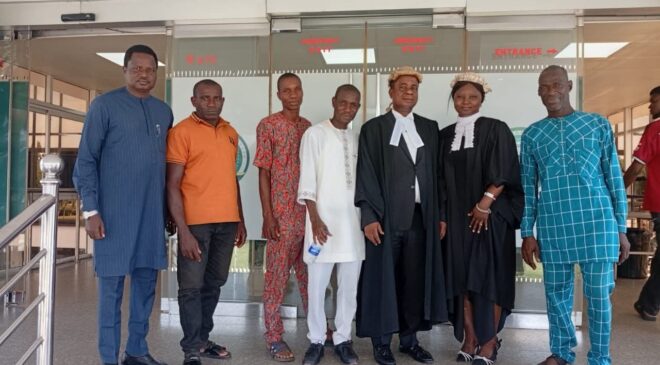
ABUJA/Nigeria: The Supreme Court of Nigeria has upheld the fundamental rights of 13 indigenes of Etua Community in Ndokwa West Local Government Area of Delta State, dismissing appeals filed by the Nigeria Police Force and affirming earlier judgments that found the victims were unlawfully arrested and detained.
The landmark judgment, delivered on June 19, 2026, brings to a close a protracted legal battle that began following a controversial police operation in the community on May 22, 2022.
According to court records and accounts from residents, armed policemen stormed Etua in the early hours of the day, conducting house-to-house searches and arresting several residents. Community members alleged that the operation resulted in the death of one villager, while 15 persons were taken away by security operatives.
The detainees were reportedly held for extended periods without access to their families or legal representatives, prompting widespread concern among residents and human rights advocates.
The fifteen innocent residents who were unlawfully arrested and detained include: Chukwuka Ndego, John Abami, Kingsley Chukwuka Ukpe, Emmanuel Aliphor, Ernest Ezenem, Ojieh Chukwudi, Jeremiah Ituma, Solomon Ukpor, Gift Okolie Ogwu, Godfrey Ukpor, Jennifer Ogborgu, Obi Chuks Malior, Chukwueloke Igba, Sunday Mbam and Ifeanyi Akpati.
In response, the affected individuals and their families approached the Federal High Court in Asaba, alleging violations of their constitutional rights, including unlawful detention, denial of personal liberty, and inhuman treatment.
The Federal High Court ruled in their favour, a decision that was subsequently upheld by the Court of Appeal, Asaba Division. Dissatisfied with the outcome, the police authorities proceeded to the Supreme Court, filing 13 separate appeals challenging the lower court decisions.
However, in a majority judgment delivered by a five-member panel, led by Justice Inyang Okoro, the apex court dismissed all the appeals and affirmed the findings of both the Federal High Court and the Court of Appeal.
The Supreme Court held that the actions of the police amounted to a clear violation of the fundamental rights guaranteed under the Constitution of the Federal Republic of Nigeria.
The court maintained that security operations must be conducted within the limits of the law and that constitutional safeguards cannot be suspended under the guise of law enforcement.
A major highlight of the judgment was the court’s affirmation of compensation awarded to the victims. The apex court upheld the Court of Appeal’s order directing that each of the 13 respondents be paid N10 million as damages for the infringement of their rights.
In reaching its decision, the court relied on the legal principle of ubi jus ibi remedium—meaning where there is a right, there must be a remedy—holding that the victims were entitled to meaningful compensation for the injustice suffered.
The justices further affirmed orders directing the release of the affected individuals, stressing that no Nigerian citizen can be subjected to indefinite detention without due process of law.
Legal observers have described the judgment as a significant victory for human rights and the rule of law, noting that it reinforces constitutional protections against arbitrary arrest and detention.
Reacting to the verdict, community leaders and residents of Etua welcomed the judgment, describing it as long-awaited justice for families who endured years of uncertainty and emotional distress.
Human rights advocates have also hailed the ruling as a precedent-setting decision that could strengthen accountability within law enforcement agencies and encourage victims of rights abuses to seek legal redress.
The judgment is expected to resonate beyond Delta State, serving as a reference point in future cases involving allegations of unlawful detention, abuse of power and violations of fundamental rights by security agencies.
Stakeholders have called on the relevant authorities to comply fully with the Supreme Court’s directives, including the payment of compensation and implementation of all reliefs granted by the court.
The decision is being widely viewed as a reaffirmation of the judiciary’s role as the guardian of citizens’ rights and a reminder that no institution or public authority is above the law.