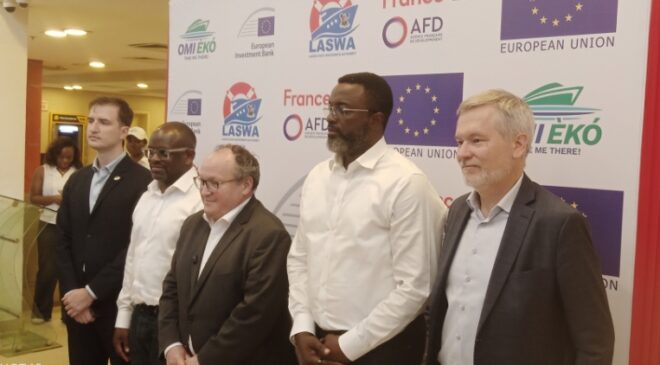
LAGOS/Nigeria: The Lagos State Government has secured a €410 million international financing package to revolutionise water transportation across the state, marking one of the most ambitious investments yet in its drive to develop a modern and sustainable blue economy.
The landmark initiative received a major boost on Friday as EIB Global, the development arm of the European Investment Bank (EIB), signed a €170 million financing agreement with the Lagos State Government for the implementation of the Omi Eko Water Transport Project.
The agreement was signed at the headquarters of the Lagos State Waterways Authority (LASWA) in Ikoyi, Lagos, in the presence of EIB Vice-President, Mr. Ambroise Fayolle; European Union Ambassador to Nigeria, Mr. Gautier Mignot; and the Consul General of France in Lagos, Mr. Laurent Favier.
The partnership, the first between LASWA and the European Investment Bank, positions the EIB as the largest financier of the Omi Eko Project. The loan is backed by a European Union guarantee under the Global Gateway Initiative.
The project is being delivered through a broader Team Europe financing package involving the EIB, the French Development Agency (AFD) and the European Union, with total funding valued at €410 million. The financing package includes a €130 million sovereign loan from AFD and a €60 million investment grant from the European Commission.
Speaking at the signing ceremony, Lagos State Commissioner for Transportation, Mr. Oluwaseun Osiyemi, described the partnership as a significant milestone in the state’s efforts to build a world-class and environmentally sustainable transportation system.
He assured development partners of the state’s commitment to providing the necessary policy support, transparency, accountability and institutional framework required for the successful implementation of the project.
“The Lagos State Government is fully committed to providing the enabling environment required for the success of this partnership.
“This includes strong political will, policy consistency, transparency, accountability and effective collaboration. We will work closely with the European Investment Bank to ensure that Omi Eko meets the highest global standards of project delivery and sustainability,” Osiyemi said.
He explained that the project would support the development of a comprehensive water transport network through the construction and upgrade of ferry terminals, passenger stations and jetties, alongside the acquisition of electric ferries and maintenance facilities.
According to him, the initiative will establish 15 ferry routes covering approximately 140 kilometres and connect 25 upgraded terminals across the state.
Osiyemi disclosed that 75 electric ferries, each capable of carrying up to 440 passengers, would be deployed under the project to improve mobility while reducing environmental pollution.
“The vessels will significantly reduce greenhouse gas emissions and water pollution.
“Once completed, the project is expected to increase the share of water transport in Lagos from less than one per cent to about eight per cent by 2032, in line with the Lagos State Transport Master Plan,” he said.
Also speaking, the Special Adviser to the Governor on Blue Economy, Mr. Oluwadamilola Emmanuel, described the partnership as a major breakthrough in efforts to unlock the enormous economic potential of Lagos’ waterways.
He said the Omi Eko Project would stand as a flagship example of how strategic international partnerships can drive infrastructure development and economic growth.
EIB Vice-President, Ambroise Fayolle, said the bank was proud to support what he described as a flagship green transport initiative that would deliver safer, more efficient and affordable mobility for millions of Lagos residents.
According to him, the project would not only improve transportation but also support sustainable economic growth and job creation while reinforcing the European Union’s Global Gateway strategy in West Africa.
European Union Ambassador to Nigeria, Gautier Mignot, said the financing package demonstrated the EU’s commitment to supporting sustainable transport infrastructure and strengthening connectivity across Lagos and the wider region.
He noted that the combination of loans and grants from the EU, EIB and AFD would deliver tangible benefits to millions of residents while advancing broader regional development goals.
“I look forward to travelling on electric ferries across the Lagos Lagoon in the near future and to seeing improved transport links within Lagos, Nigeria and the wider ECOWAS region,” Mignot said.
The Omi Eko Project aligns with Nigeria’s National Development Plan and supports broader regional objectives on infrastructure development, climate resilience and the Sustainable Development Goals.
When completed, the project is expected to significantly ease transportation challenges in Africa’s largest city, expand access to water transport and position Lagos as a leading model for sustainable urban mobility on the continent.