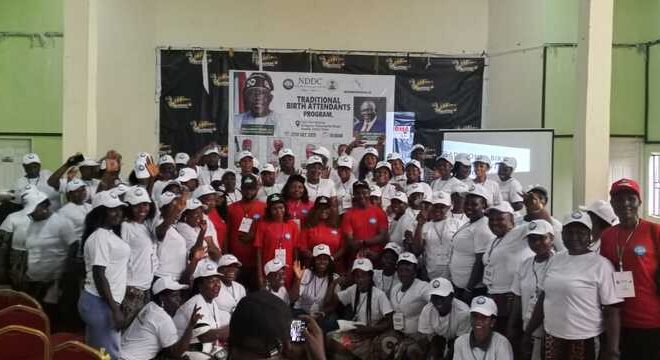
ASABA/Nigeria: Efforts to reduce preventable maternal and newborn deaths in Delta State received a boost on Thursday as traditional birth attendants from across the state underwent specialised training on safer childbirth, infection prevention and emergency referral procedures.
The programme, organised by the Niger Delta Development Commission (NDDC) in partnership with Menuchimso Resources Nigeria Limited (MRNL), brought together participants at the Nigeria Union of Journalists (NUJ) Press Centre, Asaba, where healthcare professionals provided practical lessons aimed at improving maternal care in rural communities.
For many expectant mothers in hard-to-reach areas, traditional birth attendants remain the first point of contact during pregnancy and delivery because of limited access to healthcare facilities. Medical experts say equipping them with updated knowledge can help improve early detection of complications and encourage timely referrals to hospitals.
Speaking at the training, the Principal Manager, Education, Health and Social Services of the NDDC, Mr. Precious Peter Okali, who represented the Commission’s Delta State Director, Engr. Omohudoye Joseph Onoriode, said the initiative was designed to strengthen the capacity of traditional birth attendants while promoting closer collaboration between community caregivers and healthcare professionals.
He said many traditional birth attendants possess years of practical experience but require periodic training to keep pace with evolving maternal healthcare practices.
According to Okali, participants were selected from different local government areas to ensure the knowledge acquired would benefit communities across Delta State and contribute to reducing avoidable maternal and infant deaths.
Facilitators at the workshop trained participants on antenatal care, safe delivery techniques, newborn care, infection prevention, hygiene standards and the early recognition of pregnancy-related complications that require immediate medical attention.
A Staff Nurse and Midwife at the Federal Medical Centre (FMC), Asaba, Mrs. Nnanna Anurika Precious, said the programme was particularly important because many women in rural communities still depend on traditional birth attendants during pregnancy and childbirth.
She noted that strengthening their understanding of modern maternal healthcare would improve the quality of services they provide while ensuring women experiencing complications receive prompt referral to hospitals.
Consultant Obstetrician and Gynaecologist at FMC Asaba, Dr. Lucia Okeke, said the training was intended to complement traditional birth practices rather than replace them.
She explained that recognising danger signs such as prolonged labour, excessive bleeding and other pregnancy-related complications at an early stage could significantly improve survival rates for both mothers and babies.
Also speaking, the Head of the Department of Obstetrics and Gynaecology at FMC Asaba, Dr. Sunday Jombo, described traditional birth attendants as critical partners in community healthcare because of the confidence many pregnant women repose in them.
He urged participants to adopt simple monitoring tools, including digital blood pressure monitors, and to refer complicated cases to hospitals without delay.
A Registrar in the Department of Obstetrics and Gynaecology at Asaba Specialist Hospital, Dr. Emeuazia Wisdom, also emphasised the importance of maintaining proper hygiene during pregnancy and delivery.
He said participants received practical instruction on hand hygiene, sterilisation of delivery equipment, infection prevention and the correct use of personal protective equipment to minimise health risks during childbirth.
Participants described the workshop as a valuable learning opportunity.
One of them, Mr. Peter Ozobira, said the training had improved his understanding of maternal healthcare and reinforced the importance of encouraging pregnant women to attend antenatal clinics and undergo routine medical examinations.
Another participant, Mrs. Obidike Gloria, said the programme enhanced her knowledge of infection prevention, safe delivery practices and recognising cases that require immediate referral to health facilities.
Health experts at the programme expressed optimism that strengthening the skills of traditional birth attendants and improving collaboration with healthcare institutions would help expand access to safer maternal care and reduce preventable deaths among mothers and newborns in communities where access to skilled medical services remains limited.