By Emmanuel Enebeli
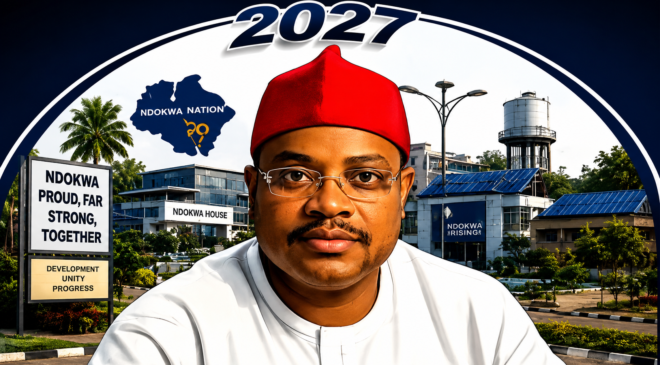
KWALE/Nigeria: As the 2027 House of Representatives election draws closer, Action Alliance candidate for Ndokwa/Ukwuani Federal Constituency, Ogbuefi Nicholas Onyekachukwu Enubuzor, says the constituency needs to move beyond short-term distribution of empowerment items and build an economy capable of giving young people sustainable livelihoods.
Enubuzor, in an exclusive interview with Ndokwa Reporters, said his approach to youth development would centre on employment, skills, enterprise, financing and access to markets, rather than one-off empowerment distributions.
He argued that while items such as motorcycles may provide temporary income, they do not address the deeper economic challenges facing young people.
“If you give a young man a motorcycle today but do not create an economy in which he can eventually move beyond that motorcycle, you have not solved the underlying problem,” he said.
According to him, the objective should be to create an environment in which young people can build careers, establish businesses and achieve sustainable economic independence.
“I want the day to come when a young man from Ndokwa does not look at a motorcycle as the highest economic opportunity available to him,” Enubuzor said.
“I want him to be able to say: ‘I have a job. I have a career. I have a business. I have a future.’ That is empowerment.”
Youth development through the wider economy
Enubuzor said youth empowerment could not be separated from the broader economic development of Ndokwa/Ukwuani.
He identified agricultural processing, tourism and hospitality, student housing, attractive communities and opportunities arising from companies operating within the constituency as areas capable of generating employment.
He said the objective should be to connect young people to these opportunities rather than leave them dependent on political patronage.
His proposed approach, he said, would seek to connect young people with jobs, training, financing, businesses and markets, while creating an environment where they can transition from survival activities to sustainable economic independence.
Agriculture as an economic engine
On agriculture, Enubuzor said Ndokwa/Ukwuani must stop viewing farming simply as a means of subsistence and begin treating it as an organised business ecosystem.
“The farmer should not be abandoned at the farm gate,” he said, stressing the need for a complete value chain covering production, storage, processing, transportation, financing and markets.
He specifically mentioned cassava, oil palm, rice and other agricultural products, arguing that greater local processing could create additional employment.
According to him, processing, packaging, transportation and marketing could each generate economic opportunities.
“That is how agriculture becomes an economic engine,” he said.
The AA candidate said he would seek partnerships involving government agencies, financial institutions, private investors and development organisations to support farmers and build agricultural value chains.
He also proposed exposing younger people to modern agricultural technologies, including data, machinery, irrigation, improved seedlings, modern storage systems and digital marketplaces.
“We need to make agriculture profitable enough that young people deliberately choose it as a career,” he said.
Education: pushing #FreeUniversityForNdokwa
Education is another major component of Enubuzor’s proposed youth development strategy.
He said he wants a situation where a young person from Ndokwa is not denied university education simply because the person’s parents cannot afford it.
That thinking, he explained, informs his advocacy for #FreeUniversityForNdokwa, which he said would involve practical pathways through scholarships, partnerships, educational interventions and legislative advocacy.
But he stressed that his education vision extends beyond university degrees.
According to him, Ndokwa/Ukwuani also needs stronger technical education, vocational training, digital skills and professional development to prepare young people for the economy the constituency hopes to build.
“We need to educate our young people for the economy we want to build,” he said.
Flooding: from emergency response to permanent strategy
The candidate also addressed the recurring flooding affecting parts of the constituency, particularly riverine communities.
Enubuzor said flooding requires a permanent strategy rather than responses that begin only after disasters occur.
His proposed approach includes mapping vulnerable communities, drainage planning, early-warning systems, emergency response mechanisms and stronger support for farmers and families affected by flooding.
He also linked flood management to environmental planning, saying waterways, riverbanks and public spaces should be properly managed.
He proposed combining infrastructure, environmental management, emergency preparedness and economic recovery, while seeking partnerships with development organisations with expertise in flood resilience and humanitarian response.
A different development philosophy
For Enubuzor, the issues of youth unemployment, agriculture, education, electricity, roads, healthcare and flooding are interconnected.
He argues that a functioning road can connect farmers to markets, electricity can allow businesses to operate, while education gives young people the capacity to participate in a modern economy.
His broader argument is that development should create an economic environment in which young people have choices.
The candidate says his proposed first-term youth and human-capital programme would ultimately be judged by whether young people gained access to employment, training, financing, businesses and markets, rather than simply receiving empowerment items.
The proposals remain campaign commitments at this stage, and the interview does not provide detailed costings or specific funding figures for the programmes. Enubuzor, however, says he wants his performance to be judged by measurable outcomes.
In his words: “Our young people should be too busy building businesses, developing careers, working, studying and creating value” rather than waiting for political handouts.
For the candidate, the ultimate test is whether Ndokwa/Ukwuani can create an economy where young people no longer see political distribution as their primary route to survival.
Part 4 of the NDOKWA REPORTERS EXCLUSIVE will examine Enubuzor’s proposed legislative agenda, the role he believes a federal lawmaker should play, his plans for federal project accountability and the five measurable achievements he says voters should use to judge him if elected in 2027.