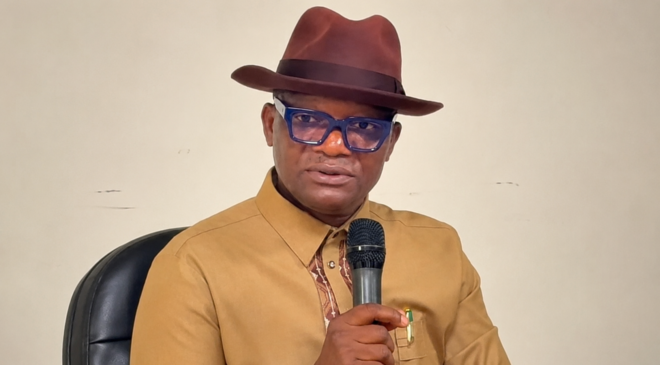
By Nelson Egware
A conversation with Charles Ehiedu Aniagwu rarely remains a conversation for long. Give him an issue and he is likely to approach it from several angles—political, social, professional and, sometimes, humorous. Ask a difficult question and he is unlikely to be short of words. That ability did not begin in government. It was cultivated in journalism.
As he marks another birthday today, September 7, Aniagwu’s career offers an interesting study in how skills acquired in the newsroom can be carried into business, politics and public administration. His journey has taken him from journalism, including his years at DBN and African Independent Television (AIT), through enterprise and into government, where he currently serves as Delta State Commissioner for Works (Rural Roads) and Public Information. The titles have changed over the years, but one professional characteristic has remained constant: communication.
Aniagwu’s experience as a journalist gave him an early education in public affairs. Journalism requires more than the ability to write. It demands curiosity, persistence, the capacity to question claims and an appreciation of the difference between information and evidence. Those habits remain visible in his public engagements.
He is comfortable discussing policy, politics and current affairs, and understands the logic behind the questions journalists ask. That is particularly useful in his responsibility for public information, where he frequently operates between government, the media and the wider public.
His familiarity with journalism also shapes his relationship with reporters. He understands the pressures of the newsroom—the deadline, the unanswered call, the search for confirmation and the responsibility of getting a story right. Consequently, his engagement with journalists is often less formal than one might expect from a government official.
For many journalists who interact with him, that shared background makes conversations easier. He can discuss the substance of an issue without losing sight of the practical realities of reporting it.
Aniagwu’s speaking ability is perhaps his most obvious public attribute. He can speak at length without losing the thread of an argument, move between serious discussion and humour, and respond to questions without relying entirely on prepared notes. His language is generally conversational, enabling him to explain political and administrative issues without making them unnecessarily technical.
Public communication is an important part of governance. Government programmes have to be explained, decisions defended, misconceptions corrected and citizens kept informed about policies that affect their lives. As Commissioner for Public Information, Aniagwu operates squarely in that space.
His journalistic background means he understands both the importance of getting information into the public domain and the questions that are likely to follow. His years in business have added another dimension to that experience. Running an enterprise requires attention to people, resources, timing and outcomes. It also demands decision-making in circumstances where complete information is rarely available.
Those lessons have relevance in public administration. Government operates on a larger scale and carries a different responsibility, but citizens ultimately expect results.
In the area of rural roads, for instance, the value of a project is measured by what it changes in the lives of the communities concerned. A rehabilitated or newly constructed road can shorten the journey from a farming community to the market, improve access to schools and health facilities, and make the movement of people and goods easier.
That is where the Works portfolio meets the everyday experience of citizens. The people of my community, Emevor in Isoko North Local Government Area, may not yet fully appreciate the role Aniagwu played in the construction of the Emevor–Orogun Road, Phases I and II, or the efforts currently being made towards the award of Phase III. In due course, the details of those interventions will become clearer.
For now, it is enough to say that the Emevor–Orogun corridor is only one example of Aniagwu’s contributions to communities across Delta State—contributions that have often taken place away from the glare of public attention.
Away from official engagements, those who work with Aniagwu encounter another aspect of his personality. He is known for maintaining relationships with journalists, colleagues, aides and others around him. His willingness to interact with people at different levels of the professional hierarchy has helped him build relationships across the media and political communities.
This is particularly noticeable in his dealings with younger professionals. Rather than treating those around him merely as functionaries, he often engages them directly. Conversations can range from work to personal matters, with humour frequently easing the formality associated with public office.
For someone who spent years in journalism, this approach is understandable. Newsrooms are collaborative environments, and experienced journalists learn quickly that the success of a publication depends on the combined efforts of reporters, editors, photographers, production staff and others. That appreciation for teamwork has remained useful in public service.
Aniagwu’s public-service philosophy places emphasis on performance. For him, the work of government cannot end with announcing a policy or inaugurating a project. Citizens ultimately want to know what has changed as a result.
That distinction matters in an environment where government communication can sometimes become dominated by activities, ceremonies and statistics. The more important question is what those activities mean in practical terms.
A road project should translate into easier movement. A public programme should address a defined need. An intervention should produce a discernible benefit. Public communication, in turn, should enable citizens to understand what government is doing and to ask questions about it.
This is where Aniagwu’s two portfolios intersect. The Works portfolio deals with physical infrastructure, while Public Information deals with explaining government activity and helping the public understand it. Both require attention to the gap between what government promises and what it ultimately delivers.
His relationship with journalists is significant for another reason: Aniagwu understands both sides of the profession. He has been the person asking questions and is now frequently the person expected to provide answers.
That experience can be useful in managing the inevitable friction between government and the press. A reporter’s responsibility is to question; a government spokesperson’s responsibility is to provide information and articulate the administration’s position. The two responsibilities will not always produce agreement.
Aniagwu’s ability to engage journalists without making every disagreement personal has helped him navigate that territory. He can argue his position, provide context and, where necessary, challenge a premise while keeping the conversation focused on the issue. That is a useful quality in democratic governance, where scrutiny is part of the system.
Birthdays provide an opportunity to step away from official designations and consider the individual behind them. For Aniagwu, the story is one of professional evolution.
The journalist acquired the habits of inquiry and communication. Business added experience in enterprise and decision-making. Public service provided the platform to apply those skills to governance.
None of these stages exists in isolation. Together, they have shaped the public figure Nigerians see today: a man comfortable in a newsroom discussion, a government briefing or an ordinary conversation, and able to move between policy arguments and everyday human interaction with relative ease.
The years ahead will bring their own demands—more questions from journalists, greater expectations from citizens, infrastructure challenges and continuing pressure on government to demonstrate results.
For a man whose career has been built around words, the challenge is increasingly to ensure that the words remain connected to the work.
On his birthday, therefore, I celebrate Mr. Charles Ehiedu Aniagwu not simply for the offices he has occupied, but for the professional experiences he has brought into public life: journalism, business, communication and an understanding of people.
His story is still unfolding. Perhaps the most fitting birthday wish is that the years ahead provide him with more opportunities to put those experiences to work in the service of Delta State and Nigeria, in support of good governance and in the continuing task of making public institutions more responsive to the people they serve.
Happy birthday, Sir. May the years ahead bring good health, sound judgment and many more opportunities to make a difference.
— Nelson Egware, PhD