By Mokobia Rita.
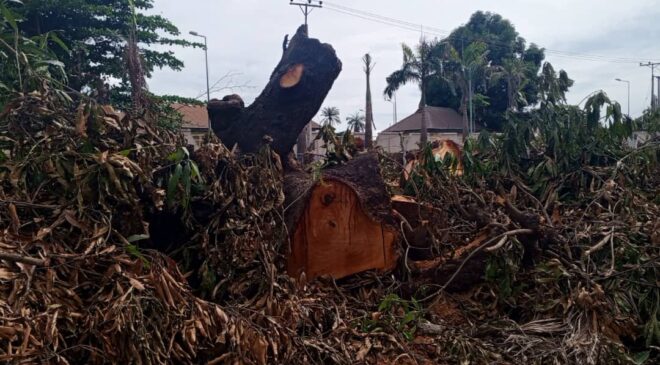
ASABA/Nigeria: What many residents initially dismissed as another urban renewal exercise has now emerged as a painful response to tragedy, as eyewitness accounts reveal that the ongoing removal of decades-old mango trees along Okpanam Road in Asaba was triggered by fatal accidents linked to the aging trees.
For weeks, the sound of chainsaws and falling trees has echoed across one of Asaba’s busiest corridors, stirring mixed emotions among residents who have watched the iconic mango trees disappear one after another. While some viewed the exercise as part of road expansion and beautification efforts, fresh revelations point to a darker reality behind the government’s action.
According to an eyewitness, Mr Christian Jiadauna, a security personnel at an undisclosed establishment, the decision to begin removing the trees followed a tragic incident during a heavy rainstorm that claimed two lives near Macdons Junction.
Recounting the incident, Jiadauna said the accident occurred around 8 p.m. when a violent downpour accompanied by strong winds swept through the area, creating panic among motorists and commuters hurrying home.
He explained that an unsuspecting commercial tricycle rider, popularly known as a keke driver, was heading toward the junction with passengers onboard, unaware that one of the old mango trees standing along the road median had become dangerously unstable.
“There was heavy rain and strong breeze that night,” Jiadauna recalled.
“Vehicles were rushing because everybody wanted to get home quickly. The keke driver did not know the tree was about to fall.”
Moments later, the massive tree reportedly uprooted completely and crashed directly onto the moving tricycle, landing heavily on the driver’s side and killing the rider instantly.
“There were about four passengers inside,” he said.
“The tree fell from the root and landed directly on the keke. The driver died instantly while people were trying to rescue him.”
Although the passengers survived the impact, one female passenger who sustained critical injuries later died in hospital, raising the death toll from the incident to two.
“Two people died from that incident,” Jiadauna said.
“The government heard about it and saw what happened. That was when they decided to start cutting the mango trees before another life would be lost.”
He further disclosed that barely two days after the fatal incident, another near-tragedy occurred during another storm when heavy branches from a mango tree crashed onto a Toyota Venza driven by a woman along the same route.
“The woman was injured and rushed to the hospital, but she survived after treatment.
“Anytime there is heavy rain and wind, branches fall from those trees. That is why the government started removing them — to prevent another tragedy,” he added.
The revelations have since shifted public discourse from environmental concerns to a wider debate over public safety, urban planning and the human cost of preserving aging infrastructure.
Despite the dangers associated with the trees, many residents insist the mango trees represented more than part of the landscape. For traders, labourers and commuters, they served as shelters from the harsh Asaba sun and resting points in the daily struggle for survival.
Contractor, Mr Clement Osuya, while acknowledging the government’s safety concerns, urged authorities to provide alternative public shelters and relaxation points across key junctions along Okpanam Road.
“In every junction on Okpanam Road, there should be a relaxation point where people can wait for keke, rest when tired, and where workers doing menial jobs can gather while waiting for employment opportunities,” he said.
He noted that such facilities would support pedestrians, artisans and daily labourers while enhancing the city’s aesthetics.
Construction labourer, Mr John Okafor, also described the trees as a refuge for workers seeking daily employment.
“The mango trees gave us shade and shelter while waiting for work. I am not happy they are cutting all of them. They should leave some trees for people to relax under,” he lamented.
For roadside trader, Mr Douglas Obi, the tree-cutting exercise feels like losing an old companion.
“It saddens my heart seeing the mango trees being cut down. Whenever I am tired or the sun becomes too much, I go under the trees to rest. The trees are like shelter for us,” he said emotionally.
Today, the remaining stumps lining Okpanam Road stand as silent reminders of two conflicting realities — the need to protect lives and the painful loss of a natural shelter that had become woven into the daily existence of many residents.
For some, the trees had become ticking hazards waiting for the next storm.
For others, they were symbols of comfort, endurance and survival beneath the scorching Asaba sun.

“Heartbreaking story, yet very professionally written.”