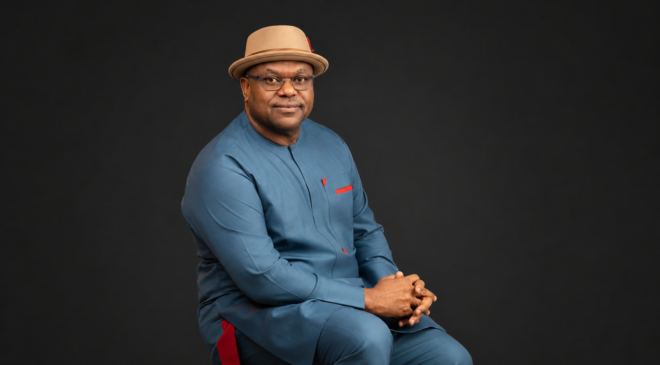
There is a tendency in Nigerian politics to measure public service by titles, buildings and contracts. But sometimes the more enduring story is found in people whose lives changed, whose careers took off and whose opportunities expanded because somebody in public office made the system work.
That is the perspective from which I have come to appreciate Rt. Hon. Victor Ochei’s years at the Nigerian Maritime Administration and Safety Agency (NIMASA).
Ochei did not arrive at NIMASA merely as a politician looking for another public appointment. He is an engineer by profession, with years of legislative and leadership experience behind him. His appointment in March 2020 as Executive Director, Maritime Labour and Cabotage Services therefore placed him in a technical and human-centred portfolio where regulation, industry and people intersected.
And it is the people behind that portfolio that tell the more compelling story.
Think about the Nigerian dockworker who wants decent working conditions and recognition in an industry dominated by powerful interests.
Think about the young seafarer who has completed years of maritime education but cannot progress professionally because he cannot obtain the mandatory sea-time needed for certification.
Think about the Nigerian company struggling for space in an industry where indigenous participation has historically faced formidable obstacles.
These were not abstract policy issues. They were people’s livelihoods and futures.
Under Ochei’s watch, greater attention was brought to implementation of the stevedoring framework and indigenous participation. Nigerian stevedoring companies and dockworkers gained greater opportunities within maritime operations, while his chairmanship of the National Joint Industrial Council placed him directly within efforts to improve minimum standards and working conditions for dockworkers.
There was also the challenge of Nigerian seafarers.
For years, some trained cadets faced a frustrating bottleneck: they had received maritime education but lacked the sea-time required to progress towards their Certificates of Competency.
The response during Ochei’s tenure was to pursue a more complete training pathway one that recognised that sending a young person to school was not enough if the system abandoned that person before professional qualification.
That, for me, is where policy becomes human.
A scholarship is important. But a career is better. Training is valuable. But creating the pathway through which training becomes employment is transformational.
The same human dimension can be seen in opportunities associated with his tenure. Available records credit Ochei with facilitating the engagement of more than 140 Deltans as Search and Rescue Marshals, employment opportunities for seven Deltans at NIMASA, and maritime scholarships for more than 20 Deltans, with beneficiaries studying in the United Kingdom, Greece, India and the Philippines.
Behind those numbers are families, careers and young people exposed to an international industry they might otherwise never have entered.
That is why I believe Ochei’s NIMASA story should not simply be told as a catalogue of achievements.
It is fundamentally a story about human capacity.
His engineering background may explain something about his approach: identify the problem, understand the system and find a workable pathway from one point to another.
Whether it was dockworkers seeking better conditions, cadets searching for sea-time, indigenous operators seeking greater participation or young Deltans looking for opportunities, the common thread was capacity and access.
And perhaps that provides a more useful way of assessing public service.
The most valuable legacy of leadership may not always be what a public official gives people while occupying office.
It may be what people become because opportunity was created for them.
That, to me, is the human story behind Victor Ochei’s years at NIMASA
Austin Edemodu, Phd is an Abuja based Journalist and Public Affairs Analyst