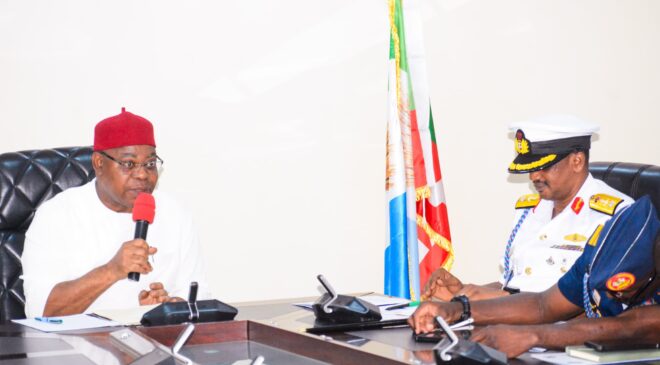
ASABA/Nigeria: Delta State Governor, Sheriff Oborevwori, has called for a more proactive approach to national security, urging intelligence and security institutions to prioritise early threat detection, information sharing and coordinated intervention.
Oborevwori made the call on Monday in Asaba when participants in the Advanced Intelligence Officers’ Course 16/2026 of the Defence Intelligence College, Karu, Abuja, visited the state as part of their study tour.
The governor, who was represented by his Deputy, Sir Monday Onyeme, said Nigeria’s changing security environment required authorities to move beyond responding to threats after they had occurred and develop systems capable of identifying and addressing risks before they escalate.
He said intelligence gathering would only be effective when information was converted into timely decisions and coordinated action capable of producing measurable security results.
Oborevwori urged the intelligence officers, who are undergoing advanced training, to apply the knowledge acquired during their tour to strengthening national resilience and improving cooperation among security institutions.
The governor said Delta’s selection for the study tour was appropriate because of the state’s strategic importance to the Niger Delta and the Nigerian economy.
He described Delta as an oil and gas centre, maritime gateway and major agricultural area, noting that developments in the state’s security environment could affect critical national assets and economic activities beyond its borders.
According to him, the state government has adopted a multi-agency approach to security by strengthening collaboration among the Nigerian Army, Department of State Services, Nigeria Police Force, Nigerian Navy, Nigeria Security and Civil Defence Corps and other relevant stakeholders.
He said the state had also continued to provide logistical support for security operations.
Oborevwori highlighted Operation Delta Sweep as one of the initiatives established to enhance joint security operations, combat crime and protect lives and property through coordinated action.
He also pointed to the State Security Council meetings as an important mechanism for reviewing emerging threats, sharing intelligence among agencies and determining appropriate responses.
Beyond conventional security structures, the governor said Delta had created institutional mechanisms for conflict prevention and intelligence gathering, including the Office of the Special Adviser on Peace Building and Conflict Resolution and the Office of the Special Adviser on Intelligence Gathering.
He stressed the importance of community-based intelligence, saying traditional rulers, Presidents-General, community development organisations and other local stakeholders were strategically positioned to provide early-warning information on emerging threats.
The governor also recalled the recent state security summit organised under the theme, “Security: A Collective Responsibility”, which brought together stakeholders to strengthen the collective response to terrorism and other forms of criminality.
He disclosed that the state was developing a Data and Investment Intelligence Hub following the 2026 Delta State Economic and Investment Summit.
According to him, the proposed hub would support the collection, integration and analysis of reliable information for evidence-based policy decisions, economic planning, investment promotion and security management.
Oborevwori further said Delta was pursuing regional security cooperation through platforms including the BRACED Commission and the Niger Delta Governors’ Forum.
He said such collaboration was particularly important in addressing security threats that cut across state boundaries, including kidnapping, cultism, illegal bunkering and maritime insecurity.
Earlier, the Team Leader of the study tour, Commodore Usman Bugaje, explained that Delta State was selected because of its strategic contribution to Nigeria’s economy and the security implications surrounding its major economic activities.
Bugaje said the team was examining the state’s oil and gas operations, offshore activities, transportation corridors and the movement of crude oil and finished products, among other economic interests.
He added that the presence of multiple security agencies in the state was another factor considered in selecting Delta for the exercise.
According to him, the study tour was designed to give the participants an opportunity to examine the security challenges peculiar to Delta and assess how integrated intelligence and cooperation among security institutions could strengthen national resilience.
Bugaje said the participants would also engage with residents and other stakeholders to gain first-hand insight into the security situation and evaluate the efforts of government and security agencies.
He particularly noted the role of traditional institutions and other community structures in supporting security efforts and promoting relative peace.
The study tour is being conducted under the theme, “Strengthening National Resilience Through Integrated Intelligence, Multi-Agency Coordination and Regional Security Cooperation.”
