KWALE/Nigeria: The decision by the Ndokwa Neku Union (NNU) to apologise for acts of infrastructure vandalism in Ndokwa communities and embrace a partnership approach with the Delta State Government has sparked debate across Ndokwa Nation, with UK-based Data and AI for Good advocate, Ambassador Chuks Ododo, insisting that strategic engagement—not perpetual confrontation—is the surest path to development.
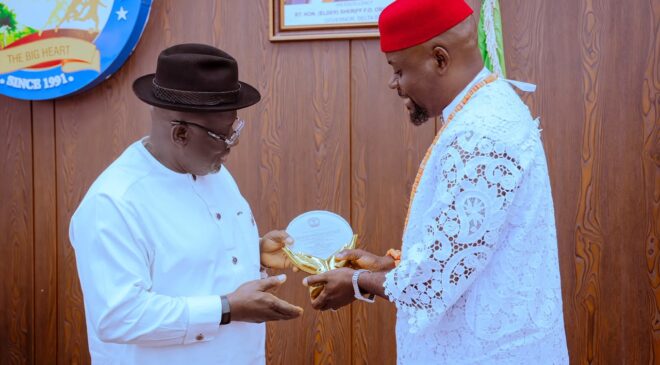
Ododo’s intervention followed a landmark visit by a high-powered NNU delegation led by President-General, Chief Amaechi Asugwuni, to Governor Sheriff Oborevwori at Government House, Asaba, where the apex socio-cultural body not only presented an award to the governor and endorsed him for a second term, but also tabled critical demands relating to electricity, road infrastructure and higher education in Ndokwa land.
The visit took an unusual turn when Chief Asugwuni openly apologised to the governor over repeated acts of vandalism targeting electricity installations in Ndokwa communities, describing the destruction of public infrastructure as a major setback to the region’s development aspirations.
“As a people, we condemn in the strongest possible terms every act of vandalism directed at public infrastructure. We cannot continue to demand development while allowing a few individuals to sabotage facilities meant to improve our lives,” Asugwuni said.
The NNU President-General pledged that the organisation would work with communities to protect public facilities and support efforts aimed at restoring electricity to affected areas. Governor Oborevwori acknowledged that vandalism had significantly delayed power restoration projects in parts of Ndokwa land.
Beyond the apology, the delegation sought concrete commitments from government, including the step-down of the Okpai Independent Power Plant to address electricity shortages, the establishment of higher institutions in Ndokwa land and the acceleration of strategic road projects to improve connectivity and economic growth.
The delegation also passed a vote of confidence in the governor, endorsed him for a second term and presented him with an Award for Infrastructural Development and Inclusive Leadership.
While the endorsement and award generated criticism from some quarters, Ododo argued that public attention should focus on the broader strategic objective of the engagement.
Describing the visit as “long overdue, strategic and intentional,” he said the NNU had repositioned itself as a constructive development partner capable of attracting government attention and investment to the region.
“Many tools of engagement are useful in attracting development: courtesy visits, lobbying and working as partners. NNU is a socio-cultural body; it is not an enemy of government,” Ododo stated.
According to him, many Ndokwa people have become trapped in the belief that development can only be achieved through protests, social media campaigns and constant opposition to government.
He maintained that while advocacy and scrutiny remain important, dialogue, negotiation and partnership are equally powerful tools for advancing the interests of the people.
“I appeal to Ndokwa people not to be comfortable in an uncomfortable wheel,” he said, stressing that development advocacy must be strategic rather than emotional.
Ododo further argued that nothing in the NNU’s mandate requires it to adopt an adversarial relationship with government, urging the organisation’s leadership to remain focused on achieving tangible results for the people.
Governor Oborevwori, in his response, thanked the people of Ndokwa Nation for their confidence in his administration and reaffirmed his commitment to equitable development across all parts of Delta State.
The governor also praised Deputy Governor Sir Monday Onyeme and commended Chief Asugwuni for his passion and commitment to the development of Ndokwa communities.
Political observers say the significance of the visit lies less in the endorsement itself and more in the emerging consensus that Ndokwa’s development challenges—including electricity, roads and access to higher education—may require a combination of advocacy, accountability and constructive engagement with government.
For Ododo, that is the central lesson from the Government House meeting.
“The road to development in Ndokwa land will not be paved by protest alone. It will require advocacy, accountability, dialogue, negotiation and strategic engagement,” he said.