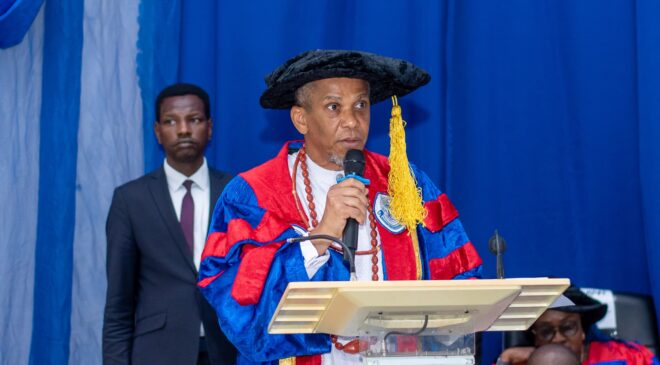
ABRAKA/Nigeria: Senator representing Delta Central Senatorial District, Ede Dafinone, has challenged Nigerian youths to embrace discipline, innovation and institution-building as the only viable pathway to sustainable national development, warning that the country’s vast potential may remain unrealised without deliberate action.
In a lecture delivered at the 18th Convocation Ceremony of Delta State University (DELSU), Abraka, the lawmaker, in a statement issued by his office, urged the graduating class of 2026 to shift focus from mere capacity to measurable productivity, stressing that Nigeria’s future depends largely on the choices of its young population.
Speaking on the theme, “Harnessing Nigeria’s Potential: Strategies for Sustainable Development,” Dafinone described Nigeria as richly endowed with human and natural resources, yet burdened by persistent challenges including unemployment, weak institutions and infrastructure deficits.
He raised what he termed “the Nigerian question,” asking why a country so abundantly blessed continues to struggle with translating potential into real economic and social outcomes, insisting that the issue lies not in talent deficiency but in systemic failures.
According to him, Nigeria’s enormous crude oil reserves, expansive agricultural land and vibrant youthful population should ordinarily position the country among leading global economies, but millions remain trapped in poverty while skilled professionals continue to migrate abroad.
Dafinone warned that the nation’s opportunity for transformation is narrowing, noting that other countries are advancing rapidly due to strong institutional frameworks and disciplined implementation of policies.
“The question is not whether Nigeria will develop, but whether this generation will be the one to turn promise into performance,” he said.
He emphasised that one of Nigeria’s most critical mistakes is the confusion between potential and productivity, explaining that while potential reflects capacity, productivity is the consistent application of that capacity within functional systems.
The senator cautioned against what he described as a “dangerous narrative of inadequacy,” urging Nigerians not to internalise failure but to focus on building resilient institutions that can drive long-term progress.
He maintained that sustainable development cannot be achieved through rhetoric or policy announcements alone, but through disciplined, consistent and system-driven efforts across generations.
Drawing comparisons with countries such as South Korea, Singapore, Malaysia, Botswana and Rwanda, Dafinone noted that their success was anchored on deliberate investment in human capital and efficient institutional structures.
On emerging global opportunities, he identified artificial intelligence and the knowledge economy as potential game changers for Nigeria, provided the country creates enabling systems to harness them effectively.
He cited the global success of Nigerian entrepreneurs and entertainers as evidence of the country’s talent, adding that such success stories must be replicated across other sectors through strategic support.
Dafinone also advised graduates to prioritise critical thinking, lifelong learning and intellectual depth over mere acquisition of certificates, noting that the global workforce is increasingly shifting towards competence-based evaluation.
Addressing the growing trend of migration, he acknowledged the frustrations driving young Nigerians abroad but urged them not to completely abandon the country.
“Nigeria needs you here — the most capable, the most courageous — to help rebuild systems and institutions,” he said.
He further criticised the nation’s weak execution culture, noting that while ideas are abundant, implementation remains Nigeria’s greatest challenge.
The senator urged the graduates to remain disciplined, uphold integrity and commit to continuous self-improvement, stressing that the responsibility to transform Nigeria lies with their generation.
In his remarks, the Vice-Chancellor of DELSU, Prof. Samuel Ogheneovo Asagba, commended the lecture as insightful and reflective of the nation’s realities, urging the graduates to internalise its lessons as they transition into the next phase of life.