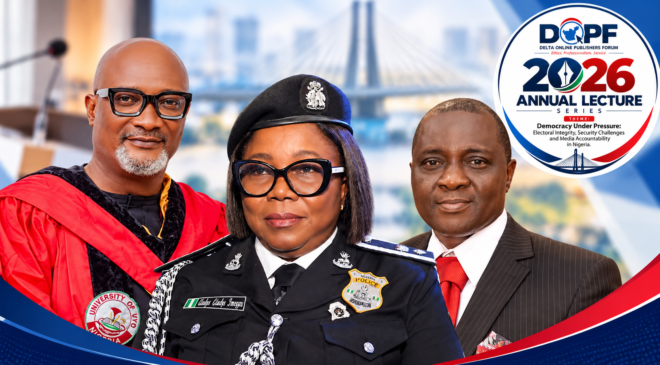
ASABA/Nigeria: A communication scholar, a veteran journalist and a senior police officer will bring academic, media and law-enforcement perspectives to discussions on electoral integrity, security and media accountability at the 2026 Annual Conference and 6th Lecture Series of the Delta Online Publishers Forum (DOPF).
The panellists are Professor Presley Ogheneruke Obukoadata, Deputy Vice-Chancellor of Southern Delta University, Ozoro; Comrade Norbert Chiazor, PhD, journalist and media scholar; and Chief Superintendent of Police (CSP) Gladys Imegwu, who is in charge of Legal Matters at the Delta State Police Command.
The conference will hold on Wednesday, October 21, 2026, at 11 a.m. at David’s Event Centre, Government Reservation Area, Asaba, under the theme, “Democracy Under Pressure: Electoral Integrity, Security Challenges, and Media Accountability.” Delta State Governor, Rt. Hon. Sheriff Francis Oborevwori, is expected to attend as Special Guest of Honour.
The panel is expected to examine how the media, security agencies and other institutions can help protect electoral credibility, improve public confidence and uphold accountability without undermining citizens’ rights or the media’s watchdog role.
Obukoadata is expected to contribute an academic and strategic communication perspective to the discussion. A professor of Brand, Strategic and Metacommunication, he serves as Deputy Vice-Chancellor of Southern Delta University and Dean of its Faculty of Communication Technology. He previously pioneered the institution’s Faculty of Communication and Media Studies.
His academic career spans several institutions, including the University of Calabar, American University of Nigeria, Delta State Polytechnic, Ogwashi-Uku, and the National Open University of Nigeria. His research interests include strategic communication, brand management, crisis communication, media ecology, artificial intelligence, development communication and public relations. He has published more than 50 journal articles, books and book chapters, according to the information supplied for the conference.
His contribution is expected to address the impact of digital communication and emerging technologies on electoral information, including the need to counter misinformation, encourage informed public debate and hold public institutions accountable.
Chiazor brings decades of experience in journalism, broadcasting, newsroom management and government communication. Popularly known as “The Wordsmith,” he holds degrees in English and Literature and Mass Communication, as well as master’s and doctoral degrees in Mass Communication.
He worked with the former Bendel Broadcasting Service in Benin City and Delta Broadcasting Service in Warri, where he rose to become Deputy General Manager and Head of News and Current Affairs. His journalism experience also includes work with local and international media organisations.
Publisher of The Nigerian Post, Chiazor served as Chairman of the Nigeria Union of Journalists, Delta State Council, from 2011 to 2017. His tenure included initiatives in media infrastructure and professional development, including the advancement of the NUJ Press Centre project and training for Delta journalists at the Reuters Journalism Institute in London.
He has also served as Executive Assistant on Media to former Delta State Governor, Senator Ifeanyi Okowa, and currently holds the same position under Governor Oborevwori.
His experience is expected to inform discussions on editorial independence, professional ethics, verification of information and the responsibility of online publishers to scrutinise public institutions while resisting the spread of unverified claims, particularly during election periods.
Imegwu will provide a law-enforcement and legal perspective. As Officer in Charge of Legal Matters at the Delta State Police Command, her responsibilities place her within the interface between policing, legal oversight and the administration of justice.
Her participation is expected to bring attention to the role of security agencies in protecting lives and property, maintaining public order, enforcing the law impartially and respecting citizens’ rights during elections.
The panel will also have an opportunity to examine the relationship between the police and the media, particularly the importance of accurate reporting of security incidents, responsible information sharing and respect for the distinct responsibilities of journalists and law-enforcement officers.
The combination of the three professional backgrounds is intended to broaden discussion beyond election administration alone, addressing the relationship between credible elections, public safety, reliable information and institutional accountability.
For online publishers and other media practitioners, the issues include verifying election-related claims, reporting security developments responsibly and holding public officials accountable without spreading misinformation. For security agencies, the discussion concerns the protection of citizens and the creation of conditions in which democratic participation can take place peacefully.
The conference forms part of DOPF’s engagement with issues affecting journalism, public communication and democratic governance. Its theme places particular emphasis on the need to protect media freedom while strengthening professional responsibility and public access to accurate, verifiable information.
With the conference approaching, the forum is expected to bring together media professionals, academics, security personnel, public officials and other stakeholders to consider how institutions can respond to pressures on Nigeria’s democratic process and strengthen public trust.