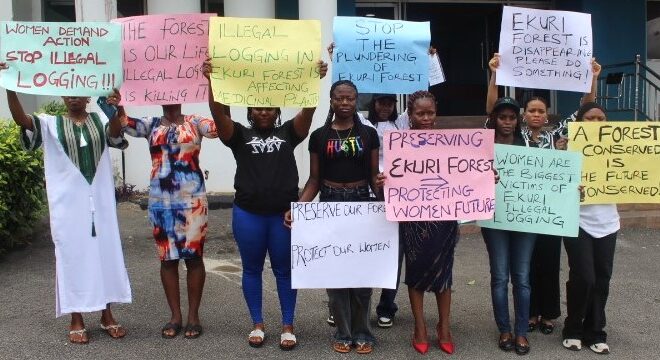
EKURI/Nigeria: Women from Ekuri community in Akamkpa Local Government Area of Cross River State have petitioned the State House of Assembly over the activities of illegal loggers, warning that the continued destruction of the Ekuri forest is threatening their livelihoods, food security, and safety.
The concerns were conveyed in a petition dated March 26, 2026, titled “Illegal Logging in Ekuri and Environs Impacting Negatively on Women, Forest and Biodiversity,” jointly signed by the Women Leader of Ekuri, Mrs. Lawrencia Agbor, alongside Imelda Offiong Oyi, Theresa Benedicta Akamo, Agatha Egot, Lucy Abel, Esther Atim Jerome, Akamo Mary Godwin, and Mrs. Freda Francis.
Addressed to the Speaker of the Cross River State House of Assembly, Rt. Hon. Elvert Ayambem, the women detailed the devastating impact of unchecked logging activities, including harassment by security personnel allegedly hired by logging merchants and the steady depletion of forest resources.
In the petition, the women alleged that despite a government ban on illegal logging, the practice has continued unabated for years, with dire consequences for the Ekuri people who rely heavily on the forest for sustenance.
“Honourable Speaker, every day more than 200 truckloads of timber and other exotic wood leave Ekuri forest and efforts by our people to halt this practice are met with harassment and intimidation by security personnel hired by the logging merchants,” the petition read.
They further lamented the deteriorating condition of access roads in the community, blaming heavy-duty trucks used by loggers for worsening the situation.
“Sometimes these trucks break down in the middle of the road and remain there for days, making access by our people totally impossible,” they added.
The women also cited alarming environmental data, noting that an estimated 91,000 tons of timber are lost annually to illegal logging in Cross River State, while a Global Forest Watch report indicated that Ekuri and its environs had lost over 540 square miles of tree cover as of 2024.
They stressed that women, who constitute the majority of farmers in the community, are the most affected, as they depend on the forest for food, fuel, and medicinal resources, but are now forced to travel longer distances under difficult and unsafe conditions.
The petition also highlighted the exclusion of women from key decision-making processes concerning forest management, despite bearing the brunt of the socio-economic impact of deforestation.
To address the situation, the women urged the House of Assembly to mandate relevant government ministries, particularly Women Affairs and Youth Development, to actively engage local women and youths in forest governance.
They also called for collaboration with conservation groups to undertake reforestation efforts and restore degraded areas, as well as the establishment of a clear framework to regulate logging activities within the Ekuri forest.
The petitioners appealed to the Speaker to intervene decisively and halt the illegal logging operations that have worsened living conditions in the community.
Reacting to the development, the Renevlyn Development Initiative (RDI) described the move as a significant step toward environmental justice and community empowerment.
RDI Project Officer, Linda Amadi, commended the women for taking action, saying: “We anticipate that the Cross River State House of Assembly will handle this issue with the seriousness it deserves. The forest sustains the Ekuri people and no one understands this better than the women. They have asked for environmental justice and that is what they deserve. Anything short of this is unacceptable.”
Observers say the petition marks a bold intervention by grassroots women in the fight against environmental degradation, as pressure mounts on authorities to enforce existing laws and protect one of Nigeria’s most important forest reserves.