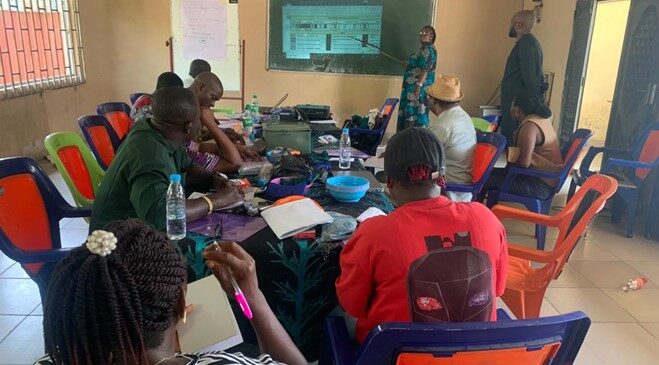
EFFURUN/Nigeria: The Environmental and Rural Mediation Centre (ENVIRUMEDIC), with funding support from the ActionAid Strategic Partnership for Agroecology and Climate Justice West Africa Project (SPAC), has successfully concluded a three-day Village Savings and Loans Association (VSLA) training aimed at strengthening community-based financial inclusion and economic empowerment in Delta State.
The training, which held from November 25 to 27, 2025, at the Delta Central Agricultural Development Programme Office in Effurun, targeted rural dwellers, particularly women and smallholder farmers, who are often excluded from formal banking systems.
Organisers explained that the VSLA model, a globally recognised savings and lending approach developed in the early 1990s, is designed to promote self-managed, transparent and trust-based savings among community members. Through the system, members save through share purchases, access loans from pooled savings at agreed interest rates, and share accumulated funds at the end of a cycle, thereby improving household resilience and livelihoods.
The objectives of the training included introducing participants to VSLA principles and methodology, building capacity for the formation and sustainability of VSLA groups, strengthening understanding of community-based savings systems, and promoting accountability and proper record-keeping through the effective use of VSLA tools such as passbooks and ledgers.
Participants were drawn from communities across Delta State’s three senatorial districts, including Oyede in Isoko North, Obiaruku in Ndokwa East, and Emonu, Ebor-Orogun and Ophorigbala communities in Ughelli North and Ughelli South. Representatives of ENVIRUMEDIC also participated in the programme.
A total of 15 participants attended the training, comprising 10 community representatives, six of whom were women, three ENVIRUMEDIC staff members and two facilitators from ActionAid Nigeria. The sessions covered the entire VSLA cycle, from community sensitisation and group formation to leadership election, savings, lending, conflict resolution and share-out processes.
Participants were introduced to standard VSLA tools, including passbooks, deposit and loan ledgers, cash box ledgers, plastic bowls, cloth bags and training manuals. However, facilitators noted that due to prevailing security concerns in Delta State, the traditional VSLA cash box was considered unsuitable for local use.
The training adopted participatory and learner-friendly methodologies such as interactive discussions, question-and-answer sessions, drama simulations and the use of Pidgin English to ensure inclusiveness and clarity, alongside manual projections and practical demonstrations.
Key sessions focused on VSLA methodology, preparatory engagement with community leaders, group formation, roles of management committees, development of internal regulations, conflict resolution mechanisms and proper conduct of savings and lending meetings. Particular emphasis was placed on accurate record-keeping, transparency and accountability.
On the final day, participants engaged in a drama simulation using Oyede community as a case study, demonstrating how facilitators mobilise communities, form VSLA groups, elect leaders, conduct savings and lending activities, apply fines, record transactions and share out savings and interest. The exercise significantly enhanced participants’ practical understanding of VSLA operations.
Facilitators, however, observed gaps in areas such as detailed discussions on fines, penalty funds, interest calculations during share-out, donor recognition and linkages with other community committees, recommending that these aspects be strengthened in future trainings.
Challenges encountered during the programme included intermittent power supply, limited funding which constrained the number of participating communities, and security concerns associated with the use of cash boxes. Recommendations from the training included adopting safer savings options such as bank accounts or PoS-based systems, redesigning passbooks for improved documentation, centralised printing of ledger books for uniformity and continuous capacity-building for VSLA management committees.
Despite these challenges, organisers said the training successfully equipped participants with the knowledge and practical skills required to establish and manage sustainable VSLA groups in their communities, laying a strong foundation for improved financial inclusion, accountability and economic resilience among rural households in Delta State.