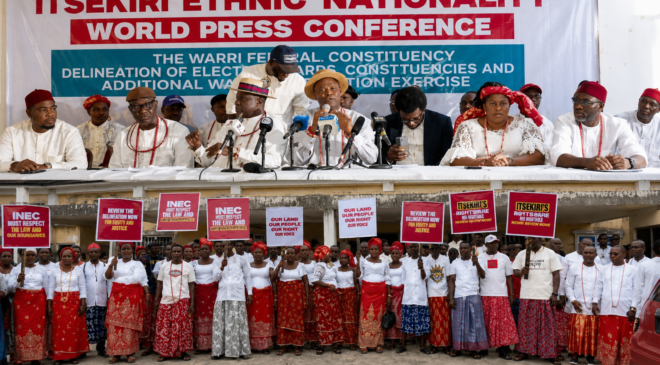
WARRI/Nigeria: The Itsekiri Ethnic Nationality (IEN) has rejected the Independent National Electoral Commission’s (INEC) proposed delineation of wards, polling units and constituencies in Warri Federal Constituency, alleging that the exercise is riddled with legal, technical and constitutional irregularities capable of undermining electoral fairness and regional stability.
Addressing a World Press Conference at the Ubeji Town Hall, Warri, on Tuesday, prominent Itsekiri leaders, Chief Edward Ekpoko, Prince Yemi Emiko, Sir A.S. Mene, Alex Eyengho and Chief Robinson Ariyo, said the ethnic nationality could not accept the delineation proposal unveiled by INEC on May 20, 2026, insisting that it violated constitutional provisions, the Electoral Act and the Commission’s own guidelines.
The leaders maintained that while the Itsekiri people fully support lawful electoral reforms and respect the Supreme Court judgment directing a fresh delineation exercise in Warri North, Warri South and Warri South-West Local Government Areas, the process adopted by INEC failed to meet the standards of transparency, legality and technical accuracy required for such a sensitive national assignment.
According to the group, independent reviews conducted by geographic, cartographic and surveying experts uncovered serious flaws in the data and mapping methodology used by the electoral body. They alleged that several proposed polling units and wards were situated outside recognised local government boundaries, with some locations reportedly extending into neighbouring Edo and Ondo states.
The Itsekiri leaders further claimed that a number of polling units were mapped to rivers, swamps, forests and other uninhabitable terrains, raising questions about the credibility of the fieldwork that formed the basis of the exercise.
They argued that the Constitution, the Electoral Act 2026 and INEC’s extant delineation guidelines require electoral wards to respect geographical contiguity, established administrative boundaries, community identity and cultural balance, principles they alleged were disregarded in the proposed arrangement.
The group also accused INEC of creating wards that cut across different local government areas, contrary to the Commission’s own regulations, which stipulate that a ward must not fall within more than one local government area.
Presenting what they described as findings from an independent technical review, the leaders alleged that hundreds of mapped polygons in Warri South-West and Warri North were duplicated, submerged in water bodies or located outside their lawful boundaries. They contended that these discrepancies distorted the demographic realities of the area and produced an inequitable outcome.
The Itsekiri nation also expressed concern over what it described as inadequate fieldwork in Warri South, claiming that several rapidly developing communities with significant populations were omitted from the delineation process.
The leaders insisted that the Supreme Court judgment did not invalidate the voter register used for the 2023 General Election and argued that any fresh delineation should be anchored on verifiable voter data rather than disputed mapping exercises.
They presented figures from the 2023 elections which, according to them, showed that six Itsekiri wards in Warri North accounted for 75,912 registered voters and 134 polling units, while four Ijaw wards recorded 34,480 voters and 58 polling units.
In Warri South-West, they said Itsekiri wards recorded 94,074 registered voters and 175 polling units, compared to 95,042 registered voters and 157 polling units in Ijaw wards.
The Itsekiri leaders maintained that their opposition to the proposed delineation was not directed at any ethnic nationality but was rooted in the pursuit of equity, justice and constitutional compliance. They argued that historical records did not support claims that other ethnic groups in the Warri Federal Constituency lacked political representation.
The group also condemned what it described as threats, provocative statements and inflammatory rhetoric emanating from some groups involved in the controversy, warning that such actions could heighten tensions and threaten the peace that has largely prevailed in the region.
While faulting the delineation exercise, the leaders commended INEC’s proposal to create two additional state constituencies and an additional federal constituency in Warri Federal Constituency, noting that such measures could strengthen democratic representation if implemented in accordance with the law.
They called on the Federal Government to investigate the technical processes that produced the proposed delineation and urged INEC to suspend reliance on the disputed fieldwork and GIS mapping data pending an independent and transparent verification exercise.
The leaders also appealed to security agencies and oversight institutions to closely monitor developments surrounding the delineation process to ensure accountability, transparency and strict adherence to constitutional provisions.
Reaffirming their commitment to peaceful engagement, the Itsekiri nation pledged to continue pursuing its grievances through lawful and democratic channels, insisting that its demands were guided solely by the principles of fairness, justice, equity and respect for the rule of law.