By Emmanuel Enebeli
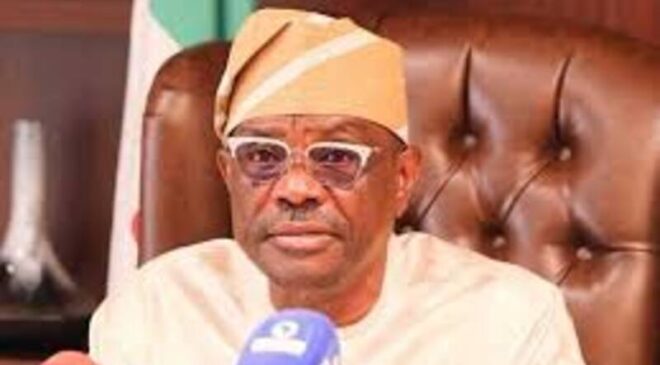
Barrister Nyesom Wike is the kind of political force who simply refuses to be part of the background noise. From the modest offices of local government to his current command of the Federal Capital Territory, his rise has been a masterclass in project-driven politics and hard-nosed bargaining. He is a man who builds as quickly as he breaks alliances. When people ask, “What does Wike want?” they aren’t just asking about his next job; they are trying to decode the formula he’s used to reshape the power map of Rivers State and, more recently, spark a full-blown political war with his hand-picked successor. This hunger for relevance is no longer just a Rivers problem; it is the central gear in the machinery of the 2027 presidential race.
Wike’s backstory is as straightforward as it is revealing. He started out as the Chairman of Obio-Akpor Local Government back in 1999—a role that gave him his “street” grounding and a reputation for being a doer. If you look at his methods today, you can see that early influence: for Wike, politics is a mix of delivering tangible results and maintaining an iron-clad grip on patronage. He learned early on that people will follow you if you build the roads, but they’ll stay loyal if you control the machinery. This grassroots obsession is why he remains a formidable ally for any presidential hopeful; he doesn’t just deliver speeches, he delivers “structures” that translate into actual votes.
After his local service, he climbed the ranks into the state executive and then the federal stage. He served as Chief of Staff in Rivers, moved to Abuja as the Minister of State for Education, and even did a stint as the acting Minister. Those years weren’t just about policy; they gave him an insider’s view of how the “Abuja game” is played. He learned how to use federal influence as a shield and a sword—knowledge he has since deployed with surgical precision. Today, that insider knowledge makes him a dangerous gatekeeper for the 2027 cycle, as he knows exactly which federal levers to pull to favour his friends or frustrate his foes.
His two terms as Governor of Rivers State (2015–2023) are what truly cemented the Wike brand. He was a high-energy executive who poured massive funds into infrastructure, earning the nickname “Mr. Projects.” He didn’t just build flyovers; he made sure everyone saw him building them. This record is his greatest asset; it’s how he proves his worth to his party and the public. He essentially offers a deal: I will give you “deliverables,” but in return, I expect total, unquestioning loyalty. In the lead-up to 2027, this persona is his bargaining chip, allowing him to argue that he is the only one who can actually “deliver” the South-South.
But don’t mistake him for a simple technocrat; Wike is a political operator through and through. He knows exactly which levers to pull in the party room. Over the years, he’s cultivated a fierce bloc of loyalists who act as his frontline in the state’s often chaotic politics. When he loses his grip on those tools, he doesn’t panic; he just shifts the battlefield. Whether it’s the courts, the media, or mobilizing the streets, he’s always ready to recalibrate. For 2027, this means he is currently the primary “disruptor” within the PDP, acting as a wedge that prevents the opposition from uniting against the incumbent.
That blend of visible achievement and ruthless control explains his often-confusing alliances. In 2022, he fought for the PDP presidential ticket, came in second, and then publicly burned bridges with the nominee. Fast forward, and he’s a key minister in President Tinubu’s APC administration. To a casual observer, it looks like a contradiction. To Wike, it’s a strategic pivot: he’s willing to swap jerseys if it means keeping his seat at the table in Abuja. This “cross-carpet” influence is a nightmare for the PDP’s 2027 strategy, as it creates a bridge between the ruling party and a key voting bloc that should technically belong to the opposition.
Ultimately, what Wike seems to want is a power base that doesn’t have an expiration date. He wants a structure of influence that spans from the FCT back to the creeks of Rivers. Controlling the Rivers political machine gives him the chips he needs to gamble in the national arena, while his federal post gives him the reach and protection he needs to stay untouchable. He wants a brand of power that is “portable”, something he can carry with him regardless of what office he holds. In the context of 2027, this makes him the ultimate “Kingmaker-at-Large,” a man who can sell his support to the highest political bidder.
The current, bitter fallout with Governor Siminalayi Fubara is the perfect case study. What started as a smooth succession has turned into a constitutional nightmare, even leading to a six-month period of federal emergency rule in 2025. Wike has been blunt about this lately: he recently vowed that Fubara will never get a second term in 2027, calling the governor’s New Year message “political noise.” It’s a classic story of the limits of patronage: Wike found out that supporting a successor doesn’t mean you own them. This rift has now forced 2027 alliances into two camps: those backing Wike’s “old guard” and those rallying behind Fubara’s “new dawn.”
This isn’t just a local drama; it has massive national stakes. Rivers is the oil-rich heart of the country, and when it catches a cold, Abuja sneezes. Political instability in Port Harcourt threatens the very revenue that keeps the country running. When a powerful minister and a sitting governor are in an open war, it forces every institution to take a side. Wike knows this leverage exists. As 2027 approaches, he is essentially telling the presidency: “If you want the oil and the votes from Rivers, you have to stand with me against Fubara,” forcing President Tinubu into a very delicate balancing act.
Wike’s style is intentionally loud. He doesn’t whisper; he litigates, he shouts, and he deploys his loyalists to keep the pressure high. His critics call him a bully, while his fans see a “strongman” who is necessary in a system that often rewards weakness. Either way, he values control above all else—control of the narrative, the resources, and the institutions. This loud-mouthed approach is his primary weapon for 2027; he uses it to de-legitimize opponents like Peter Obi or Atiku Abubakar before they can even get their campaigns off the ground, often doing the “dirty work” for the current administration.
His choices also reveal a man who is constantly “hedging his bets.” Taking the FCT ministry gave him administrative muscle and a massive spotlight in the capital, even if it made him a villain to his old party members. It’s a recurring theme: Wike will always choose pragmatic control over tidy partisan loyalty. He’d rather be a powerful minister in a “rival” cabinet than a sidelined elder in his own party. By doing this, he has effectively neutralized himself as a 2027 presidential candidate but tripled his value as a 2027 partner.
Looking ahead to 2027, Wike likely has two goals. First, he wants to rebuild his Rivers base so he can dictate who runs for what. Second, he wants to remain the ultimate kingmaker on the national stage. These goals feed each other: local control gives him national clout, and national office provides the armour he needs to fight his local battles. If he succeeds, any 2027 presidential candidate will have to come to him to “clear” their path through the South-South, giving him a veto over the next four years of Nigerian leadership.
But this “confrontational” path is full of landmines. Wike has made a lot of powerful enemies, former governors and local leaders who are tired of his shadow. The federal interventions we saw during the 2025 Rivers stalemate showed that even a “political general” can be checked if the centre gets tired of the drama. For 2027, the risk is that he might become “too toxic” for a president seeking a peaceful second term. Ambition is a powerful engine, but without building new, broader coalitions, it can eventually run out of fuel.
There’s a deeper, perhaps more human side to this: legacy. Wike has always framed his projects as gifts to the people. In his mind, controlling the succession might be the only way to ensure his “achievements” aren’t erased. His fights aren’t just about raw power; they are about who gets to write the history of modern Rivers State. In the 2027 grand scheme, he wants to be remembered as the bridge that connected the old PDP power to the new APC reality.
For the average person in Rivers, the question is how this elite boxing match affects their lives. If the rift with Fubara leads to legislative gridlock and stalled budgets, the people are the ones who pay the price. The best-case scenario is a settlement that protects the state’s development while letting government work predictably again. Unfortunately, in a battle of egos this large, and with the 2027 prize so close, predictable governance is often the first casualty of the war for the presidency.
So, what does Wike want? He wants power that lasts, a local fortress and a federal megaphone. He wants to be the one who decides who eats at the table in Rivers and who represents the state in Abuja. He wants the credit for every bridge built and the ability to influence politics long after he’s gone. His 2027 objective is simple: to make himself so essential that no serious challenger can afford to ignore him. Whether that ambition builds the state or breaks it depends on whether he and his rivals choose to de-escalate or double down.
In the end, Wike’s career is a reminder of how Nigerian politics really works: it’s a mix of concrete flyovers, patronage networks, and massive personalities. As we watch the next move in the Rivers chess match, the real question isn’t just about Wike’s ambition, but whether the system itself is strong enough to handle it. The answer to that will determine the future of Rivers and the health of the 2027 presidential alliances. Wike isn’t just a player in the game; he is trying to become the house, ensuring that no matter who wins the presidency, he never loses.
Emmanuel Enebeli, A Public Relation Strategist, Entrepreneur
+2348063319057, enebelli@hotmail.com